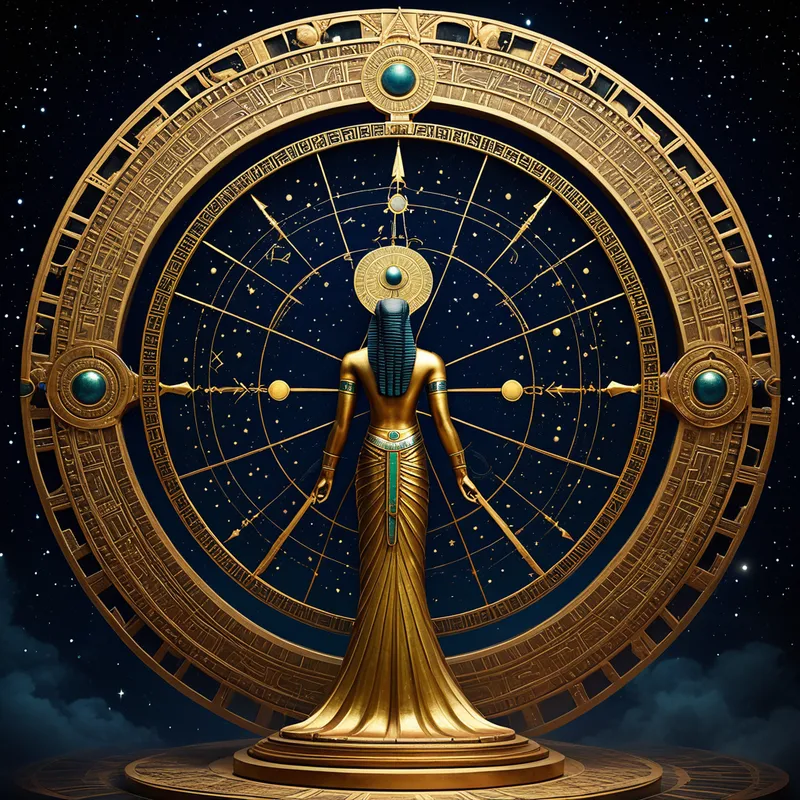
The Dream Theme of Fate: From Destiny to Sovereignty
The Somatic Echo
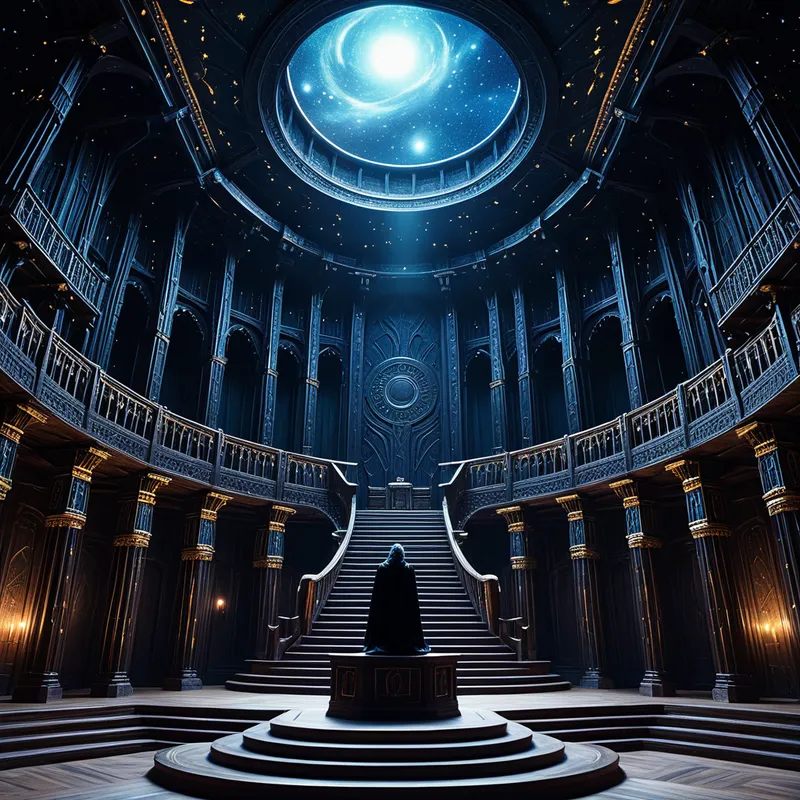
Before the mind can articulate a concept of destiny, the body knows its signature. It is not a thought, but a climate. It is the deep, resonant hum in the bones that speaks of tracks laid down long before you arrived. It is the peculiar weight in the chest—not the crush of immediate anxiety, but the gravity of a long, slow orbit. Your breath may feel like it’s moving through a pre-carved channel. Your footsteps might echo with a sense of déjà vu, as if the path beneath you remembers your shape from another lifetime. This is the somatic echo of Fate: a visceral, non-negotiable givenness. It is the architecture of your life felt as a completed blueprint, a script whose final page you can almost feel, thick and inevitable, waiting in the dark. To dream of Fate is to temporarily inhabit this blueprint, to feel its walls and corridors from the inside, and to encounter the profound question: Is this a prison, or is it the very ground from which freedom grows?
The Dreamer's Log
I am standing at the end of a narrow, rain-slicked alley. A single, ornate brass key lies at my feet, glowing with a soft, internal light. I know, with absolute certainty, that this key opens a door I have spent my entire life searching for. But as I bend to pick it up, my hand passes through it. The key is an illusion, a projection. The real key, I understand in a flash of grief, is the choice to stop searching for doors and to finally feel the rain on my skin.
Alchemical Interpretation: The dream transmutes the seeker’s obsession with a predetermined destination (the fated door) into the raw material of present-moment awareness (the feeling of rain), forging sovereignty from the grief of a lost object.

The False Lead
Fate is not synonymous with misfortune, bad luck, or a simple linear prediction. To mistake it for such is to remain in the cartoon of destiny—the idea of a capricious god or a malicious universe scripting your failures. The dream theme of Fate is far more profound and structural. It is not about what happens, but the deep, often unconscious agreement to a certain pattern of happening. It is the psychological architecture that makes a specific kind of event feel inevitable, personal, and true. A dream of Fate is not announcing your doom; it is making visible the hidden struts and beams of your inner world that have, until now, determined the shape of your outer life. It is the revelation of the contract you didn’t know you signed.
Psychological Architecture
To engage with Fate in dreams is to be summoned to the deepest level of Shadow work and Individuation. Here, the psyche does not deal in small adjustments or behavioral tweaks. It deals in foundational covenants. The Shadow aspect of Fate is the exiled part of you that agreed, long ago, to a limiting story: “I am meant to struggle,” “Love is always loss,” “My role is to serve, never to lead.” This agreement was likely a brilliant, life-preserving strategy for a younger self navigating an impossible terrain. But now, it runs as archaic firmware, generating a reality that feels fated.
The individuation process here is a conscious, often terrifying, re-negotiation. It requires you to sit in council with these exiled parts—these internal family members who hold the old contracts. You must listen to their fears, honor their original protective intent, and then, with immense compassion and firmness, inform them that the treaty is up for review. This is the pain point: the dissolution of a familiar, if painful, identity. Letting go of a fated story can feel like a death, because it is. It is the death of a world where you were not responsible for its core design.
Mythic Resonance
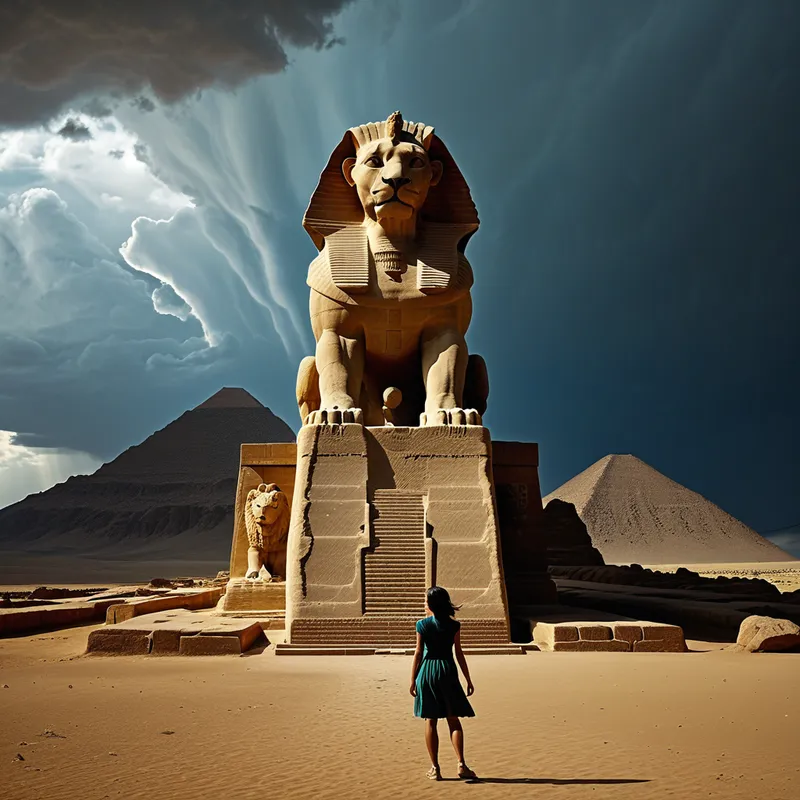
We see this eternal drama in the myth of Oedipus, not merely as a tale of a prophecy fulfilled, but as a map of a psyche fleeing its own architecture. The oracle declares his fate—to kill his father and marry his mother. Every action Oedipus takes to avoid this destiny—fleeing Corinth, solving the riddle of the Sphinx—becomes the very mechanism of its enactment. The myth shows us that a fate resisted from a place of fear and ignorance only strengthens its hold. The power is not in the prophecy itself, but in the unexamined agreement to a narrative of defilement and tragedy that drives all his choices. His fate was sealed not at the crossroads where he killed Laius, but in the inner chamber where he believed he was fundamentally cursed.
Symbolic Nodes
- Inexorable Machinery: Clockwork, gears, conveyor belts, ticking metronomes, unstoppable vehicles on a single track.
- Written/Inscribed Objects: Scrolls with unfading ink, stone tablets, tattoos that move, computer code that writes itself.
- Predetermined Paths: Single bridges over chasms, hallways with no doors, tunnels with a pinpoint of immutable light at the end.
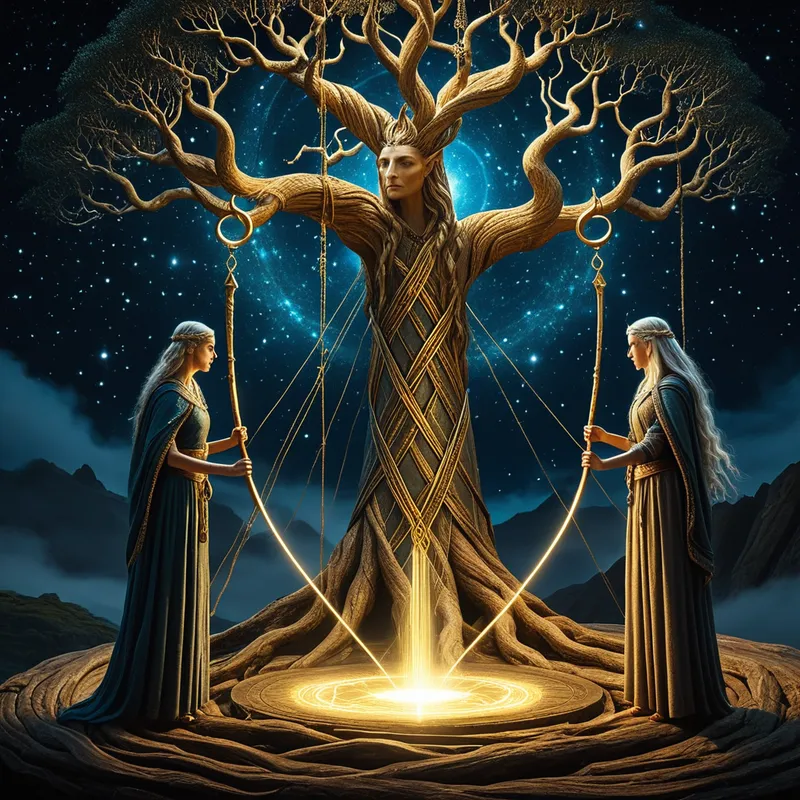
- Bound Figures: Being woven into a tapestry, wrapped in thread, fused with a statue, or having one’s shadow pinned to the ground.
- The Unchangeable Element: A mountain that cannot be climbed, a river that cannot be crossed, a door that will not open—or worse, opens only onto the same room.
Archetypal Resonance
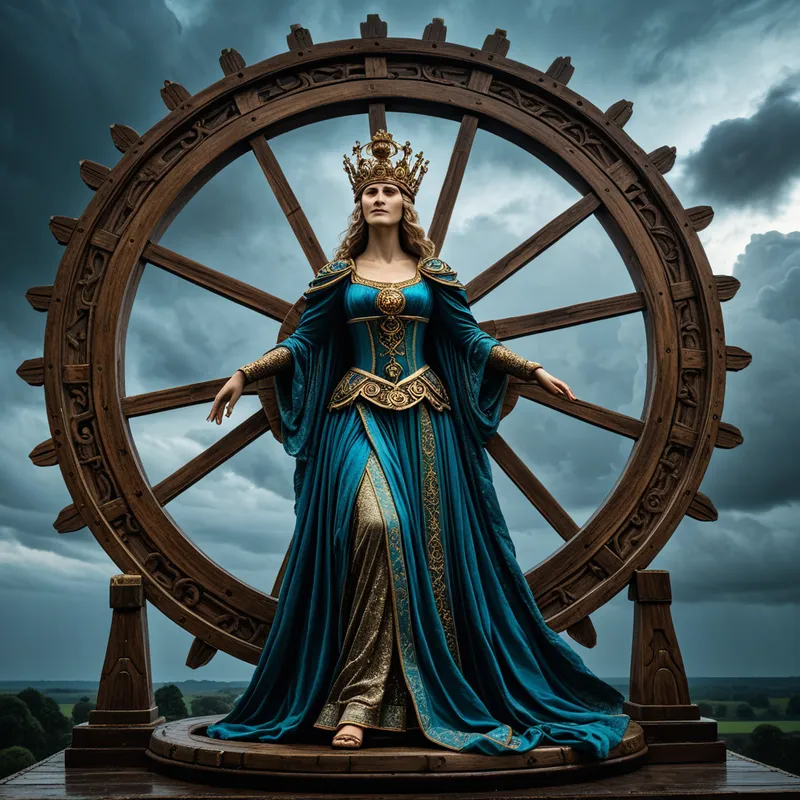
The energy of Fate is most intimately related to The Ruler Archetype, specifically in its disowned, Shadow aspect. The Shadow Ruler is the internal tyrant who mistakes control for sovereignty. It is the part that, feeling powerless, creates a rigid, deterministic system to simulate order. In the somatic echo, this is the source of that heavy, pre-ordained gravity—it is the weight of a kingdom run by a fearful despot who has outlawed spontaneity. The dream of Fate is often this Shadow Ruler’s domain showing its seams. The alchemical potential lies in dethroning this inner tyrant not through rebellion, but through a compassionate coup. By integrating the Ruler’s true power—the capacity to establish inner law, order, and values—you transform fate from an external mandate into an internal governance. Sovereignty is born when you stop being a subject in your own kingdom and become its architect.
The Alchemical Process
The transmutation of Fate requires the most intense heat of all: the heat of conscious responsibility without blame. This is the solve et coagula of the soul. First, the solve: you must allow the old, fated story to dissolve. This feels like a surrender, a admission of helplessness, a grieving for the identity that was built upon that story. It is the “pressure” of holding two contradictory truths: “I did not choose this pattern consciously” and “I am the only one who can change it.”
Then, the coagula: from that dissolved state, you consciously choose the cornerstone of your new foundation. This is not positive thinking. It is the deliberate, somatic assertion of a new internal agreement. It might be as simple as, “My worth is not contingent on struggle,” or “I am permitted to occupy space.” You repeat this not as a mantra to convince yourself, but as a decree to the very cells of your being, rewiring the archaic firmware. The terror is in the dissolution; the grief is for the lost, familiar self. The sovereignty is the silent, unshakable authority that emerges when you realize you hold the pen to your own script.
The Integration Protocol
Question 1: Where in my waking life do I feel a sense of “this is just how it is” or “this always happens to me”? Can I trace the emotional signature of that feeling back to an earlier, younger version of myself who made a decision for survival?
Question 2: If the “fated” pattern in my dream were a protective law in an internal kingdom, what was it originally designed to protect? And what is the cost of that protection now?
Question 3: What one, small, deliberate choice—contrary to the “fated” pattern—could I make today? Not to change the outcome, but simply to assert to my psyche that choice itself is now a living element in my system?
Action 1 (Somatic Re-patterning): For five minutes, sit or stand in a way that feels deliberately unfamiliar—a posture your “fated” self would not take. Breathe into the slight discomfort. Notice the subtle shift in your internal atmosphere. This is the physical ground of a new possibility.
Action 2 (Creative Unwriting): Take the core sentence of your fated story (e.g., “I am alone”). Write it in the center of a page. Now, using any medium—ink, paint, collage, digital art—visually dismantle the sentence. Dissolve its letters, fragment its words, surround it with colors that contradict its meaning. Do not create a new statement; perform an alchemical deconstruction of the old one.
Action 3 (Ritual of Sovereignty): Find a small stone or natural object. Hold it, and for a moment, let it represent the old, heavy contract of fate. Thank it for its service. Then, go to a body of moving water—a river, the sea, even a steady rain gutter. With clear intent, place the object into the flow and release it. Do not watch it go. Turn and walk away, feeling the literal and metaphorical weight leave your hand.
Final Validation
To encounter Fate in your dreams is to be asked to bear the weight of your own genesis. It is not a gentle invitation; it is a profound and daunting summons. The feeling of being scripted, of moving along grooves worn deep by time, is a real and valid agony of the soul. Honor that ache. It is the friction of a consciousness growing too large for its old casing. This theme arrives not to crush you with predestination, but to show you, with startling clarity, the walls of the room you have always lived in. And in that showing, it hands you the first, faint blueprint of a door you must build yourself. The sovereignty you seek is not freedom from your fate, but the breathtaking authority to recognize that you are, and have always been, its sole, reluctant, and magnificent author.