Baldr Myth Meaning & Symbolism
The radiant god Baldr is slain by a mistletoe dart, plunging the Norse cosmos into grief and revealing the inescapable shadow within the psyche.
The Tale of Baldr
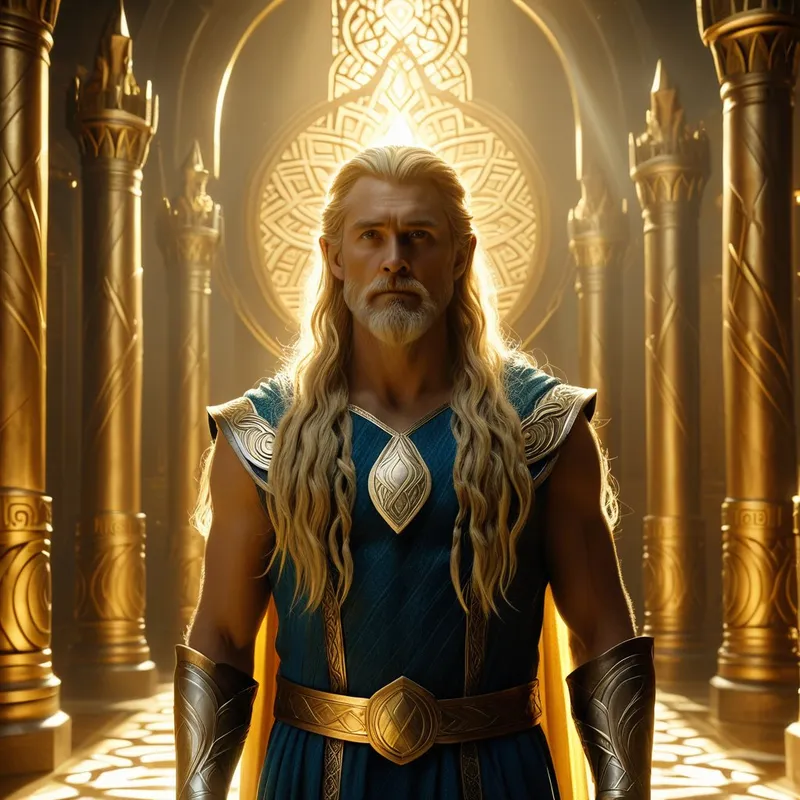
In the golden age of the gods, when the walls of Asgard shone bright and the laughter of the Æsir echoed through the halls, there lived a being of such purity that light itself seemed to weep with joy at his presence. His name was Baldr, and he was the beloved of all things. His hair was the pale gold of a winter sunrise, his voice the sound of a calm sea. Where Baldr walked, flowers did not wilt, and sorrow dared not linger.
But Baldr began to dream. Not the gentle dreams of summer, but dark, chilling visions of his own end. He saw himself falling, a light extinguished, into a cold and silent place. The dreams haunted his waking hours, casting a faint shadow over the shining halls. His mother, Frigg, queen of foresight, saw the terror in her son’s eyes. In a frenzy of maternal love, she traveled to every corner of the nine worlds. She went to fire and water, to iron and stone, to the beasts of the earth and the birds of the air, and from each she extracted a solemn oath. They would not harm her son. The serpent vowed not to bite him, the wolf not to maul him, the flame not to burn him. Secure in this web of protection, the gods made a sport of it. They would cast spears at Baldr, hew at him with axes, and watch as the weapons turned aside or fell harmless at his feet. Laughter rang out again in Valhalla, a brittle, nervous laughter.
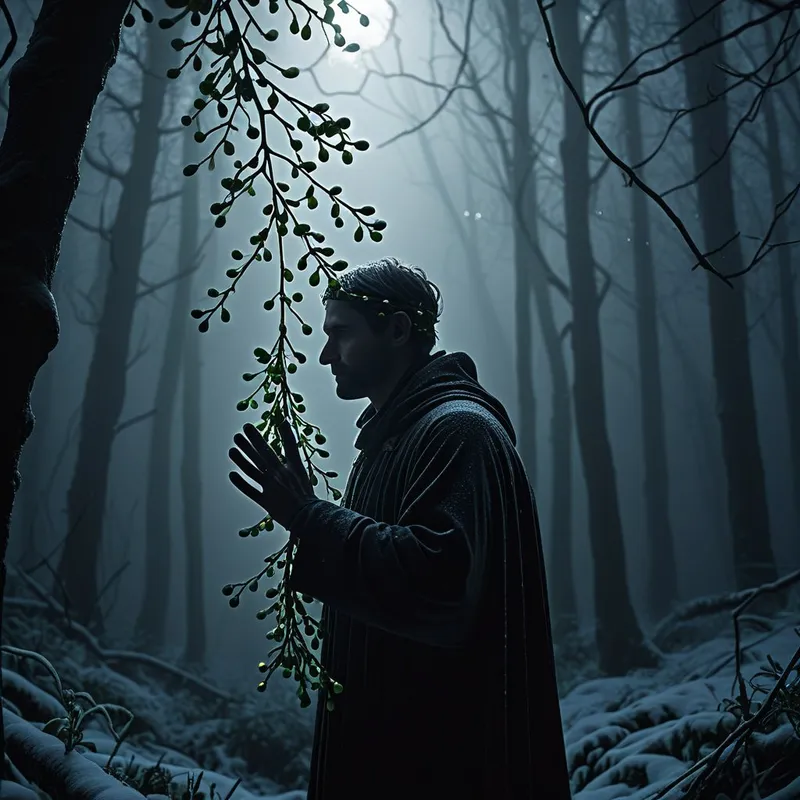
Yet in her haste, Frigg had overlooked one thing. In the western woods, on the young oak at the edge of the world, grew a plant she deemed too young, too tender, too insignificant to swear an oath. The mistletoe.
Loki, the weaver of schemes, saw the flaw in the tapestry. He disguised himself and went to Frigg, and with honeyed words he learned of the unsworn mistletoe. A cold smile touched his lips. He went to the western woods and carved from the pale green wood a dart, sharp and slender.
The gods were at their game again, on a green field outside the walls. Baldr stood smiling, bathed in light, as objects of all kinds thudded softly around him. Loki approached Hodr, Baldr’s own brother, who stood apart in the shadows, unable to join the sport. “Why do you not honor your brother?” Loki whispered, placing the mistletoe dart in Hodr’s hand. “I will guide your aim.” With a gentle push, he directed Hodr’s arm.
The dart flew, a sliver of green against the sky. It did not turn aside. It struck Baldr in the heart, and the shining god fell. A silence fell with him, a silence so profound it was as if the very breath of the world had been stolen. The laughter died, not even an echo remaining. The light did not go out slowly; it was simply gone.
What followed was a grief that shook the roots of Yggdrasil. The gods were frozen, statues of despair. Frigg’s wail was the first sound to break the silence, a sound that cracked the stones of Asgard. Only through desperate cunning did they convince the goddess of the underworld, Hel, to release Baldr—if all things in the nine worlds would weep for him. And weep they did. Stones shed gritty tears, iron wept rust, and the ancient giants themselves sobbed into their beards. But in a dark cave, a giantess named Thokk, who was Loki in disguise, sat unmoved. “Let Hel hold what she has,” she sneered. And so Baldr remained, the prisoner of shadows, and the first true winter settled upon the world, a winter of the soul from which it would never fully awaken.
Cultural Origins & Context
The myth of Baldr comes to us primarily through the Prose Edda of Snorri Sturluson and the older, poetic fragments of the Poetic Edda. It is a cornerstone of the Norse mythological cycle, a story told not for mere entertainment but as a foundational explanation for the nature of their cosmos. This was a culture intimately acquainted with harsh winters, sudden death, and the fragile beauty of summer light. The tale of the shining god slain by the most innocent of things would have resonated with a profound, existential truth: that beauty is transient and vulnerability is woven into the fabric of existence, even for the gods.
The story was likely told by skalds and elders during the long winter nights, serving as a ritualized expression of collective grief and a meditation on fate (wyrd). It functioned as a theodicy—an attempt to explain the presence of evil and suffering in a world governed by powerful deities. It showed that the gods themselves were not omnipotent, that they were subject to treachery, blindness, and irreversible loss, making the human condition a shared, cosmic experience.
Symbolic Architecture
Baldr represents the principle of pure, undifferentiated consciousness—the innocent, radiant Self before its encounter with the world’s harshness. He is the integrated psyche in a state of grace, where all internal conflicts are seemingly harmonized. His invulnerability is not strength, but a fragile perfection, a state of being that has not yet acknowledged its own shadow.
The most potent poison always grows nearest to the heart of the garden. The shadow cannot be exiled; it must be invited to the feast, lest it arrive unannounced with a dagger.
The oath extracted by Frigg symbolizes the ego’s desperate attempt to create a perfect, risk-free identity. It is the illusion of control, the belief that we can wall off our consciousness from pain, doubt, and destructiveness. The mistletoe—young, soft, parasitic—is the perfect symbol for the unconscious shadow. It is that which is deemed too small, too harmless, too insignificant to matter. It is the repressed thought, the unacknowledged envy, the gentle spite we refuse to see in ourselves. Loki, the trickster, is the catalyst of consciousness, the necessary force that unearths this repression. He does not create the shadow; he merely reveals its existence and hands it to our blind spot—Hodr, the unconscious brother, who acts without malice or awareness.
The failure of the universal weeping is the final, brutal lesson: not all parts of the psyche will mourn the loss of naive innocence. Some parts (Thokk/Loki) are hardened, cynical, and invested in the reality of a fallen world. The retention of Baldr in Hel signifies that once consciousness is wounded by the reality of the shadow, a return to pure, unconscious innocence is impossible. The light is remembered, but it is now a memory, a hope for a distant future (the rebirth after Ragnarök), not a present reality.
The Dreamer's Resonance
To dream of the Baldr pattern is to be in a somatic state of profound vulnerability. The dreamer may encounter a figure, a place, or an object of breathtaking beauty and peace that feels utterly sacred and protected. This is the “Baldr-space” of the psyche—a nascent talent, a cherished relationship, a spiritual belief, or a core identity that feels inviolable.
The attack, when it comes in the dream, is always from an unexpected, seemingly trivial source. A trusted friend makes a casual, cutting remark. A small forgotten task unravels a major life plan. A tiny doubt grows like a vine and shatters a long-held conviction. The emotional resonance is one of shock, betrayal, and a chilling, silent grief. The body may respond with a feeling of being pierced, a sudden coldness, or a weight of immovable sorrow upon waking.
This dream signals that the psyche’s period of protected innocence is over. The ego’s defensive oaths have failed. The dream is the psyche’s enactment of the inevitable and necessary wounding that leads to deeper consciousness. It is not a prophecy of literal doom, but a somatic announcement: the shadow has been activated, and integration must now begin.
Alchemical Translation
The alchemical process mirrored in Baldr’s myth is the nigredo—the blackening, the initial putrefaction and despair that is the first, crucial stage of the individuation process. The radiant, golden state (aureum) of the innocent Self must be dissolved so that a more durable, conscious wholeness can be forged.
The death of the god is the birth of the human. We do not lose our light by facing the dark; we learn it was never ours to hoard, but to kindle from the friction of opposites.
For the modern individual, the “slaying of Baldr” manifests as any shattering event that destroys a naive self-concept: the failure of a perfect plan, the betrayal that reveals one’s own capacity for blindness, the depression that follows the loss of an idealized identity. The key to the alchemical translation is not to seek to resurrect the old, invulnerable innocence—that is the futile bargaining with Hel—but to sit fully in the grief of the nigredo.
This means honoring Hodr, the blind brother within. It is the part of us that acted without full awareness, that carried the shadow projection. To integrate Hodr is to take responsibility for our unconscious enactments. It means confronting the Loki-trickster, not as an external enemy, but as the intelligent, amoral drive of the psyche that forces consciousness by any means necessary. Finally, it requires acknowledging the Thokk within—the cold, stubborn part that refuses to weep for lost illusions because it knows, harshly, that they were illusions.
The promise of the myth is not in Baldr’s premature return, but in his prophesied rebirth after Ragnarök. Psychologically, this represents the emergence of a new consciousness forged through the confrontation with the shadow. This new Self is not invulnerable. It is wise, compassionate, and resilient precisely because it has housed the darkness and remembers the light. It carries the scar of the mistletoe, not as a wound, but as a seal of authenticity, a testament to a wholeness earned, not given.
Associated Symbols
Explore related symbols from the CaleaDream lexicon: