Arianrhod Myth Meaning & Symbolism
A goddess of sovereignty is tested, her fate declared, and her hidden sons emerge to claim their destiny from the spiral castle of stars.
The Tale of Arianrhod
Let the fire be banked, and the night draw close. Listen now to a tale spun from starlight and sovereignty, from the mist-shrouded isle of Caer Sidi. In the court of Math fab Mathonwy, a king whose feet must rest in the lap of a virgin, a shadow fell. His footholder was shamed, and a new maiden was sought. His niece, Arianrhod, was brought forth—proud, radiant, her bearing that of one who knows her own power.
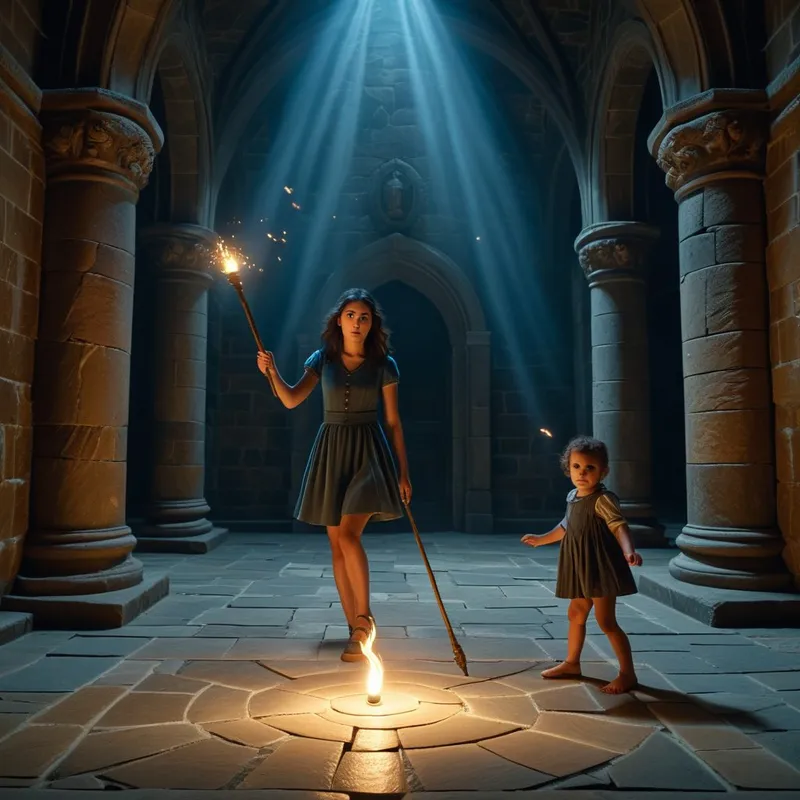
“Are you a virgin?” Math asked, his voice the sound of stones grinding deep in the earth. “I know not but that I am,” she declared, her chin held high. To test her truth, Math took his magic wand and bade her step over it.
She stepped. And as her foot touched the ground, a shock ran through the hall. From her fell a sturdy, golden-haired boy. He let out a cry that was not of an infant, but of a soul arriving with purpose. Before the court could gasp, a second form, a mere shapeless mass, dropped silently beside him. Arianrhod stood frozen, her sovereignty shattered by this sudden, public birth.
She named the first son Dylan ail Don, and he, sea-longing in his blood, fled to the ocean and became one with the waves. The second, the formless one, was taken by her brother Gwydion, who saw not a monster, but potential wrapped in mystery. He hid the child in a chest at the foot of his bed.
Years passed. Gwydion, a master of illusion, nurtured the boy, who grew handsome and clever. Consumed by a desire to secure his nephew’s place, Gwydion devised a scheme. He magically disguised himself and the boy, tricking Arianrhod into bestowing a name upon the youth. Thus, he became Lleu Llaw Gyffes. Enraged at the deception, Arianrhod laid a second fate upon him: he would never bear arms unless she herself armed him.
Undaunted, Gwydion conjured another illusion—a phantom fleet attacking her castle. In panic, Arianrhod armed the defenders, including Lleu, breaking her own curse. Furious and cornered, she pronounced a third, final destiny: “He shall never have a wife of the race that now inhabits this earth.”
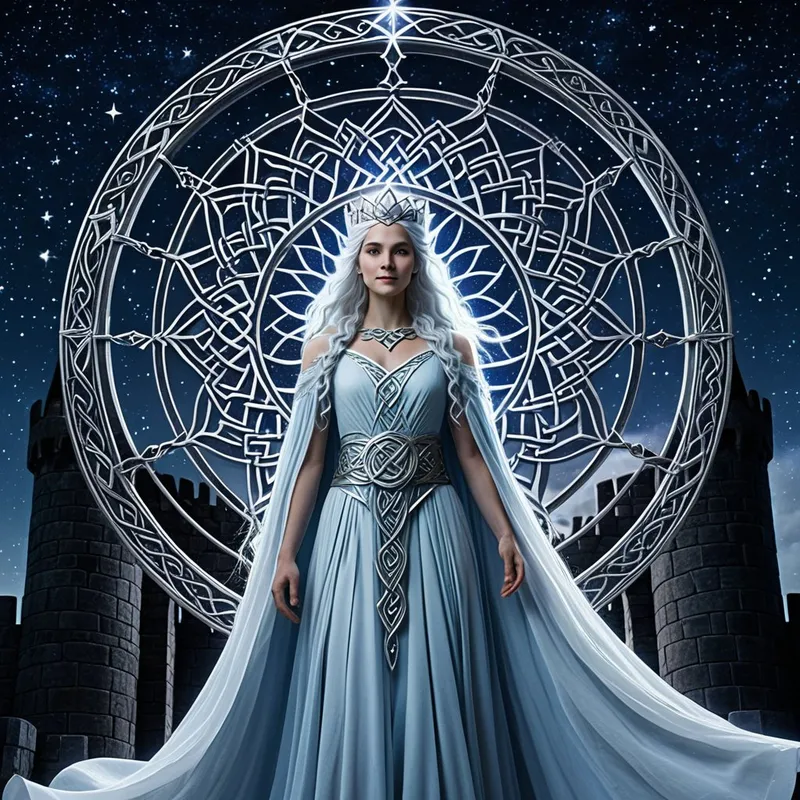
And so, through magic and craft, Gwydion and Math fashioned for Lleu a wife from the flowers of the oak, the broom, and the meadowsweet—Blodeuwedd, a woman born of earth and spell, not of woman. And Arianrhod, her fates all spent, withdrew to her spiraling fortress, Caer Arianrhod, the silver wheel of stars turning forever around her, a queen in her loneliness, the author of destinies she could not control.
Cultural Origins & Context
This myth reaches us from the Mabinogion, specifically the Fourth Branch. These are not tidy, systematized scriptures, but narrative remnants of a much older, oral Celtic paganism, filtered through the ink of medieval Welsh scribes. The teller was likely a bard, preserving the lore of gods demoted to heroes and kings.
Its function was multifaceted: to explain the origins of cultural heroes like Lleu, to explore the complex laws of sovereignty and kingship (embodied by Math’s peculiar requirement), and to grapple with profound themes of fate, shame, and creative power. Arianrhod is no Olympian goddess with a clear portfolio; she is a powerful, autonomous feminine force whose very body becomes the contested ground for destiny. The myth reflects a world where personal will clashes with inexorable geasa (taboos or fateful prohibitions), where magic is a tangible craft, and where identity is something both bestowed and fiercely claimed.
Symbolic Architecture
At its heart, this is a myth of sovereignty challenged and redefined. Arianrhod’s stepping over the wand is less a gynecological test and more a ritual invocation of her deepest, hidden potential—a potential that manifests immediately and uncontrollably.
The unconscious does not announce itself with whispers; it arrives with the force of a birth, scattering our carefully constructed identities.
The two sons represent a psychic dichotomy. Dylan, who flees to the sea, symbolizes the part of the self that returns to the primordial, unconscious unity—a blissful but passive dissolution. Lleu, the “bright son,” is the emergent consciousness, the heroic ego that must be fashioned, named, and armed to engage with the world. The formless mass is the unlived life, the potential that the conscious personality (Arianrhod) rejects but the cunning, creative spirit (Gwydion) recognizes and nurtures.
Arianrhod’s three fates—denying name, arms, and a human wife—are not mere spite. They are the defenses of a wounded sovereignty, attempts to limit what has been born from her against her will. Each represents a crucial aspect of identity: Name (who you are), Arms (your power to act in the world), and Partnership (your capacity for relationship). Lleu’s journey is the psyche’s work to reclaim these in the face of internalized prohibition.
The Dreamer's Resonance
When this myth stirs in the modern dreamer, it often signals a profound confrontation with one’s own unacknowledged creative or destructive potential. To dream of a sudden, shocking birth may point to a new talent, a long-buried trauma, or a responsibility erupting into conscious life, disrupting a carefully maintained self-image of competence or purity.
Dreams of being tested publicly, of failing a ritual, or of having hidden children speak to the somatic experience of exposure and shame. The dreamer may feel their private self laid bare. Conversely, dreaming of a formless, precious thing entrusted to you (like Gwydion’s chest) can indicate the nurturing of a nascent, undefined aspect of the soul. The Silver Wheel itself, turning in the dream sky, is a powerful image of inescapable cycles, karmic patterns, or a fate one feels subject to, calling for a reconciliation with life’s larger, impersonal rhythms.
Alchemical Translation
The alchemical process here is the opus contra naturam—the work against nature, or more precisely, the work of transforming raw, unconscious nature into conscious, individual spirit. Arianrhod represents the prima materia, the original, sovereign substance. The shock of the birth is the nigredo, the blackening, the moment of crisis and despair where the old state is destroyed.
Individuation is not about becoming perfect, but about becoming whole. It requires embracing the children of our shadow, whom we initially disown.
Gwydion is the mercurial trickster spirit, the active intellect and will that labors in the darkness (the chest at the foot of the bed) to shape the massa confusa (the formless son) into a distinct being. The bestowing of the name (Lleu) is the albedo, the whitening, where the substance gains its essential identity.
The arming of Lleu and the creation of Blodeuwedd represent the rubedo, the reddening, where the newly formed consciousness is equipped to engage with the world and forms relationships, even if they are complex and ultimately tragic. Finally, Arianrhod’s withdrawal to her spiral castle is not a defeat, but a sublimatio. She ascends to her essential, cosmic nature. She becomes the fixed point around which the wheel of fate turns, the silent, stellar witness to the drama she set in motion. The modern individual’s journey is to endure the shocking births, to nurture the formless potentials, to cleverly circumvent inner prohibitions, and ultimately, to find sovereignty not in inviolate purity, but in integrating all that has been born from one’s depths, taking a seat at the center of one’ own silver-wheeled destiny.
Associated Symbols
Explore related symbols from the CaleaDream lexicon: