Loki's Schemes Myth Meaning & Symbolism
The story of the trickster god Loki, whose brilliant, chaotic schemes weave the threads of fate, ultimately binding the gods to their prophesied doom.
The Tale of Loki's Schemes
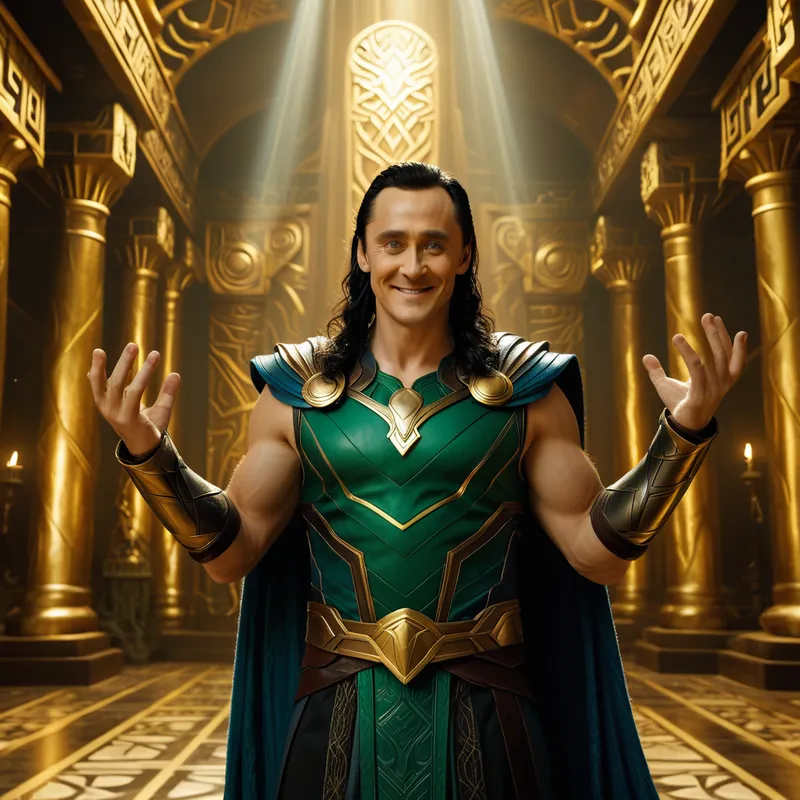
Listen, and hear the tale of the weaver of webs, the smith of snares. In the high halls of Asgard, where the mead flowed like rivers and the light of the gods was a blazing sun, there walked one who was both brother and bane. His name was Loki, son of a giant, blood-brother to Odin. His eyes held the glint of a hidden fire, and his tongue was a blade that could carve laughter from fury or fury from peace.
It began with a vanity, as great troubles often do. The goddess Sif possessed hair of flowing gold, a radiance that was her pride. In a fit of mischief darker than most, Loki sheared it all away, leaving her shorn and weeping. The thunder of Thor shook the very roots of Yggdrasil. To save his own skin, Loki swore an oath: he would replace it with hair of living gold.
He descended to the realm of the dwarves, the sons of Ivaldi. With silver words, he spurred them to a contest of craft, pitting them against the brothers Brokkr and Sindri. From the forges came wonders: not only hair that grew like grain, but Mjölnir, the hammer that would defend the gods; Gungnir, the spear of kingship; and Skíðblaðnir, the perfect ship. Loki, ever the gambler, had wagered his own head on the dwarves' failure. He tried to sabotage their work, stinging Brokkr as a fly, but the wonders were completed, surpassing all. The gods received their treasures, and Loki’s head was forfeit. Yet with a lawyer’s trick, he argued his head could be taken, but not his neck. In fury, Brokkr sewed the trickster’s lips shut with a leather thong—a temporary silence for a being of endless speech.
But the schemes did not end. They deepened, weaving into the very tapestry of fate. At a feast in Ægir’s hall, the gods compelled Loki to attend. Drunk on venomous pride, he turned his unleashed tongue on each in turn, exposing their secret shames, their hidden cowardice, their illicit loves. He laid bare the rot behind the gold, until the hall rang with truth as sharp as shattered ice. For this, the final breach, there was no redemption. The gods hunted him down.
He fled to a mountain stream, shape-shifting into a salmon. But the net of fate, a net he himself had helped design, was cast. They captured him. In a cave far from the sun, they took his sons. One, Fenrir, was already bound with a magical fetter Loki had helped create. Another, Jörmungandr, circled the world in the sea. The third, Narfi, was turned into a wolf that tore out the entrails of his brother, Váli. With those cold, wet cords, the gods bound Loki to three sharp stones.
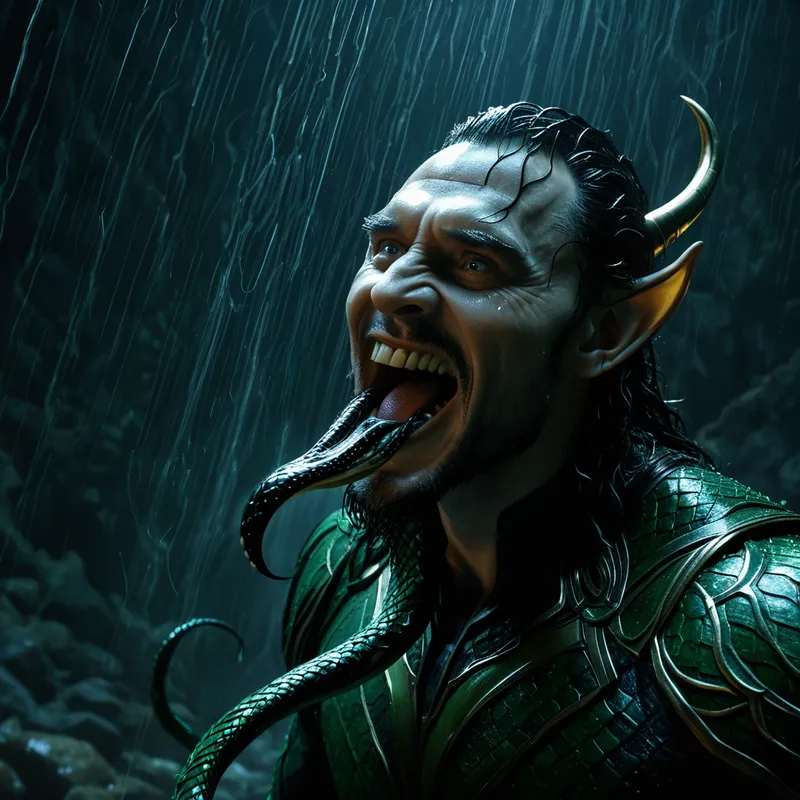
And there they left him, with Sigyn, his faithful wife, holding a bowl to catch the dripping venom of a serpent fastened above. When the bowl fills and she turns to empty it, the poison falls onto Loki’s face. He writhes in such agony that the whole earth quakes. There he lies, bound by the guts of his kin, until the chains of time break and Ragnarök is unleashed. His schemes brought the gods their greatest treasures and forged the very chains of their doom.
Cultural Origins & Context
These tales of Loki’s escalating transgressions are preserved primarily in the Poetic Edda and the Prose Edda. They were not mere bedtime stories but vital components of a worldview. Told by skalds in feasting halls, these myths served as a complex social and cosmological mirror. In a culture that valued oath-keeping, honor, and communal loyalty above all, Loki embodies the terrifying and fascinating power of the oath-breaker, the boundary-crosser. His stories explained the origins of the gods’ most prized possessions while simultaneously charting the path to their destruction. He is the necessary flaw in the system, the agent who pressures the ordered world of Asgard until it reveals its weaknesses and, ultimately, its destined end. The myths were a way to hold the paradox of creation and destruction in a single narrative breath, teaching that the source of a thing and its undoing are often inextricably linked.
Symbolic Architecture
Loki is the archetypal trickster, but in the Norse psyche, he is something more profound: the embodiment of the unintegrated shadow of the gods themselves. He is the repressed chaos, the amoral ingenuity, and the painful truth that the collective consciousness tries to exclude.
He is the psychic principle that the system must deny to define itself, yet must secretly employ to evolve.
His schemes are not random evil; they are catalytic. The shearing of Sif’s hair forces the creation of greater wonders. His insults in Ægir’s hall force a confrontation with hidden truths. His binding uses the entrails of his son—a symbol of kinship turned into a prison, representing how our deepest bonds can become the source of our most painful constraints. Loki’s punishment is not just retribution; it is the containment of a runaway complex. The venom that drips on him is the toxic, corrosive aspect of his own chaotic nature, now turned inward upon itself, causing the earthquakes that prefigure the system’s collapse.
The Dreamer's Resonance
When this myth stirs in the modern dreamer, it often manifests as dreams of brilliant ideas that backfire, of witty remarks that cause unforeseen devastation, or of being bound by obligations created from one’s own past actions. You may dream of a tangled knot you tied yourself, or of a helpful act that somehow makes everything worse. Somatic sensations might include a tightness in the jaw or throat (the sewn lips), a feeling of being pinned or trapped, or sudden, inexplicable tremors of anxiety (Loki’s writhing).
Psychologically, this is the process of the conscious ego confronting the consequences of its own unconscious shadow material. The “Loki” within is that part of us that is clever, rebellious, and refuses to play by the internalized rules of our personal Asgard. When this energy is acted out naively or maliciously, it leads to crisis and binding. The dream signals that a pattern of chaotic or deceptive behavior (towards others or oneself) has reached a critical mass and is now creating its own prison.

Alchemical Translation
The alchemy of Loki’s myth is not about defeating the trickster, but about undergoing the transformation his presence demands. His path models a brutal but necessary stage of individuation: the confrontation with the shadow in its most potent and autonomous form.
The first step is the catalysis: the Loki-energy provokes a crisis (the loss of the golden hair, the shattered peace of the feast) that destroys a naive innocence and forces a new level of resourcefulness and consciousness. We are compelled to seek our own Mjölnir, our own tool of will and defense.
The binding in the cave represents the containment and integration. The ego cannot let the chaotic shadow run rampant; it must be bound, faced, and its poison consciously endured. The faithful Sigyn represents the part of the psyche that does not abandon this painful process, that holds the vessel to catch the venom—the act of conscious suffering and bearing witness to one’s own darkest impulses.
The final quaking that leads to Ragnarök is the ultimate transmutation. The contained pressure of the integrated shadow eventually becomes the force that destroys the old, rigid psychic order to make way for a new, more conscious one. In the personal psyche, this is the collapse of an outworn identity, a necessary death that precedes renewal. To work with the Loki within is to accept that our cleverness and our chaos are woven into our destiny, and that true wisdom lies not in banishing the trickster, but in understanding that he forges the very chains that, when broken, will set us free.
Associated Symbols
Explore related symbols from the CaleaDream lexicon: