Loki's subtle manipulations Myth Meaning & Symbolism
The trickster god Loki engineers a chain of events through cunning words and subtle actions, weaving a fate that binds gods and giants alike.
The Tale of Loki's subtle manipulations
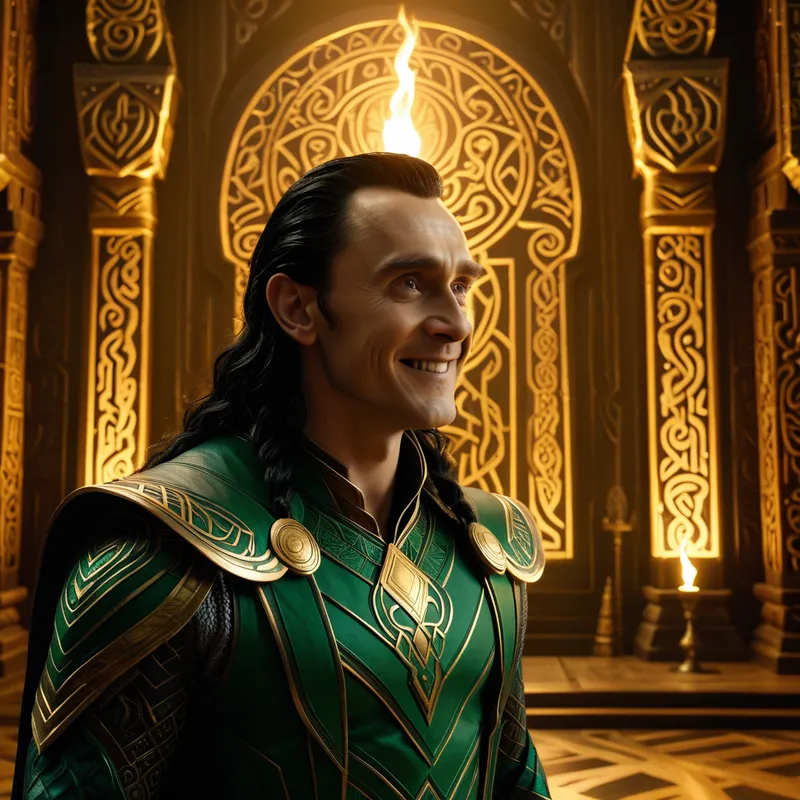
Hear now a tale not of thunderous blows, but of whispers. A tale where the greatest doom was spun not by a giant’s fist, but by a god’s cunning tongue. In the high halls of Asgard, where the mead flowed golden and boasts echoed from rafters, a shadow walked among the bright ones. His name was Loki, blood-brother to Odin, a shape-shifter whose smile was as sharp as a winter wind.
The gods were at feast, celebrating the perfection of their realm. They laughed at the invulnerability of the beloved god Balder, whom all things in the world had sworn an oath not to harm. All things, they believed. It was a game, a joyous sport, to hurl stones and spears at Balder, watching them turn harmlessly aside. Yet in their merriment, a seed of unease was sown. Loki watched, his eyes like chips of flint. He saw not joy, but arrogance. He saw not unity, but a fragile dream of perfection that denied the very nature of the world—a world that includes sharpness, and poison, and things overlooked.
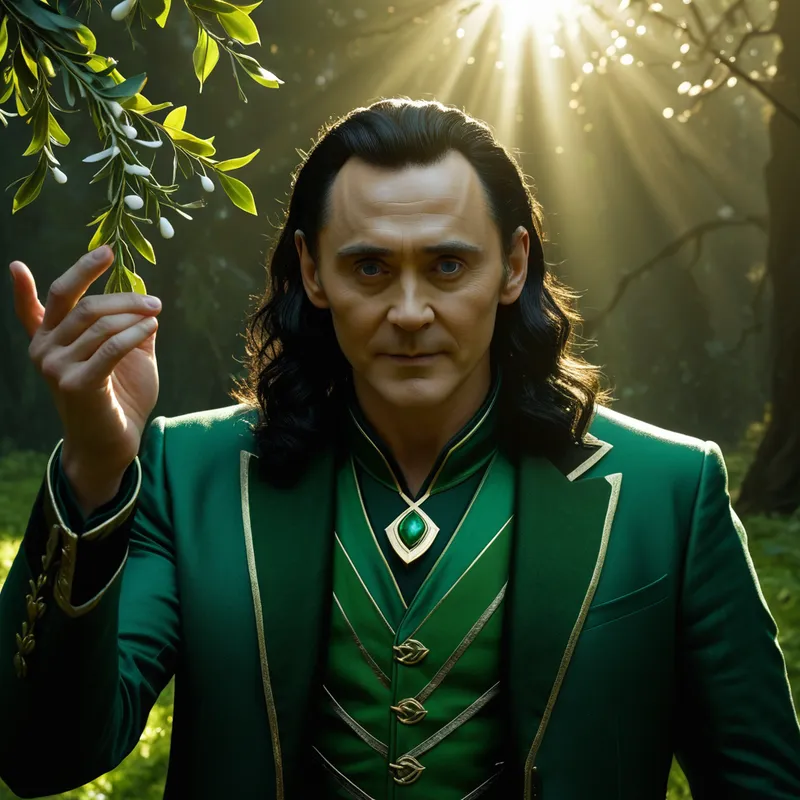
Disguised as an old woman, Loki went to Frigg. With gentle, probing words, he learned the secret: one young plant, the mistletoe, had been deemed too small and tender to swear the oath. A whisper of a thing. A nothing. And in that nothing, Loki saw the everything of fate.
He went to the western woods and carved a dart from that very mistletoe—a green sliver, light as a sigh. He returned to the gathering, finding Hodr standing apart, unable to join the sport. Loki’s voice was all helpful concern. “Here, brother Hodr,” he said, placing the dart in the blind god’s hand. “Let me guide your aim. Share in the honor of Balder’s strength.” Hodr, trusting, drew back his arm. Loki guided it. The slight dart flew, a flicker of green against the sun.
The laughter died. A sound like the cracking of the world’s spine followed. Balder fell. Not with a roar, but with a soft, terrible sigh. The shadow had spoken, and with the subtlest of gestures—a guided hand, a whispered suggestion—had turned joy to ashes, binding the gods to a path of grief and vengeance from which there was no return. The threads of wyrd were pulled taut, and the first true note of the Ragnarök echoed across the worlds.
Cultural Origins & Context
This pivotal myth comes to us primarily from the Gylfaginning in Snorri Sturluson’s 13th-century Prose Edda, a work that systematized Norse mythology from earlier poetic sources. It is crucial to remember these are Icelandic texts from a Christian era, yet they strive to preserve a pre-Christian worldview. The story of Balder’s death was not mere entertainment; it was a foundational tragedy in the Norse cosmic narrative.
Told by skalds and around hearths, this myth served a profound societal function. In a culture acutely aware of fate (wyrd) and the fragility of order, Loki’s manipulations illustrated the terrifying power of the overlooked detail, the unspoken word, and the trusted friend who is not what he seems. It taught that perfection is an illusion and that chaos (Ginnungagap) is never fully banished, only temporarily held at bay. The myth reinforced the value of vigilance, the acceptance of inevitable loss, and the understanding that even the gods are subject to a web of cause and effect they themselves have spun.
Symbolic Architecture
Loki is the embodied principle of the unintegrated shadow, the psychic force that destabilizes stagnant order. He is not “evil” in a simplistic sense, but the necessary catalyst that shatters illusions of invulnerability. Balder represents the conscious ego in its idealized, untested state—beloved, bright, but ultimately naive, believing itself protected from the full spectrum of reality.
The shadow does not attack with a sword, but with a truth the conscious mind has refused to acknowledge.
The mistletoe is the ultimate symbol of the “exception to the rule,” the repressed element deemed too insignificant to matter. Psychologically, it is the small, unexamined complex, the tender memory or slight resentment we ignore, which holds the precise key to our undoing. Loki’s act is a brutal form of initiation: the conscious self must “die” to its innocence to engage with the darker, more complex reality of the world and the psyche. Hodr, the blind instrument, represents the unconscious, unwitting part of the self that enacts the shadow’s will when it is not recognized and integrated.
The Dreamer's Resonance
When this mythic pattern stirs in modern dreams, it often manifests as scenarios of subtle sabotage or unforeseen consequences from a trusted source. You may dream of a close friend offering seemingly benign advice that leads to a disaster. You may see yourself as Hodr, manipulated into an action you do not understand, or as the gods, witnessing a perfect system collapse from a tiny, overlooked flaw.
Somatically, this can feel like a knot in the stomach, a sense of dread or betrayal that has no clear, external cause. Psychologically, this dream pattern signals that the dreamer’s psyche is working through a process where a long-held self-image or belief (the “invulnerable Balder”) is being challenged. The shadow (Loki) is active, pointing out the “mistletoe”—the exception, the weakness, the repressed truth that the conscious attitude has sworn to ignore. The dream is an internal Ragnarök, the necessary destruction of an outdated psychic structure to make way for a more authentic, if more painful, consciousness.

Alchemical Translation
The alchemical process mirrored here is the nigredo—the blackening, the putrefaction, the first essential stage where the base material is broken down. Loki is the spiritus mercurius, the volatile, tricksterish agent of dissolution. His manipulation forces the “gold” of Balder’s innocent consciousness into the dark night of the soul.
For the modern individual on the path of individuation, this myth models the unavoidable confrontation with the personal shadow. We all have our “Balder’s oath”—a self-concept we believe is impervious to criticism, failure, or darkness. The psyche’s innate movement toward wholeness will send a “Loki” to expose its flaw. This may come as a life crisis, a betrayal, a failure, or a piercing insight that shatters our self-assurance.
The goal is not to defeat the trickster, but to heed his terrible lesson: wholeness requires the death of the partial self.
The alchemical translation is the understanding that this shattering is not an end, but the beginning of the work. After the nigredo comes the albedo (whitening) and rubedo (reddening). The grief and chaos Loki unleashes force the gods—and the individual—out of passive reliance on oaths and into active engagement with a fractured, complex reality. We are compelled to journey to the underworld (like Hermod seeking Balder), to face the consequences, and to rebuild a consciousness that includes, rather than denies, the shadow, the flaw, and the ever-present potential for transformation through chaos. In this light, Loki’s subtle manipulation is the cruel but necessary catalyst for all profound becoming.
Associated Symbols
Explore related symbols from the CaleaDream lexicon: