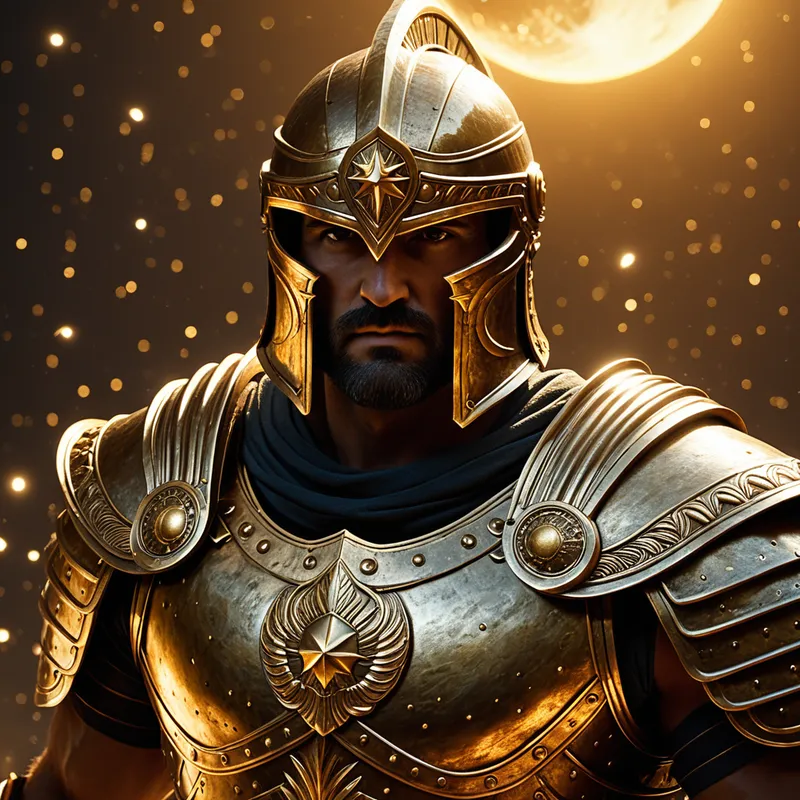
The Armor of Achilles - protec Myth Meaning & Symbolism
A divine shield forged in cosmic fire, protecting the hero's one weakness, yet destined to pass to another, embodying the paradox of invincibility and mortality.
The Tale of The Armor of Achilles - protec
Hear now the lament of the swift-footed son of Peleus, a grief that shook the very foundations of Olympos. The air above the plain of Troy was thick with the dust of battle and the metallic scent of blood. Achilles, the greatest of the Achaeans, raged not on the field, but within his heart. His beloved companion, Patroclus, lay slain, his body despoiled by Trojan hands, the very armor of Achilles stripped from his fallen form. A cry tore from the hero’s throat, a sound so raw it silenced the crows. His divine mother, the sea-nymph Thetis, heard his agony from the ocean’s depths and rose, wreathed in sea-foam and sorrow, to comfort her son.
But comfort was not enough. Vengeance required a vessel. Achilles vowed to return to the war, a hurricane of fury aimed at Hector, the slayer of Patroclus. Yet he stood naked before destiny, his first armor lost. Thetis, her eyes like deep, sad pools, knew what must be done. She ascended the bronze pathways of heaven to the one place where fire was not destruction, but creation: the forge of Hephaestus.
There, in a cavern lit by the hearts of volcanoes, the divine smith labored. Bellows breathed like great beasts, and anvils rang with the music of making. Thetis found him, sweat gleaming on his powerful, misshapen form, and she bowed, her voice a whisper of the sea. “Fashion for my son, who is doomed to die young, armor such as no mortal has ever borne. Make him a shield against all the sorrows of the world.”
Hephaestus, moved by her tears and her plea, set his genius ablaze. He did not merely craft armor; he forged a cosmos. Into the great, five-layered shield, he hammered the universe. Upon its boundless disk, he set the sun, the moon, and all the constellations. He depicted two beautiful cities: one at peace, with weddings and dances and laws being spoken in the marketplace; the other besieged by war, with ambush, battle, and strife. He showed fields of ripe grain being harvested, a vineyard heavy with purple clusters, and a herd of cattle attacked by lions. He placed a dancing floor where youths and maidens whirled. Around the rim, he set the great stream of Oceanus.
Alongside this world-shield, he fashioned a corselet brighter than flame, a heavy helmet with a crest of gold, and greaves of flexible tin. The work was complete—not just protection, but a testament to all of life that Achilles was destined to leave.
When Thetis laid the armor at her son’s feet, it clashed with a sound like distant thunder. The Myrmidons trembled and could not look directly upon its glory. Achilles’s eyes filled with a terrible light. As he donned the divine panoply, he seemed to burn with a god’s own fire. The armor did not hide him; it revealed his true, fatal nature. Clad in Hephaestus’s gift, he became an avatar of wrath, and the river Scamander would soon run red with Trojan blood. The shield protected his body completely, a mobile fortress. Yet, for all its cosmic craftsmanship, it could not extend to the one spot where his mortality was held: the heel by which Thetis had once held him. The protection was total, yet the vulnerability was absolute. The armor ensured he would fulfill his destiny, not escape it.
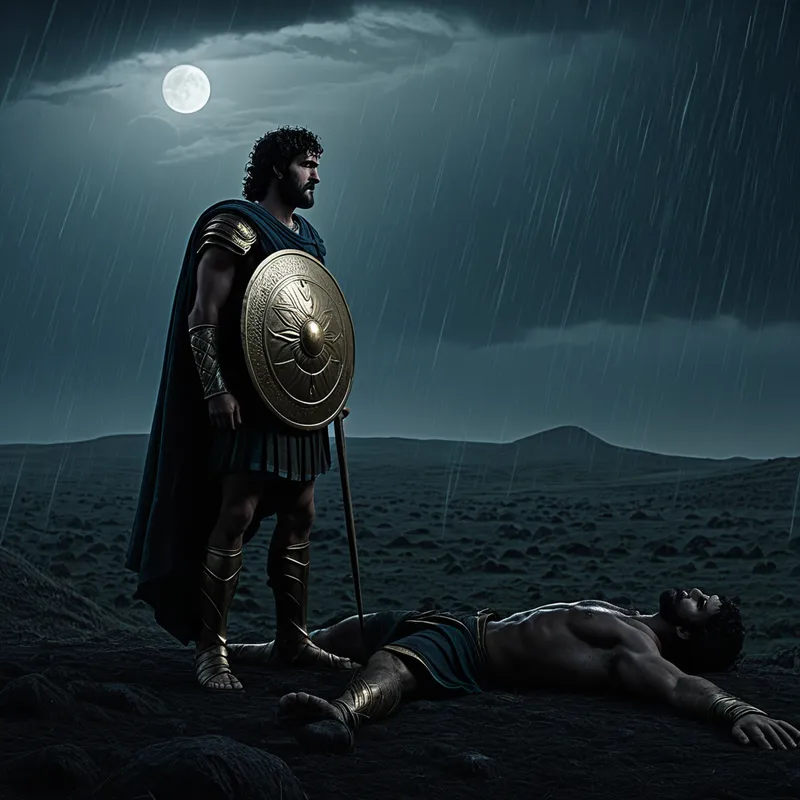
Cultural Origins & Context
This core narrative is drawn from the epic tradition of ancient Greece, specifically from Book 18 of Homer’s Iliad. It was not a standalone “myth” but the pivotal turning point within the grand oral saga of the Trojan War. For centuries before being codified in writing, these tales were performed by rhapsodes at festivals and in the halls of the aristocracy. The description of the Shield of Achilles is a famed set-piece, a moment of breathtaking narrative scope where the story pauses to depict not just an object, but an entire worldview.
Its societal function was multifaceted. On one level, it celebrated divine craftsmanship and the heroic ideal, reinforcing the cultural value of arete. On another, it served as a profound piece of philosophical and political imagery. The scenes on the shield presented a microcosm of the civilized human experience—peace and war, justice and conflict, labor and festivity—all contained within the hero’s primary defensive tool. It asked the audience to consider what, exactly, a hero fights to protect. The armor is a gift from the divine realm to enable a mortal’s preordained path, blurring the line between fate and free will, protection and entrapment.
Symbolic Architecture
The Armor of Achilles, particularly the Shield, is one of mythology’s most potent symbolic constructs. It represents the paradox of the heroic ego: a structure of immense power and beauty built around a core of fatal fragility.
The Shield is the ego complex at its most magnificent and elaborate. It is the persona we craft to navigate the world—a dazzling display of our skills, achievements, and worldview. It shows everything we believe we are protecting: our social order, our labors, our joys. It is the “cosmos” of the conscious self.
The most brilliant armor does not defend the soul; it merely makes the site of its wounding sacred.
Yet, this divine protection has a fatal flaw. The Achilles Heel symbolizes the irreducible core of personal vulnerability, the childhood wound, the inherited fate, or the repressed shadow content that exists outside the carefully constructed self. No amount of conscious achievement (the armor) can fully assimilate this unconscious vulnerability. In fact, the very act of constructing such potent armor often serves to hide this heel, both from the world and from the hero himself, until destiny (in the form of a guided arrow) finds its mark.
Furthermore, the armor is not originally his; it is forged in response to a profound loss (Patroclus) and must be passed on (to Odysseus after Achilles’s death). This speaks to the transpersonal nature of these psychic structures. Our most defining traits and defenses are often gifts (or curses) from the parental or cultural complex (Thetis/Hephaestus), and they become part of a legacy we bequeath to the future.

The Dreamer's Resonance
When this mythic pattern stirs in the modern unconscious, it often manifests in dreams of profound, yet flawed, protection. A dreamer may find themselves in a suit of magnificent, impenetrable armor, feeling invincible, only to discover a small, inexplicable crack or a missing piece over the heart or back. Alternatively, they may dream of guarding something precious—a child, a treasure, a home—with a formidable shield that somehow cannot cover the one angle of attack they fear most.
Somatically, this can correlate with a feeling of tense, rigid strength in the body (the armored carapace) juxtaposed with a specific point of chronic pain, sensitivity, or weakness (the symbolic heel). Psychologically, the dream signals a confrontation with the limits of the ego’s defenses. The individual is being made aware that their primary strategy for safety and identity—perhaps perfectionism, intellectualism, relentless achievement, or emotional detachment (the shining armor)—has a fundamental flaw. The dream is the psyche’s way of pointing to the vulnerable, mortal, and often wounded self that exists beneath the heroic persona, demanding acknowledgment and integration.

Alchemical Translation
The alchemical journey modeled here is not about strengthening the armor, but about consciously relating to both the armor and the heel. The initial stage is nigredo: the devastating loss of Patroclus, which shatters Achilles’s old identity and leaves him psychologically naked. From this despair, the divine intervention occurs—the albedo of Thetis’s plea and Hephaestus’s forging. This is the construction of a new, more conscious and complex ego-structure, one that contains the whole world (the Shield).
Individuation is the process by which one learns to wear one’s fate as a garment, not a fortress.
The ultimate alchemical work, however, lies in the rubedo. This is the conscious acceptance of the heel. For the modern individual, this translates to the difficult, sacred work of vulnerability. It is the act of identifying that core wound—be it a fear of abandonment, a sense of inherent inadequacy, or a traumatic memory—and bringing it into relationship with the strong, capable, worldly self (the armor). One does not destroy the armor; that is the persona necessary for life. Nor does one “fix” the heel; that is the touchstone of one’s humanity. Instead, one achieves a paradoxical integration: moving through the world with the strength and skill of the forged self, while holding a tender, non-judgmental awareness of the vulnerable self. The protection then transforms from a rigid, external shell into a fluid, internal resilience. The individual becomes, like the shield itself, a container for the full spectrum of human experience, invincible not because they cannot be wounded, but because they know the source and nature of their wound, and carry it as part of their sacred story.
Associated Symbols
Explore related symbols from the CaleaDream lexicon: