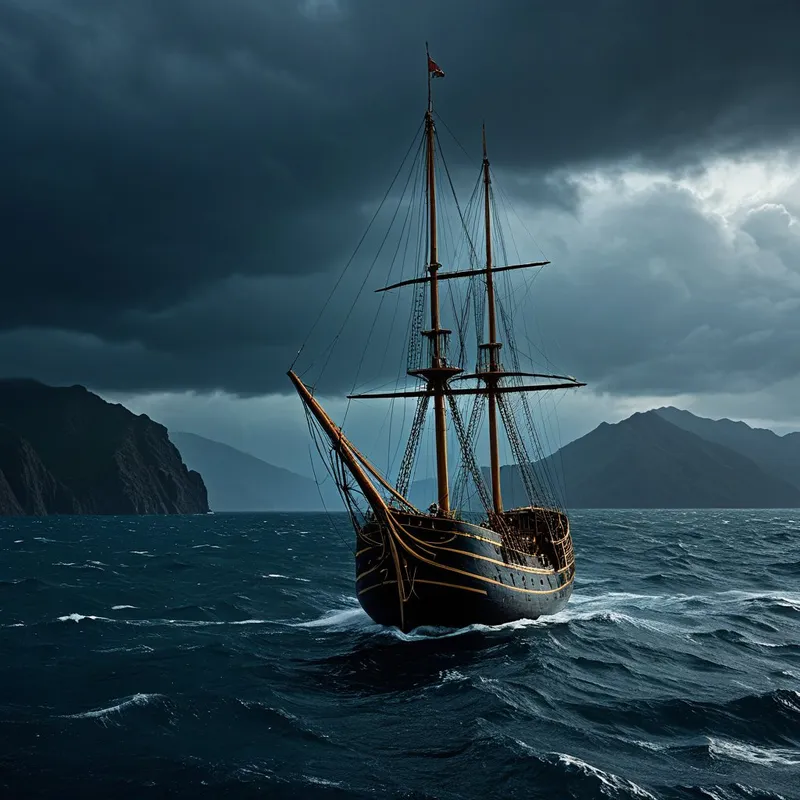
Argonauts Myth Meaning & Symbolism
A band of legendary heroes sails on the Argo to retrieve the Golden Fleece, a perilous quest testing their unity, courage, and relationship with the gods.
The Tale of Argonauts
Hear now the tale of the first ship, the first crew, the first great quest that bound the fates of gods and mortals. In the shadow of Mount Pelion, a usurper’s throne trembled. Pelias, who stole the crown of Iolcus from his half-brother, lived in dread of a prophecy: a man with one sandal would be his doom. And so it came to pass. A stranger, having lost a sandal crossing a raging river, arrived in the city. He was Jason, son of the deposed king, come to claim his birthright.
Pelias, cunning as a serpent, smiled and offered a bargain. “Take the throne,” he said, “if you first bring back the glory that belongs to our house. Fetch the Golden Fleece from the far end of the world.” It was a sentence of death disguised as a kingly task. For the Fleece hung in a sacred grove in Colchis, guarded by a dragon that never slept, in a land ruled by a ruthless king, Aeëtes.
But the gods had woven a different fate. Athena herself inspired the building of the Argo, a ship with a speaking timber from the sacred oak of Dodona. To its call came the mightiest heroes of the age: Heracles, the strongman; Orpheus, whose music could soothe the savage heart; the winged sons of the North Wind, Zetes and Calaïs; and many more, a constellation of demigods and kings’ sons. They became the Argonauts, sailors of the Argo.
Their voyage was the map of the unknown world, painted in peril. They fought the Gegeines on the coast of Mysia. They wept when Hylas was stolen by nymphs, and in their grief, left Heracles behind. They passed the Symplegades, the Clashing Rocks, only by the grace of Athena and the speed of their oars. They endured the harpies tormenting the blind prophet Phineus, whom they freed. Each league was a trial, each island a test of their unity and purpose.
Finally, they reached Colchis, a land of sorcery and bronze. King Aeëtes set impossible labors: yoke fire-breathing bulls, plow a field with them, and sow the teeth of the dragon, from which would spring an army of armed men. Jason’s doom seemed sealed. But here, the true magic of the quest revealed itself. Medea, the king’s daughter, pierced by Eros’s arrow, chose betrayal for love. With her enchanted ointment, Jason was protected from the bull’s flames. With her cunning advice, he threw a stone among the sown men, causing them to turn and slay each other.
Yet Aeëtes would not yield the Fleece. So, under a moonless sky, Medea led Jason to the sacred grove. With a potion and incantations, she lulled the sleepless dragon into a deep slumber. There, in the silent darkness, Jason took the Fleece. It glowed, a captured sunrise, heavy with the scent of pine and power. Their flight was frantic, a chase across the sea, marked by Medea’s horrific sacrifice of her own brother to delay their pursuers. They returned to Iolcus, Fleece in hand, but the homecoming was not an end. It was the beginning of a deeper, darker story of betrayal, vengeance, and broken oaths—a price paid in full for the golden prize.

Cultural Origins & Context
The saga of the Argonauts is one of the oldest and most pervasive cycles in Greek mythology, predating even the Trojan War in the epic timeline. Its primary literary vessel is the Argonautica of Apollonius of Rhodes, a Hellenistic epic from the 3rd century BCE, but the story’s roots are far more ancient, woven from oral traditions, local hero cults, and pre-Homeric lore. It functioned as a foundational narrative of exploration, linking the Greek world to the mysterious shores of the Black Sea (the Pontus Euxinus). The voyage of the Argo provided a mythic charter for early Greek colonization and trade routes, turning geographic unknowns into a landscape populated by monsters, magic, and divine will.
Bards would have performed this tale in the halls of nobles, serving not just as entertainment but as a cultural database of heroic ideals, geographical knowledge, and religious practice. It was a story about the first collective Greek heroic endeavor, a pan-Hellenic crew setting out before there was a unified Greece. The myth reinforced values of xenia (guest-friendship), the favor of the gods (charis), and the perilous glory of seeking fame (kleos) beyond the horizon. It was a bridge between the age of individual monster-slayers like Heracles and the coordinated, fate-driven warfare of the Iliad.
Symbolic Architecture
At its heart, the Argonautica is not merely an adventure but a profound map of the soul’s journey toward integration. The Golden Fleece itself is the ultimate symbol of the unattained Self, a numinous prize representing kingship, spiritual authority, and wholeness. It is not won by brute force alone, but through a combination of heroic effort (Jason’s labors), divine aid (Athena’s ship, Hera’s patronage), and an encounter with the deep, instinctual, and magical feminine (Medea).
The quest is always for the golden center, but the path leads through the shadowed grove where the dragon sleeps.
The ship Argo, with its living, prophetic timber, represents the vehicle of consciousness—the psyche itself—embarking into the uncharted waters of the unconscious. The crew of heroes symbolizes the fragmented but potent aspects of the individual’s own psyche: strength (Heracles), art and harmony (Orpheus), swift intuition (the Boreads). The loss of Heracles partway through the voyage is critical; it signifies that raw, undifferentiated strength is insufficient for the final, more nuanced stages of the quest, which require guile, relationship, and acceptance of the shadow.
Medea is the archetype of the terrible sorceress, the guide who is also a destroyer. She embodies the transformative power of the unconscious, which can enable victory (the sleeping dragon) but at a terrifying cost (the betrayal of her family). Her inclusion marks the point where the heroic, solar consciousness must ally with the lunar, chthonic, and irrational forces to succeed. The Fleece is never truly Jason’s alone; it is always Medea’s gift, and with it comes a curse, illustrating that integrating the shadow brings both power and profound responsibility.

The Dreamer's Resonance
When the myth of the Argonauts stirs in the modern unconscious, it often manifests in dreams of collective endeavor and impossible journeys. To dream of being on a great ship with a crew of disparate but familiar figures suggests the psyche is mobilizing its various resources—talents, instincts, past selves—for a significant life transition or a quest for identity. The ship may navigate strange seas, representing the emotional and unknown depths one is currently traversing.
Dreams of a specific, unattainable golden object resonate with the Fleece. This could reflect a deep yearning for purpose, authentic vocation, or a sense of inner completeness that feels just out of reach, guarded by a “dragon” of fear, obligation, or internal resistance. The appearance of a powerful, enigmatic helper figure (a Medea archetype) in a dream—someone who offers magical aid but seems dangerous—often signals a crucial, if unsettling, engagement with one’s own intuitive or instinctual wisdom. It is the psyche’s way of stating that the old rules and the ego’s plans are insufficient; one must accept help from the irrational, the emotional, and the deeply feminine (regardless of the dreamer’s gender) to proceed. The somatic feeling is often one of both exhilaration and deep anxiety, a bodily recognition of being on a threshold where everything is at stake.

Alchemical Translation
The alchemical process mirrored in the Argonautica is the long and perilous journey of nigredo through to the coveted rubedo, with the Golden Fleece as the lapis philosophorum. Jason begins in a state of deprivation (the stolen throne), the massa confusa of his life. Building the Argo with the divine timber is the creation of the vas hermeticum, the sealed vessel of the individuation journey—in this case, the tightly bound fellowship of the quest.
Individuation is not a solo voyage, but a sailing with all the selves we have been and might yet be, crewmates in the vessel of the soul.
The sequential trials—the clashing rocks, the harpies, the loss of Heracles—represent the necessary separatio and calcinatio. Old aspects of the self are burned away or left behind; illusions are shattered. The climax in Colchis is the coniunctio oppositorum. Jason (the striving ego-consciousness) must unite with Medea (the transformative, magical unconscious) to overcome the final guardian. Putting the dragon to sleep is not killing it, but integrating the primal, protective energy of the unconscious, making its power accessible.
The return with the Fleece is the rubedo, the achievement of the goal. Yet, the myth is brutally honest about the alchemical outcome. The gold is tainted. The new, integrated consciousness (Jason with Medea and the Fleece) is exiled, pursued, and ultimately tragic. For the modern individual, this translates to a hard truth: achieving wholeness, finding one’s “Golden Fleece” of purpose or Self-realization, does not lead to a fairy-tale ending. It leads to a more complex, burdened, and responsible existence. The old life (Iolcus) cannot simply resume. The prize transforms the winner, and the journey home is the beginning of living with that transformation, with all its beauty and its terrible cost. The true alchemy is in bearing that weight without losing the gleam of the gold.
Associated Symbols
Explore related symbols from the CaleaDream lexicon: