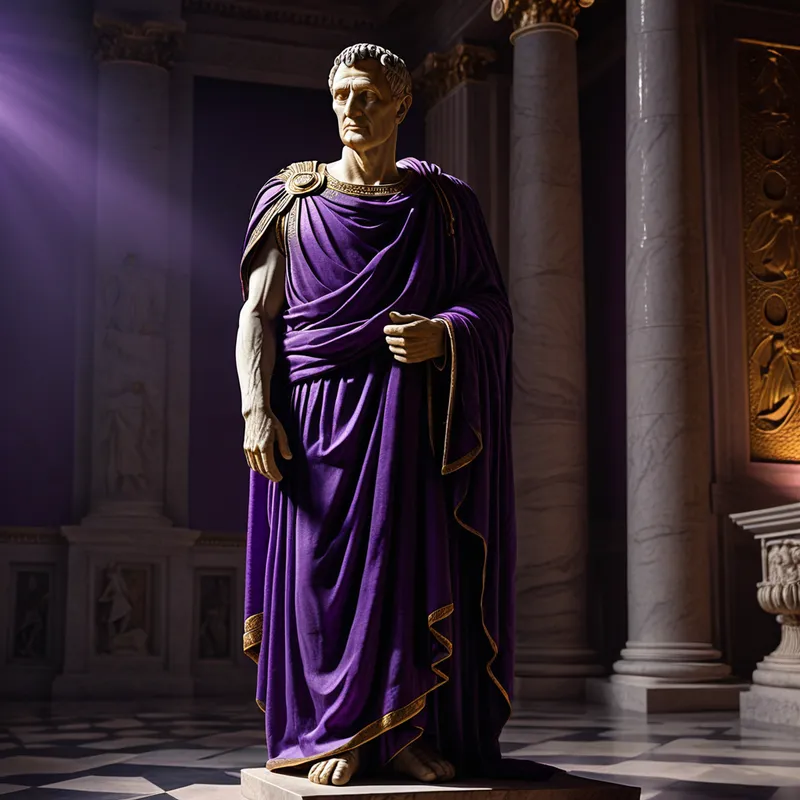
Julius Caesar Myth Meaning & Symbolism
A mortal who touched divinity, whose ambition shattered the Republic and whose death birthed an Empire, becoming an eternal symbol of power and its price.
The Tale of Julius Caesar
Hear now the tale of the man who was a god, and the god who was a man. The air in the Forum was thick with the scent of incense and ambition. Gaius Julius Caesar, his brow still cool from the waters of the Rubicon, walked a path paved not with stone, but with the brittle bones of the old Republic. He had seen the sun set on Gaul and rise on his own limitless fortune. The people roared his name, a sound like the ocean, and he drank it as a thirsty man drinks wine.
He was the Pontifex Maximus, the general who claimed descent from Venus, the dictator in perpetuity. They offered him a crown, and though he refused, the shadow of it clung to his shoulders like a purple cloak. Yet, in the silent hours, the warnings came. The soothsayer’s voice, dry as parchment: “Beware the Ides of March.” The nightmare of his wife, Calpurnia, who saw the pediment of their house collapse and his body bleeding in her arms. The very heavens protested; strange fires were seen in the night sky.
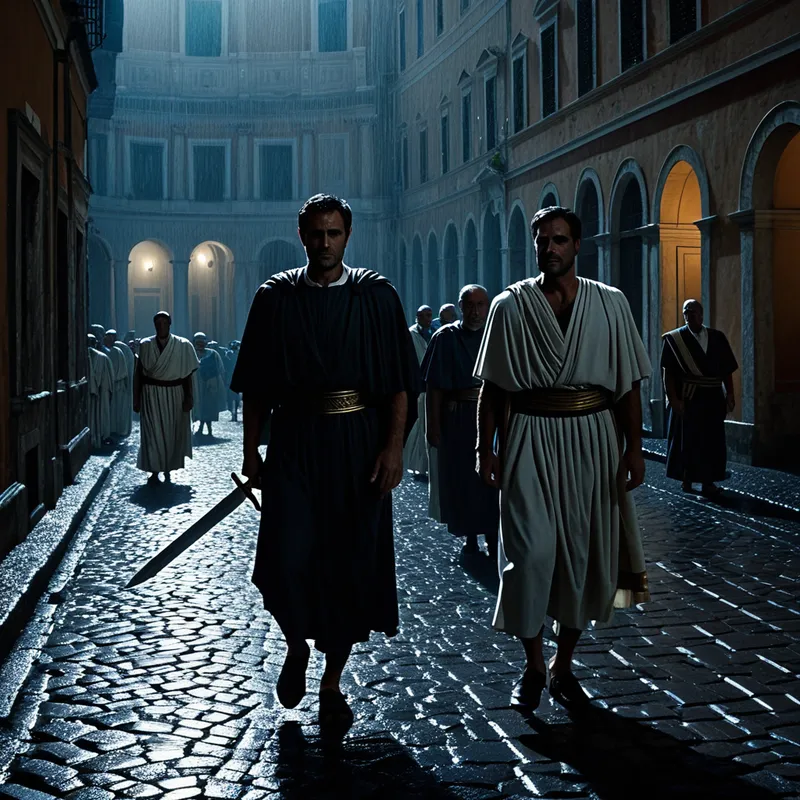
On that day, the Ides, the air was electric, a metallic taste on the tongue. Caesar went to the Curia of Pompey, a place named for the rival he had defeated. The conspirators, men he called friends, sons, and colleagues, gathered like wolves pretending to be sheep. Their togas hid the cold steel. As they pressed around him, a petition in their hands, the first blade flashed. It was a pinprick, then a storm. He saw Marcus Brutus among them, and with a gasp that was more sorrow than pain, he uttered, “You too, my child?” Then he drew his toga over his face and fell at the base of the statue of Pompey, his blood pooling on the marble, an offering to the ghost of the old order he had shattered.
But a man like Caesar does not simply die. His spirit, a flame of sheer will, ascended. They say three nights later, a comet, the Sidus Iulium, blazed in the sky for seven days. The people pointed and wept and knew. The Senate, in fear and awe, decreed him a god—Divus Iulius. The mortal was slain, but the myth was born, eternal and demanding, from the very wound that killed him.
Cultural Origins & Context
This is not merely a history, but the foundational myth of the Imperial Roman psyche. It was crafted in the white-hot forge of civil war, between the death of the dictator and the triumph of his heir, Augustus. The sources are many-voiced: the partisan histories of Sallust, the polished propaganda of Augustus’s court, the later tragic dramatizations by writers like Suetonius and Plutarch.
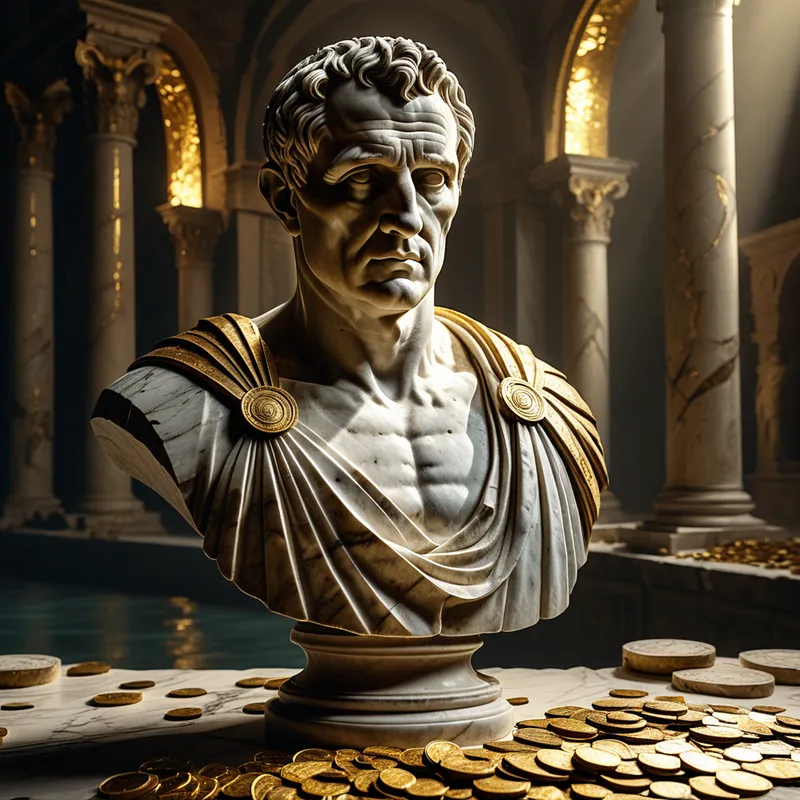
The tale functioned as a profound societal trauma and its necessary alibi. For the Republic, it was a cautionary myth of hubris and tyrannicide. For the new Empire, it was a sacred narrative of apotheosis: the necessary death of the great man that fertilizes the birth of a new world order. It was told in the forum, enacted in plays, etched onto coins bearing his divine profile, and recited as a foundational epic of the Julio-Claudian line. It served to legitimize absolute power by framing it as a tragic, fated, and ultimately divine inheritance.
Symbolic Architecture
At its core, the myth of Caesar is about the collision of individual will with the impersonal machinery of Fate and the collective. Caesar represents the archetypal Animus in its most potent and unchecked form. He is the human intellect and ambition attempting to sculpt reality itself, to become the author of his own destiny and that of the state.
The tragedy of the ruler is that he must become a sacrifice to the system he creates, for no single person can embody the totality of the realm.
The Senate, and particularly Brutus, symbolize the Senatus Populusque Romanus—the collective body politic. Brutus, descendant of the founder of the Republic, is the conscience of that tradition, however flawed. The assassination is not just murder; it is a ritual killing, a sparagmos (dismemberment) of the king-figure to renew the community. Yet, the myth subverts this ancient pattern. The sacrifice fails to restore the old order; instead, it unleashes the deified spirit of the very power it sought to destroy. The Sidus Iulium is the ultimate symbol of this transmutation: personal ambition combusts into an eternal, impersonal celestial force.
The Dreamer's Resonance
When this myth stirs in the modern soul, it manifests in dreams of profound ambition and its perils. To dream of being Caesar is to feel the terrifying weight of one’s own potential, the drive to conquer, organize, and leave an indelible mark. It is the dream of the CEO, the artist, the revolutionary—anyone at the precipice of monumental change.
Conversely, to dream of being a conspirator, or of being betrayed by close allies, signals a profound psychological process: the “assassination” of an over-inflated part of the self. Perhaps the dreamer’s conscious ambition (the inner Caesar) has grown too large, too dictatorial, suppressing other vital aspects of the personality (the inner Senate). The daggers in the dream represent the painful but necessary integration of shadow elements—doubt, humility, collective responsibility—that rise up to correct a dangerous psychic imbalance. The somatic feeling is often one of piercing shock, followed by a strange, cold relief.
Alchemical Translation
The alchemical journey modeled here is the transmutation of the personal into the transpersonal, the leaden ego into golden legacy, but only through the nigredo of violent dissolution. Caesar’s life represents the albedo (whitening)—the brilliant, conscious expansion and purification of will. The Ides of March is the brutal nigredo (blackening), the death of the identified ego, the moment everything turns to ash and blood.
The true apotheosis is not in avoiding the dagger, but in what the soul chooses to become in the moment the blade strikes.
His deification is the rubedo (reddening) and final stage: the conscious personality, having been utterly broken, is reconstituted at a higher level. The personal “Caesar” dies, but the archetypal principle of “Caesar”—the ruler, the order-bringer, the focal point of power—is liberated and integrated into the world soul. For the modern individual, this translates to the agonizing process of letting a rigid, controlling self-image die so that a more authentic, service-oriented identity can be born. It asks: What part of you must be sacrificed, not for failure, but for its overwhelming success? What brilliant, tyrannical ambition must fall at the base of Pompey’s statue so that your true, enduring spirit can rise as a fixed star in your own psychic firmament? The myth warns that we cannot seize divinity; we can only become it through the willing or forced surrender of the very thing we thought defined us.
Associated Symbols
Explore related symbols from the CaleaDream lexicon: