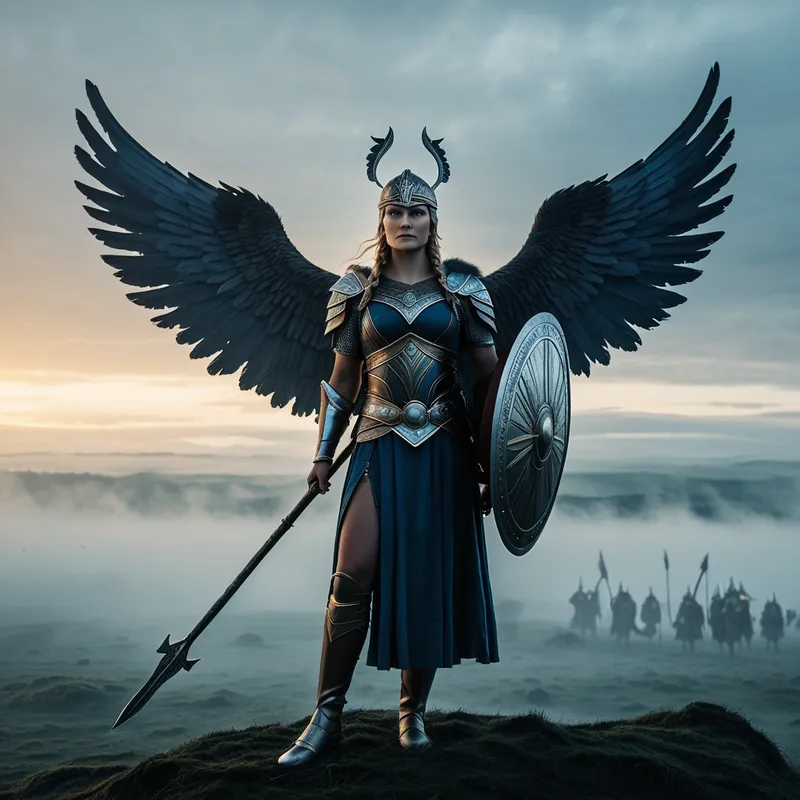
Valkyrie Myth Meaning & Symbolism
Choosers of the slain, the Valkyries weave fate on the battlefield, selecting heroes for Odin and guiding souls to the hall of the honored dead.
The Tale of the Valkyrie
Hear now the whisper on the wind that cuts through the pine forests of Midgard. It is not the wind, but the beating of wings. Look to the storm-wracked sky, where the clouds tear themselves apart like banners in a gale. There they ride, daughters of the storm, their forms flickering between woman and hawk, between shadow and spear-light. They are the Valkyries.
The air below is thick with the iron scent of blood and the roar of men. This is the Fólkvangr field, though every battlefield becomes one in its final hour. Swords clash, shields splinter, and the song of death is a ragged choir. High above, the All-Father, Odin, watches with his one eye, a gaze that holds the weight of all things to come. He has sent his thoughts into the world, and they have taken form as these fierce maidens.
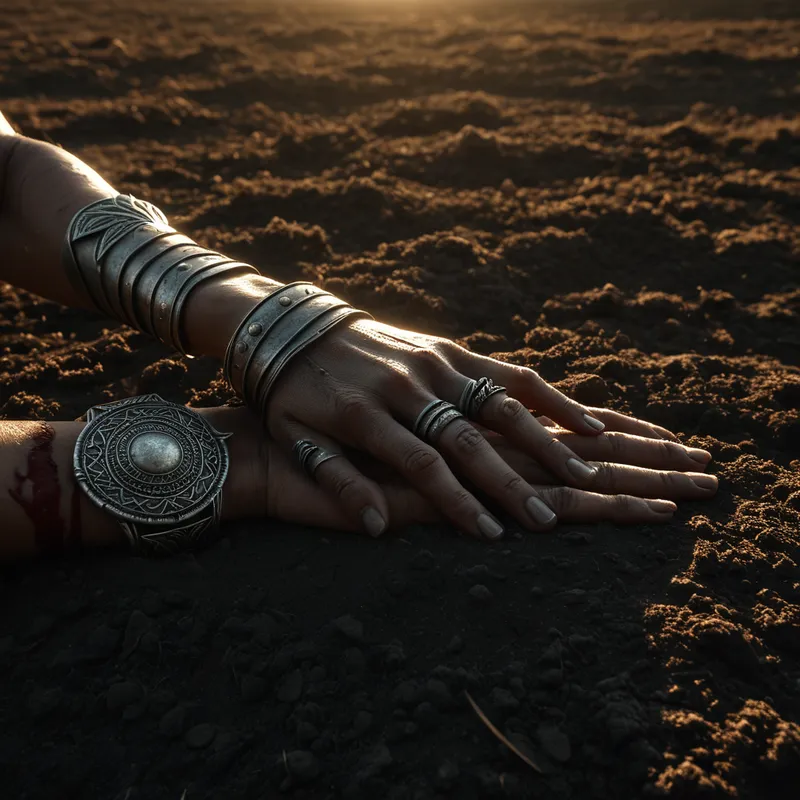
They descend not as vultures, but as sovereigns of the moment between breaths. Their armor is not heavy plate, but seems woven from moonlight and storm-cloud. One, perhaps Göndul, alights beside a fallen jarl, his lifeblood seeping into the earth. She does not weep. Her touch is not tender, but it is final. With a gesture that is both selection and sacrament, she seals his fate. His spirit, a shimmering ember, is drawn from the ruin of his body. Another, Mist, guides the spirit of a young warrior who fought with the fury of one who has nothing left to lose.
They gather these chosen ones, the Einherjar, not with chains, but with a silent call. The din of battle fades, replaced by a strange, resonant silence. The Valkyries mount their spectral steeds, and together they ride the Bifröst not in rainbow hues, but along a path of shimmering aurora that cuts through the void. Their destination is not an end, but a hall: Valhalla.
Its doors, vast as mountain gates, swing open. Within, the light is that of a perpetual feast-fire. The chosen warriors are received, their mortal wounds healed, their spirits made whole. The Valkyries, their task complete for now, set aside their spears and helms. They become cup-bearers, serving mead that flows from the udder of the goat Heiðrún. They tend the hall, not as servants, but as the very hands of fate, preparing the Einherjar for the day when the horn will sound for the final battle. And as they pour the mead, one might catch a glimpse in their eyes—not of battle-lust, but of a profound, sorrowful knowing. For they have seen the tapestry woven by the Norns, and they know what glorious, terrible dawn awaits them all.
Cultural Origins & Context
The Valkyrie, as we know her, emerges from the rich, fragmented tapestry of Old Norse literature, primarily the Poetic Edda and the later Prose Edda. These were not scriptures, but stories preserved by skalds (poets) and later written down in Christianized Iceland. Their societal function was multifaceted. In a warrior culture that prized honor and death in battle above a peaceful, forgotten end, the Valkyrie myth provided a powerful eschatology—a vision of what comes after. She was the divine validation of the warrior’s sacrifice, transforming a bloody death into a sacred selection.
Yet, they were not mere narrative devices. Place-names across Scandinavia suggest localized cults or beliefs in protective, martial female spirits. The Valkyrie occupied a liminal space in the Norse worldview: they were servants of Odin, yet possessed agency in their choosing; they were supernatural, yet described with human emotions and even romantic entanglements in some heroic lays. They were the bridge between the human struggle on the muddy field and the divine order of Asgard, making the cosmic intimately personal. Their stories were told not to incite mindless violence, but to frame death within a context of meaning, destiny, and communal memory in the great hall of the ancestors.
Symbolic Architecture
At its core, the Valkyrie symbolizes the active principle of fate. She is not fate itself—that is the domain of the Norns—but its executive force in the human realm. She represents the moment when impersonal destiny becomes personal crucible.
The Valkyrie is the psychopomp who does not console, but confirms. Her selection is the brutal, necessary acknowledgment that one phase of existence has irrevocably ended.
Psychologically, she embodies the archetypal function of discrimination and transition. The battlefield is the psyche in a state of severe conflict, where old identities, loyalties, and ways of being are at war. The Valkyrie’s descent represents the emergence of a discerning consciousness that can "choose the slain"—that is, identify which parts of the self must die (the outmoded ego attachments, the unsustainable defenses) to serve a larger, more meaningful order (the Self, or in the myth, Odin’s purpose). Her dual role as warrior-maid and cup-bearer in Valhalla encapsulates the full cycle: the fierce cut that severs, followed by the nurturing that integrates the essence into a new, purposeful whole.
The Dreamer's Resonance
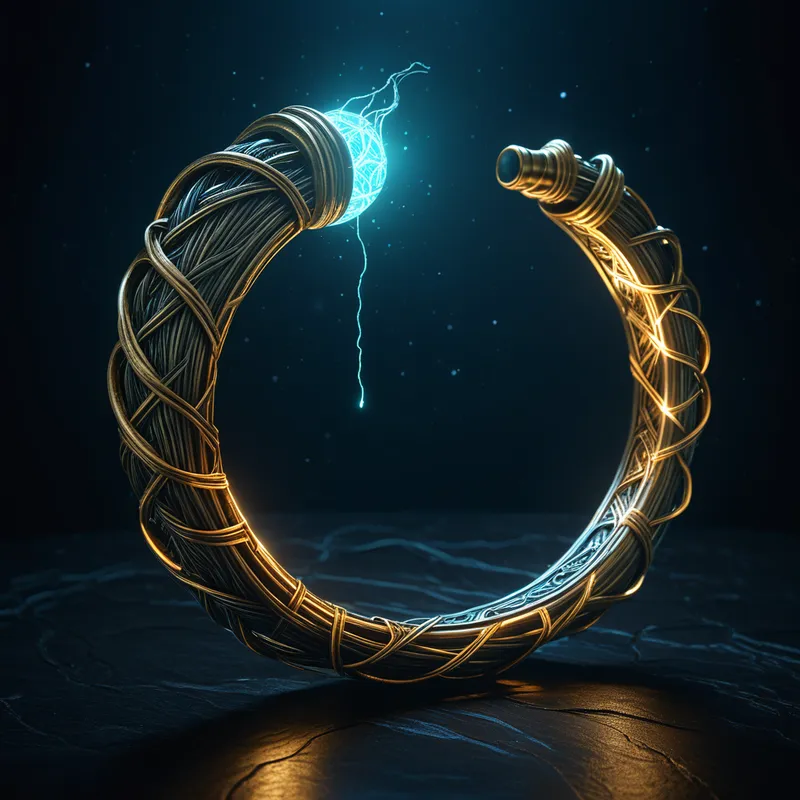
When the Valkyrie pattern stirs in the modern dreamscape, it often signals a profound psychological threshold. The dreamer may not see a winged woman in armor, but will feel the quality of her presence: a formidable, feminine authority that demands a choice or announces an ending.
Somatically, this can manifest as dreams of sudden, decisive events—a door closing, a verdict being read, a path forking in an immutable way. There is often a sense of awe, even fear, mixed with a strange relief. Psychologically, the dreamer is likely in a life phase where an old "battle" is concluding—a career, a relationship, a long-held identity. The Valkyrie energy does not fight the battle for you; she arrives after the crucial struggle, to execute the verdict of the inner Þing. She signifies the psyche’s readiness to let a significant part of itself die, not through passive defeat, but through a form of sacred selection. To dream of her is to encounter the part of your own soul that can say, with unflinching clarity, "This is over. Now, something new begins."
Alchemical Translation
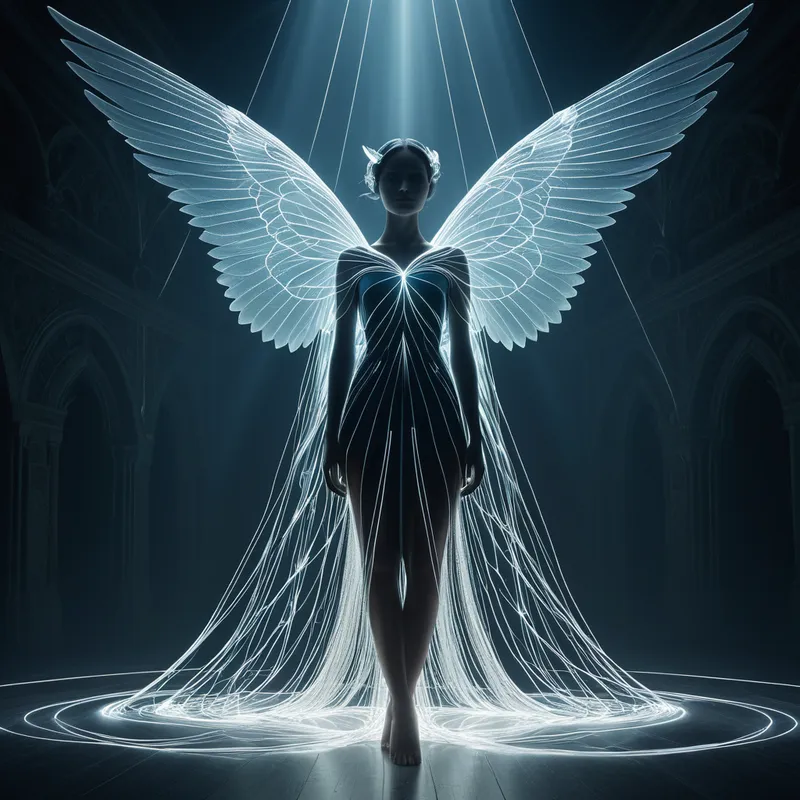
The alchemical journey modeled by the Valkyrie myth is that of mortificatio followed by exaltatio—the killing of the base matter and the glorification of its essence. For the modern individual seeking individuation, the myth outlines a non-negotiable process.
First, one must recognize the inner battlefield. This is the conflict of opposites within: duty versus desire, courage versus fear, the person you are versus the person you are called to become. Engaging in this conflict consciously is the work. The Valkyrie does not appear to those asleep at home; she appears where the fight is hottest and most authentic.
Her selection is the mortificatio, the necessary death. This is the painful but liberating realization that to serve the Self (Odin), the current ego-structure must surrender something precious. It could be a cherished self-image, a toxic relationship, or a safe but soul-killing path.
The mead served in Valhalla is the distilled spirit of the fallen warrior. Our deepest sufferings, when consciously selected and surrendered, become the intoxicating substance of our wisdom.
Finally, her service in Valhalla represents integration. The chosen part (the Einherjar) is not discarded but elevated. It is given a place at the table of the whole psyche, nourished, and prepared for the greater conflicts (Ragnarök) that represent ongoing stages of psychic growth. Thus, the Valkyrie guides us through the ultimate alchemy: transforming the lead of our personal battles into the gold of a purposeful, integrated life. She teaches that our endings, when met with the courage of a chosen one, are in fact our most sacred beginnings.
Associated Symbols
Explore related symbols from the CaleaDream lexicon: