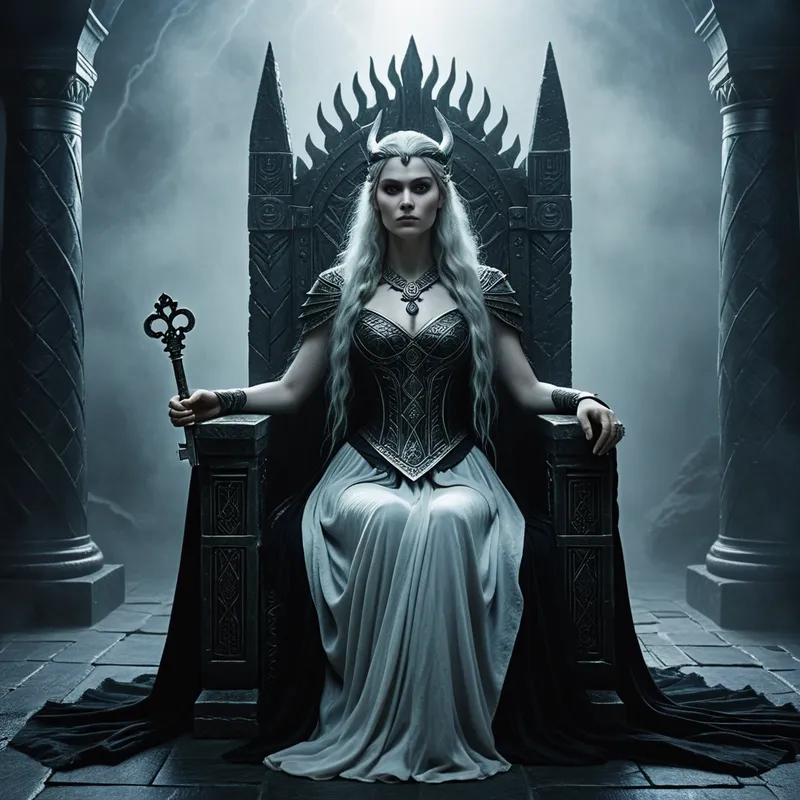
Hel Myth Meaning & Symbolism
The myth of Hel, half-living, half-dead ruler of the underworld, reveals the necessity of embracing the totality of existence, shadow and all.
The Tale of Hel
Listen, and hear of the hall that stands where the sun’s warmth is a forgotten dream. In the time before time’s end, when the Ginnungagap still echoed with creation’s first whispers, the great Loki sired children with the giantess Angrboda. Three they were, and terrible: the serpent Jörmungandr, cast into the sea; the wolf Fenrir, bound with magic; and a daughter, Hel.
When the gods of Ásgarðr beheld her, a cold dread settled in their hearts. Her form was a riddle of existence itself: one half of her was as a woman, flesh pale and fair, but the other half was corpse-flesh, blue-black and necrotic. Her gaze held the stillness of deep earth and final frost. The All-Father, Óðinn, knew this child was a power that could not be slain, only appointed. So he cast her down, down from the golden heights, through the roots of the Yggdrasil, into the ninth world.
He gave her a kingdom, a realm to rule absolutely. Helheimr. It lies northward and downward, a land of mist and clinging cold, where the river Gjöll flows with blades. Her hall is Eljudnir, its walls damp with sleet, her dish named Hunger, her knife named Famine. Here, she receives all who do not fall in battle—the old, the sick, the peaceful dead. She is their queen, judge, and keeper. Her word is law, and her gates, the Helgrindr, open only one way for the souls of men.
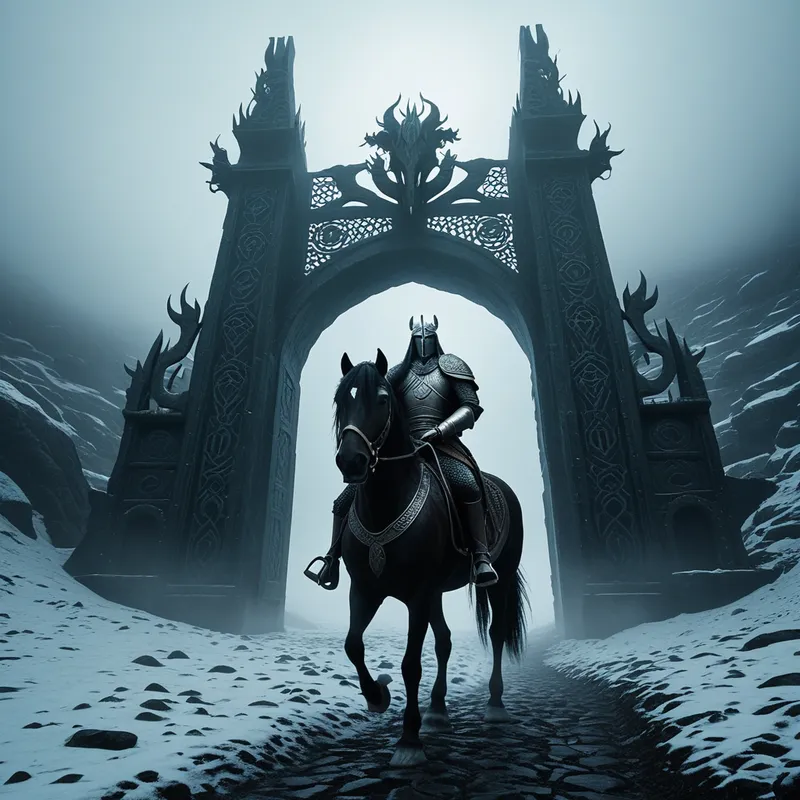
Her tale intertwines with the greatest grief of the gods. When the bright god Baldr was slain by a mistletoe dart, his soul traveled the Helvegr. The gods, stricken, sent the swift Hermóðr on Odin’s eight-legged steed, Sleipnir, to plead for his return. For nine nights Hermod rode through valleys of deepening shadow, until he crossed the echoing bridge over Gjöll and stood before Hel’s high seat.
Hel, the Split-One, listened. Her voice was the sound of soil falling on a coffin lid. “If all things in the Nine Worlds,” she decreed, “weep for Baldr, then he shall return to you. But if one thing refuses, he remains with me.”
Across all creation, stones wept, metals wept, even the giants wept. Hope flared in Ásgarðr. But in a dark cave, they found a giantess, Þökk, who would not shed a tear. “Let Hel hold what she has,” she spat. And so Hel kept her prize. Baldr, the most beloved, would remain in her grey halls until the world’s ending, a hostage of a condition unmet, a testament to the absolute and impartial nature of her dominion. She had not stolen him; she had received him. And her judgment, once given, was as immutable as the grave.
Cultural Origins & Context
The myth of Hel survives primarily in the Poetic Edda and the later Prose Edda of Snorri Sturluson. These texts, penned in Christianized 13th-century Iceland, are our windows into a much older, oral tradition. The stories of Hel were not formal scriptures but living narratives, told in longhouses during the dark winters, shaping a worldview that was stark, heroic, and deeply fatalistic.
In the Norse cosmos, death was not a single destination but a fate divided by the manner of one’s passing. Warriors who died blade-in-hand were chosen by the Valkyries for Valhalla. Those who drowned might go to Noatun or the goddess Rán. But for everyone else—the vast majority who succumbed to sickness, age, or accident—the road led to Helheimr. Hel was not a torturer like the Christian devil; she was an administrator of the inevitable. Her myth served a crucial societal function: it provided a coherent, non-demonized explanation for the most common human fate, reinforcing a culture’s acceptance of a harsh, hierarchical, and ultimately impartial cosmic order.
Symbolic Architecture
Hel is the archetypal ruler of the rejected, the queen of what we cast down and away. Her split visage is the ultimate symbol of a fractured wholeness.
To look upon Hel is to behold the fundamental dichotomy of existence: life and decay, beauty and horror, the conscious self and the repressed shadow. She is the unity of opposites that consciousness insists on separating.
Her realm is not a place of fiery punishment, but of cold, grey integration. It is the psychic basement where we store all we deem unacceptable—our weaknesses, our shames, our forgotten griefs, our passive endings. The god Baldr, representing pure light, consciousness, and divine favor, must descend there. This is the myth’s profound psychological truth: no aspect of the self, no matter how luminous, can achieve wholeness without confronting and acknowledging the realm of the “un-lamented,” the parts of ourselves we refuse to weep for.
Her condition for Baldr’s return—that all things must weep—is an impossible standard of total, universal acknowledgment. It is the psyche’s demand for absolute honesty. The refusal of one entity (Þökk, often interpreted as Loki in disguise, the embodiment of trickery and unresolved chaos) ensures the light remains in the dark. This signifies that wholeness is perpetually thwarted by some fragment of denial, some unloved and unmourned aspect of our own inner trickster.
The Dreamer's Resonance
When the imagery of Hel arises in modern dreams, it signals a profound somatic and psychological process: the ego’s confrontation with its own underworld. This is not a nightmare of persecution, but a solemn dream of reckoning.
You may dream of a vast, silent, grey landscape. You may encounter a figure of dual nature, or find yourself in a damp, cold hall that feels both foreign and intimately familiar. There is often a sense of heavy gravity, of being weighed down by something unprocessed. The somatic experience can be one of chilling stillness, a drop in core temperature, or a feeling of profound, almost peaceful, inertia.
Psychologically, this is the process of shadow-work beginning in earnest. The dream-ego is being called to meet its own “Hel”—the ruler of all it has denied, repressed, or considered “dead” within itself. This could be old grief one never properly mourned, innate capacities labeled as weaknesses, or primal instincts deemed unacceptable. The dream presents not a monster to slay, but a sovereign to acknowledge. The tension lies in accepting the split, the coexistence of vitality and decay within one’s own being.
Alchemical Translation
The myth of Hel provides a stark yet precise model for psychic transmutation, or individuation. The alchemical goal is not to destroy the base material but to transform it through recognition and integration. Helheimr is the nigredo—the blackening, the initial stage of dissolution and decay where the conscious attitude is broken down.
The journey to wholeness is not an ascent into pure light, but a necessary descent to claim the sovereignty of all that we are. One must sit upon the throne in Eljudnir before one can truly inhabit the halls of the gods.
The process begins with Odin’s act: the conscious ego (the ruling principle) casting the split-child (the nascent, unintegrated wholeness) downward, into the unconscious. This is not an evil act, but a necessary one—assigning a domain to this powerful energy. The first stage of alchemy is to grant authority to the shadow, to make it a ruler in its own right, rather than a disowned prisoner.
The quest for Baldr is the ego’s subsequent, painful realization that its light is incomplete. It must send its messenger (Hermod, the courageous, seeking function of the psyche) to parley with the shadow-sovereign. The negotiation—the weeping of all things—is the labor of feeling-tone. It requires mourning for every lost part, every rejected impulse. The inevitable failure (Þökk’s refusal) is not a final defeat, but a revelation: total integration is a horizon, not a destination. The light remains in the dark, enriching it, waiting. The alchemical gold is not the retrieval of pure Baldr, but the creation of a new, conscious relationship with the Hel within—a relationship of respect, recognition, and ultimately, a shared sovereignty over the totality of the self. In accepting the rule of Hel, we do not become corpses; we become whole.
Associated Symbols
Explore related symbols from the CaleaDream lexicon: