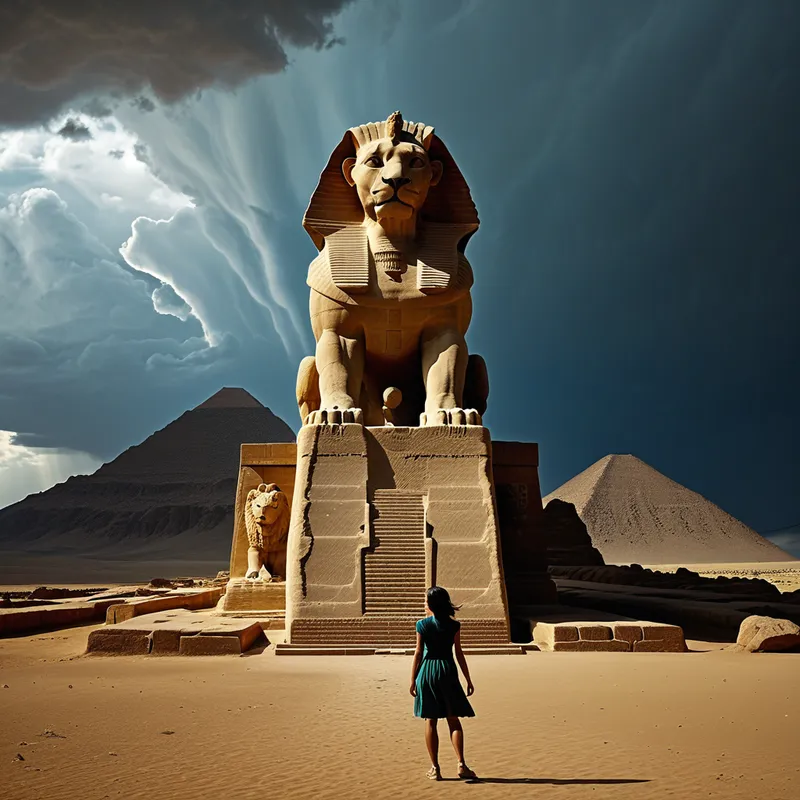
The Riddle of the Sphinx Myth Meaning & Symbolism
A winged monster devours those who fail her riddle, until a wandering hero confronts the question of man's nature and shatters her power.
The Tale of The Riddle of the Sphinx
Thebes was a city under a curse, a kingdom holding its breath. A miasma of dread clung to its seven gates, thicker than the morning fog on the river Ismenos. The cause was no plague of the body, but a terror of the mind, sent by the gods themselves. Her name was whispered in the markets and screamed in nightmares: the Sphinx.
She was not of this earth, a daughter of Typhon and Echidna, a creature of primal chaos. With the body of a mighty lion, the wings of a colossal eagle, and the face of a woman whose eyes held the cold wisdom of the abyss, she perched on the sacred mountain of Phikion. From there, she watched the road to Thebes, the only road in or out.
Her method was a cruel poetry. She did not merely rend with claw or tooth. She posed a question. To every traveler, every merchant, every hopeful soul seeking the city, she would descend with a sound like a thunderclap of silk and feather. Her voice, neither wholly human nor beast, would slice the air: "What creature walks on four legs in the morning, two legs at noon, and three legs in the evening, and is weakest when it has the most?"
To hesitate was to die. To answer wrongly was to die. The rocks below her perch were stained, littered with the bones of the clever and the brave who had failed. The Sphinx would consume them, a ritual sacrifice to her own enigmatic power, leaving Thebes isolated, paralyzed by a riddle that blocked its very throat.
Into this stagnation came a wanderer. His name was Oedipus, a man fleeing a dark oracle, his feet dusty from the road, his mind heavy with a fate he sought to outrun. He came upon the scene of despair—the warnings of locals, the palpable fear. But Oedipus was a solver of puzzles; he had unraveled the secret of the Cyclops and faced down wild beasts. This, he thought, was a challenge of the intellect, the one domain where a man might defy the gods.
He climbed the path. The air grew thin and cold. And then she was there, blotting out the sun, her shadow swallowing him whole. The smell of lion, of old blood, and something like ozone filled his senses. Her gaze pinned him, not with rage, but with a terrifying, patient curiosity.
She spoke the riddle. The words hung in the air, a trap woven from language itself.
Oedipus did not look at the bones. He looked inward. He thought not of monsters or gods, but of the journey of a life. The morning, the noon, the evening… the progression of a single day, mirroring the span of a lifetime. A smile, born not of arrogance but of sudden, dreadful clarity, touched his lips.
"Man," he said, his voice steady in the monumental silence. "As an infant, he crawls on all fours. In the prime of his life, he walks upright on two legs. In old age, he uses a staff as a third leg. And he is weakest as an infant, when he has the most potential, the most helpers, yet cannot use them."
A sound escaped the Sphinx—not a roar, but a sigh, like the wind leaving a sail. The cryptic certainty in her eyes shattered. The riddle was her essence, her reason for being. Answered, she was undone. With a cry that was both despair and release, the monstrous form hurled itself from the precipice, dashed upon the rocks below. The blockade was broken. The road to Thebes was open. The city would hail Oedipus as a savior, a king. But in solving the riddle of the monster, he had yet to confront the riddle of his own life, a truth far more terrible than any she had posed.
Cultural Origins & Context
The myth of the Sphinx’s riddle is most famously preserved in the Theban plays of Sophocles, particularly Oedipus Rex. It is a cornerstone of the Greek mythological canon, but its roots likely tap into older, Near Eastern traditions. Composite creatures like the Sphinx (the Egyptian sphinx being a protector, not a predator) were common in the mythic imagination of the Mediterranean and Mesopotamia, representing liminal power and forbidden knowledge.
In its Greek form, the story was not merely entertainment. It was a foundational narrative performed in the civic-religious context of the City Dionysia. The function was profound: to explore the terrifying limits of human knowledge and the irony of fate. The society that told this tale was one obsessed with order (kosmos) versus chaos, with the perils of hubris (excessive pride), and with the inscrutable will of the gods. The Sphinx represented a chaotic, externalized threat to the city-state’s social order. Her defeat by intellect (metis) reaffirmed the Greek ideal of human reason, yet the subsequent tragedy of Oedipus served as a permanent, chilling counterpoint: reason alone cannot save us from the truths of our own origins.
Symbolic Architecture
The Sphinx is not just a monster; she is the embodiment of the Unanswered Question, the psychic complex that paralyzes growth. She sits at the threshold, the critical crossroads between unconscious ignorance and conscious self-awareness. Her composite nature—human head, animal body, avian wings—symbolizes the tangled strata of the psyche: the intellectual, the instinctual, and the spiritual, fused into a single, menacing guardian.
Her riddle is the ultimate mirror. It is not about an external creature, but about the dreamer, the one attempting to pass. It frames a human life in its totality, from helpless dependence to confident maturity to assisted decline. The "weakest when it has the most" is the poignant core: as infants, we possess total potential and care, yet have no agency. The riddle forces a confrontation with the nature of time, mortality, and the paradoxical trajectory of human power.
The true monster is not the asker of the riddle, but the unexamined life that the riddle describes.
Oedipus, the "swollen-foot," is the archetypal problem-solver, the part of consciousness that believes all knots can be untied with logic. His correct answer is a monumental act of recognition, not just of a solution, but of the human condition itself. In naming "Man," he names himself, enacting the first, fundamental imperative of wisdom. The Sphinx’s suicide signifies the dissolution of a psychic barrier the moment its core paradox is consciously integrated. The monster of unknowing cannot survive in the light of self-knowledge.
The Dreamer's Resonance
When this myth pattern erupts in modern dreams, it rarely appears as a literal winged lion. Instead, the dreamer finds themselves in a liminal space—a locked office, a maze-like university hallway, a bridge with no end. Authority figures (a boss, a parent, a vague but imposing presence) pose a question that feels both absurd and critically important. The somatic feeling is one of frozen panic, a tightening in the chest, a dry mouth. The dream-ego scrambles for data, for the "correct" answer from the external world, but finds only static.
This is the psyche signaling a critical impasse. The Sphinx-complex guards a transition. Perhaps it is a career change, the end of a relationship, or a confrontation with a buried aspect of the self. The "riddle" is the unconscious demand for a new level of self-definition. The paralysis and fear of being "devoured" reflect the ego's terror of being overwhelmed by the unconscious if it steps into unknown territory. The dream is a rehearsal. The answer it seeks is not an intellectual fact, but an existential stance: Who are you, now, at this stage of your journey? To answer authentically is to "kill" the old, obstructive complex and move forward, though the new territory (like Thebes for Oedipus) may hold further, more personal revelations.
Alchemical Translation
The alchemical process mirrored here is the nigredo, the blackening, the confrontation with the prima materia—the raw, chaotic stuff of the soul. The Sphinx is the custodian of the threshold. Her riddle is the first and most crucial test of the individuation journey.
The hero’s journey is not about slaying the dragon with a sword, but about dissolving it with insight. Oedipus’s triumph is the sublimation of a monstrous, external threat into a conscious, internal truth. "Man" is the answer that transmutes the lead of bewildered suffering into the gold of self-recognition. This is the foundational act of consciousness: to turn the gaze inward and name one’s own nature.
The alchemical gold is not found in solving life's external puzzles, but in realizing you are the subject of the central, ongoing riddle.
For the modern individual, the process is identical. We face Sphinxes daily: societal expectations, internalized critics, midlife crises. They demand we define ourselves by external metrics—productivity, status, likes. The alchemical work is to refuse the false riddle and answer the true one. To say, "I am the creature that changes. I am the process, not the fixed point. My weakness and my strength are phases of the same journey." This conscious acceptance of one’s own three-legged, four-legged, two-legged reality is the conjunctio oppositorum—the union of the child, the adult, and the elder within. It breaks the spell of the complex, allowing the psychic energy once bound up in paralysis (the devouring Sphinx) to be freed for the next, more intimate, and often more difficult stage of the voyage: the journey into one’s own personal Thebes, to face the ghosts of origin and destiny that wait within.
Associated Symbols
Explore related symbols from the CaleaDream lexicon: