Pontius Pilate Myth Meaning & Symbolism
A Roman governor, caught between political expediency and a profound moral choice, becomes the eternal symbol of the soul's evasion of responsibility.
The Tale of Pontius Pilate
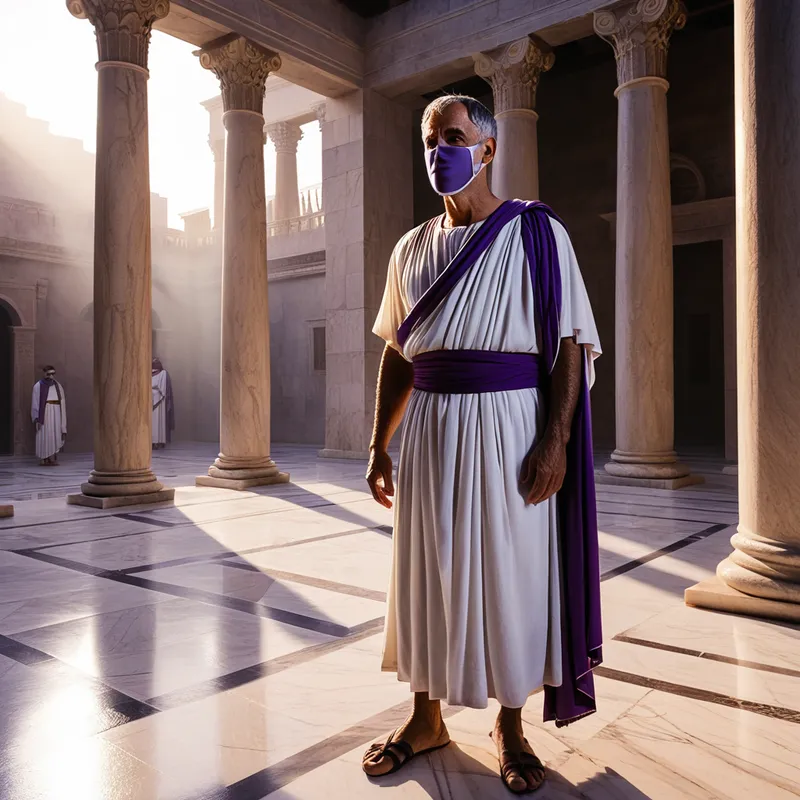
The city of Jerusalem was a vessel filled to the brim with a volatile spirit. It was the time of the Passover, and the air was thick with the scent of roasting lamb, crushed herbs, and the sharp, metallic tang of anticipation. Into this pressurized crucible walked the man who held the seal of Rome: Pontius Pilate. His palace was an island of cool marble and ordered logic in a sea of fervent, ancient passion.
He was a man of the Pax Romana, a believer in roads, laws, and the quiet efficiency of power. But the gods of this land were not the clean, distant deities of the Roman pantheon. Here, the divine was a consuming fire, and its prophets spoke of kingdoms not of this world. They brought him a man from the night, bound but serene, accused of claiming to be a king. "Are you the King of the Jews?" Pilate asked, his voice echoing in the praetorium's hall. The man, Jesus of Nazareth, answered not with defiance, but with a question that turned the inquiry inward: "Do you say this of your own accord, or did others say it to you about me?"
A chill, not from the morning air, touched Pilate's spine. This was no ordinary rebel. He saw no guilt in him. He sought release, offering the crowd a choice: this harmless preacher or the notorious murderer, Barabbas. But the crowd, a single, roaring beast stirred by the accused man's own priests, demanded Barabbas. "What then shall I do with Jesus who is called Christ?" Pilate cried, his authority bleeding away into the tumult. "Crucify him!" came the thunderous reply.
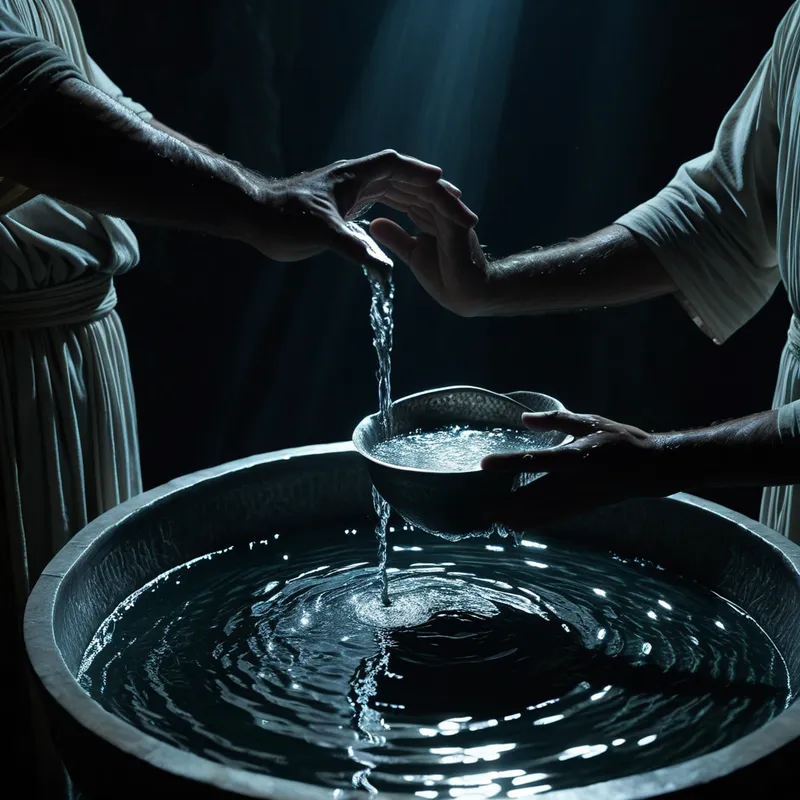
His wife sent word of a dream, a warning of a righteous man. The message coiled in his gut like a cold serpent. He took water before the multitude. The basin was brought, silver and cold. He washed his hands, the water sluicing over his skin. "I am innocent of this man's blood," he declared to the seething crowd. "See to it yourselves." And the people, in a terrible chorus, answered, "His blood be on us and on our children!" With those words, the deed was sealed. He handed over the man he found no fault in, and the machinery of the state, which he commanded, ground forward to its grim purpose. He ordered the title fixed to the cross: "Jesus of Nazareth, the King of the Jews." A final, brittle assertion of a truth he could not understand and a power he could not truly wield. The sentence was carried out under a sky that turned dark at noon.
Cultural Origins & Context
The figure of Pontius Pilate is not a myth in the classical sense of a story about gods, but a foundational historical myth—a narrative about a real historical actor that has been imbued with immense symbolic and theological weight within the Christian tradition. The primary sources are the four Gospels, written decades after the events, each with its own theological emphasis.
Pilate was the Roman Prefect of Judea, a mid-level administrator tasked with keeping a troublesome province quiet. The story was passed down orally within early Christian communities before being codified in scripture. Its societal function was multifaceted: it historically situated Jesus's death within Roman jurisprudence, it underscored the theme of prophetic fulfillment (particularly the "suffering servant" of Isaiah), and it navigated the delicate early relationship between the Christian movement and Roman authority by often portraying Pilate as a reluctant, pressured figure, shifting primary blame onto the Jewish authorities. Over centuries, this narrative crystallized in liturgy, art, and creed (where Jesus is said to have "suffered under Pontius Pilate"), making him an indispensable, if infamous, character in the Western moral and philosophical drama.
Symbolic Architecture
Pilate is the archetype of the Ruler who fails his sovereign duty. He is not a monster, but something psychologically more familiar and thus more terrifying: the compromised bureaucrat, the rational man faced with the irrational demand of spirit or conscience. His symbolic power lies in his inaction masquerading as action.
The washing of hands is not a cleansing, but the ritualization of a stain. It is the soul's attempt to make its evasion tangible, to create a spectacle of innocence while committing the sin of abandonment.
He represents the abdication of judgment. He possesses all the formal authority—the imperium—to make a just choice, yet he cedes that authority to the crowd, to political pressure, to expediency. He becomes a conduit rather than a decider. Psychologically, he embodies the conflict between the ego (the Roman governor, the man of law and order) and the Self (the encounter with the numinous, the "truth" that Jesus speaks of). Pilate's famous question, "What is truth?" is not philosophical inquiry, but the defensive shrug of a psyche that refuses to engage with a reality beyond its administrative categories. He is the shadow of the Ruler: the leader who leads by following the mob, the judge who judges by refusing to judge.

The Dreamer's Resonance
When the pattern of Pontius Pilate manifests in modern dreams, it signals a profound confrontation with moral and psychological evasion. The dreamer is not necessarily facing a literal life-or-death judgment, but a moment where their integrity is on the line.
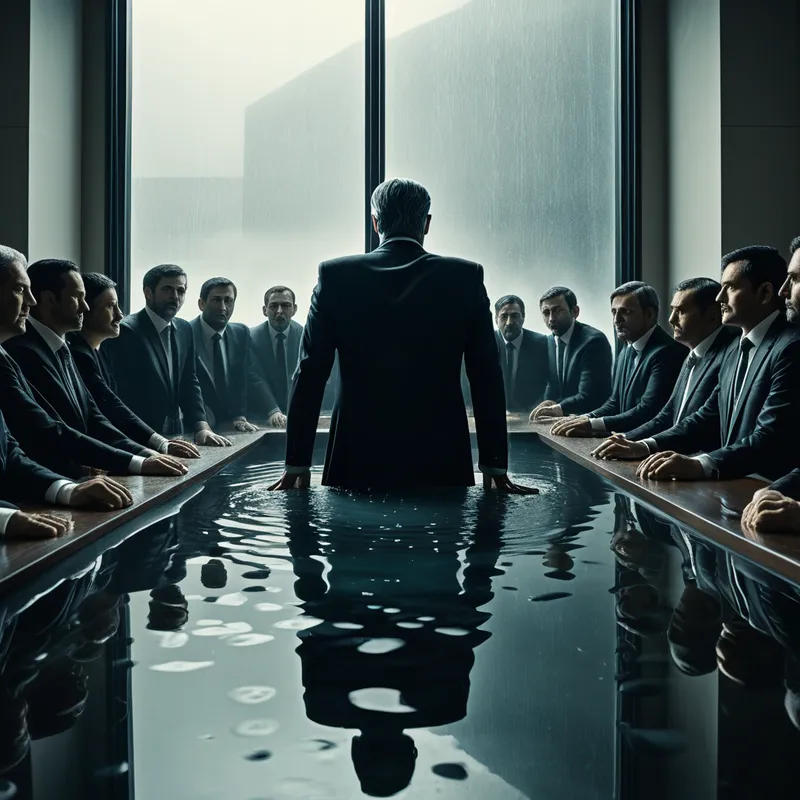
The somatic experience is often one of stuckness or paralysis. One might dream of being in a position of authority—a manager, a parent, a team leader—yet being unable to speak or act as a furious crowd (colleagues, family, internal voices) demands a compromise. The iconic "washing of hands" may appear as repeatedly scrubbing one's hands in a sink that never gets clean, or trying to wipe a stain off a document that keeps reappearing. The dream environment is typically a hybrid space—a courtroom that is also one's living room, a corporate boardroom that opens onto the Golgotha hill. This reflects the dreamer's inner conflict: the personal ("this is my career, my relationships") colliding with the transpersonal ("this is a matter of deep principle, of soul").
The psychological process is the unconscious forcing an awareness of complicity. The dream asks: Where in your life are you "washing your hands" of a difficult truth? Where are you outsourcing your moral responsibility to the "crowd" of social expectations, familial pressures, or fear of conflict? The Pilate dream is a call to reclaim one's seat of judgment.
Alchemical Translation
The alchemical process modeled by the Pilate myth is the Nigredo of responsibility—the blackening that comes from facing the shadow of one's own cowardice and compromise. The myth does not offer a triumphant transformation for Pilate himself; he remains a tragic figure. But for the modern individual on the path of individuation, he serves as the ultimate cautionary mirror.
The first stage is Confrontatio: the "Jesus" figure in our own psyche—which could be a creative impulse, a moral truth, a call to authenticity—is brought before the ego's tribunal. The ego-Pilate examines it, finds it guiltless, even compelling. The conflict arises when the "crowd"—the internalized voices of convention, the persona, the fear—demands its suppression.
The alchemical gold is not found in the verdict, but in the courage to own the verdict. To inscribe the title of the rejected truth upon the cross of one's own suffering, and to witness the consequences without the ritual of false cleansing.
The transmutation occurs if we can refuse the basin of water. This means enduring the solutio—the flood of anxiety, conflict, and potential loss—without seeking a symbolic absolution. It means making the conscious, soul-level choice to protect the inner truth, even at great cost to the social or professional persona. To "hand over" the truth to be crucified by circumstances is to live a life of quiet despair. To defend it is to undergo a crucifixion of the ego, which in alchemical terms is the necessary death that precedes resurrection. The individuated Self emerges not from Pilate's evasion, but from consciously integrating the role of both the accused truth-bearer and the responsible judge, ending the inner civil war between conscience and convenience.
Associated Symbols
Explore related symbols from the CaleaDream lexicon: