The Trojan War Myth Meaning & Symbolism
A decade-long war sparked by a golden apple, a stolen queen, and divine pride, revealing the thin line between human choice and cosmic fate.
The Tale of The Trojan War
Hear now the tale that shook the world, a story woven not just of men, but of the fates themselves. It begins not with a sword, but with an apple—a single, gleaming fruit of gold, inscribed with a word that would become a curse: Kallisti—“For the Fairest.” Cast by Eris into the midst of a divine wedding, it rolled to the feet of three goddesses, and in that moment, the loom of destiny was threaded with vanity.
Hera, Athena, and Aphrodite each claimed the prize. To judge this impossible contest, they sought a mortal hand—Paris, son of King Priam, dreaming among his flocks on Mount Ida. Each goddess offered a bribe: Hera, dominion over all kingdoms; Athena, unmatched wisdom and glory in war; Aphrodite, the love of the most beautiful woman in the world. Paris, his heart already captive to desire, gave the apple to Aphrodite. His prize was Helen, wife of King Menelaus. With the goddess’s aid, he sailed to Sparta, and under the spell of divine promise and mortal passion, Helen fled with him across the wine-dark sea to the high-walled city of Troy.
A cry went up across Greece. A thousand ships were launched, their black hulls scraping the sand, their sails like a forest of grief against the sky. Led by Menelaus’s brother, the proud Agamemnon, the host gathered: cunning Odysseus, mighty Achilles, and Ajax the bulwark. For nine years they besieged the impregnable walls, the Scamander River running red. The gods themselves took sides, hurling thunderbolts and weaving deceptions. Achilles, in a rage over a slight to his honor, withdrew from battle, and the Greeks faltered. Only when his beloved companion Patroclus donned his armor and was slain by the Trojan hero Hector, did the lion return to the fight. His grief was a storm; he chased Hector three times around the walls before cutting him down, defiling the body in his wrath.
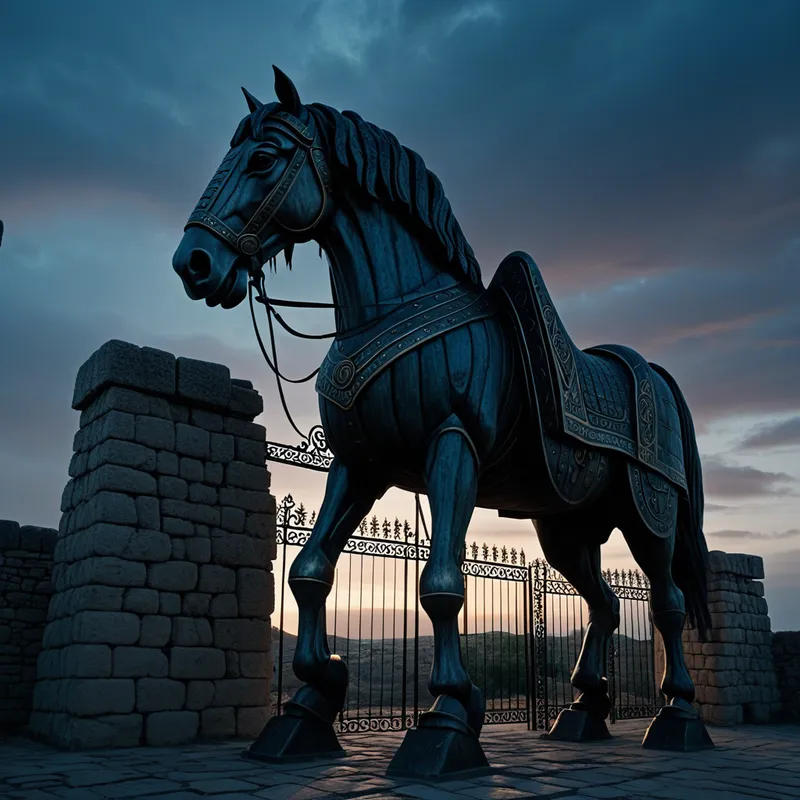
But the walls held. The war, a grinding wheel of pride and blood, seemed endless. Then, from the cunning mind of Odysseus, sprang the final trick: a monstrous offering, a wooden horse, hollow as a tomb. The Greeks pretended to sail away, leaving the silent giant before the gates. The Trojans, believing it an appeasement to Athena, dragged the harbinger of their doom inside their sacred walls. That night, as the city slept in drunken celebration, the belly of the beast opened. Greek warriors spilled into the streets, a hidden fury unleashed. Gates were thrown open, the fleet returned, and Troy was given to the fire. The palaces fell, the altars were defiled, and the women were led away to slavery. The smoke of Ilium rose to the uncaring stars, a pyre for an age.

Cultural Origins & Context
This vast epic was not born in a library, but in the firelight of aristocratic halls and public festivals. The stories of the Trojan War were the foundational narrative of the Greek world, a mythic past that defined heroism, fate, and the fraught relationship between humanity and the divine. They were carried and shaped by generations of oral poets, the aoidoi, before being crystallized in the monumental verses attributed to Homer—the Iliad (focused on the rage of Achilles) and the Odyssey (the long journey home). For the Greeks, these were not mere tales but a shared history, a source of ethical dilemmas, and a mirror for their own values of glory (kleos), honor (timē), and the inevitable suffering that accompanies them. The war provided a template for understanding the costs of hubris, the capriciousness of the gods, and the tragic beauty of a doomed, heroic struggle.
Symbolic Architecture
Beneath the clashing shields and divine machinations, the Trojan War is a profound drama of the psyche. Troy itself is not just a city; it is the citadel of the conscious self—ordered, proud, and seemingly impregnable. The war represents the necessary, often brutal, incursion of the unconscious, of all that has been repressed, denied, or projected outward.
The apple of discord is the irresistible symbol of the unintegrated complex. It is the splinter in the soul’s unity, the seed of desire that, when left unexamined, grows into a world-consuming conflict.
Paris’s choice is the ego’s fateful alignment with one compelling inner force (Aphrodite/desire) at the expense of others (Hera/structure, Athena/wisdom). The abduction of Helen is the “rape of the anima”—the capture of the soul-image, the inner beauty and vitality, by a partial complex, dragging it into the fortified realm of a rigid identity. The ensuing decade-long siege is the psyche’s stalemate, where the old defenses (Troy’s walls) hold against the besieging forces of change, leading only to exhaustion and sterility.
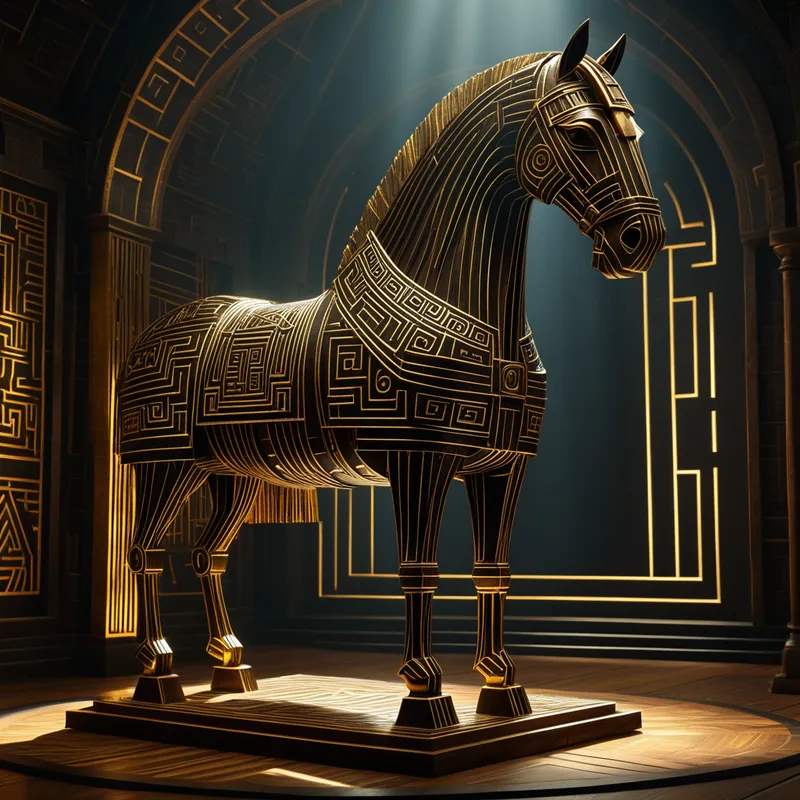
The Trojan Horse is the master symbol of the trickster archetype and the transformative power of the rejected. It is the gift that contains its own destruction, the accepted idea that carries within it the seeds of revolution. It represents the insight that cannot be taken by force but must be welcomed in, the unconscious content that disguises itself to bypass the ego’s defenses.
The Dreamer's Resonance
When the motifs of this myth stir in modern dreams, the dreamer is often in a prolonged state of psychological siege. Dreaming of impenetrable walls or a protracted, futile conflict suggests a defensive structure—a belief, a self-image, a pattern of behavior—that is consuming vast energy to maintain. A dream of a beautiful object or person being stolen away may point to a sense that one’s vital essence, creativity, or capacity for love (the inner Helen) has been captured by a compulsive desire or an outdated life pattern (the Paris complex).
The appearance of the wooden horse is a critical juncture. It signals that the conscious mind is being presented with a seemingly benign solution, a “gift,” that actually contains the transformative—and potentially disruptive—key to ending the inner war. The dreamer may feel a somatic sense of dread or eerie fascination around this symbol, a bodily knowing that to accept it is to risk everything.

Alchemical Translation
The alchemical journey modeled by the Trojan War is the opus contra naturam—the work against nature, which here means against the stagnant, defended nature of an outworn self. The long, bloody stalemate is the nigredo, the blackening, the necessary period of frustration, depression, and confrontation with shadow (Achilles’s wrath, the death of Patroclus).
The stratagem of the horse is the moment of solutio and coagulatio—dissolution and coagulation. The old, rigid boundaries (the walls) must be dissolved from within by accepting the disguised, trickster element. This is not a victory of the ego, but its intelligent surrender to a greater cunning from the depths.
The fall of Troy is not a defeat, but a necessary dissolution. The burning city is the calcined ashes of an old identity, from which the soul, like Odysseus, can begin its true journey homeward.
The triumph is not in the destruction, but in the liberation of what was trapped inside. Helen is recovered, not as a prize, but as a reclaimed part of the soul. The psychic energy once spent on maintaining the siege and the defense is freed. The individual who undergoes this process does not emerge with the same citadel intact, but as a wanderer in a new landscape, carrying the wisdom that no wall, however strong, can forever keep out the truths of the deep self. The war ends so the odyssey may begin.
Associated Symbols
Explore related symbols from the CaleaDream lexicon: