Wyrd Myth Meaning & Symbolism
The myth of Wyrd reveals a cosmic tapestry woven by the Norns, where past, present, and future intertwine to shape the destiny of gods and mortals.
The Tale of Wyrd
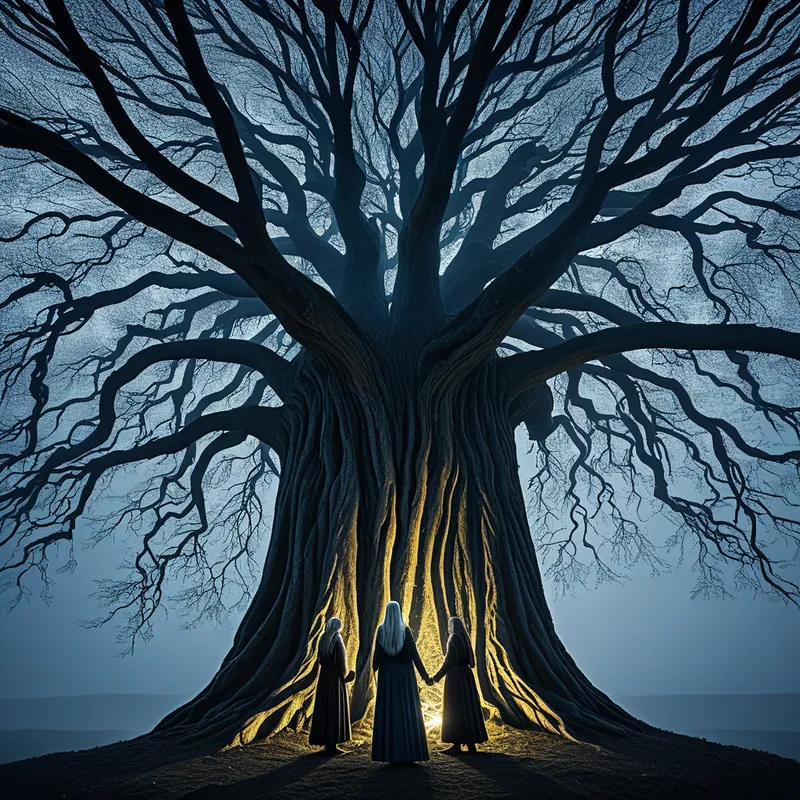
Listen, and hear the whisper from the roots of the world. Beneath the groaning, frost-laden branches of Yggdrasil, where the well of Urðarbrunnr bubbles with water of memory and mud, they dwell. They are three, yet they are one. Their names are spoken in a breath that chills the spine: Urðr, Verðandi, and Skuld.
Their hall is not of wood or stone, but of time itself. Each dawn, they gather at the well’s murky edge. Urðr, her face a map of all that has been etched by wind and sorrow, draws from the well a thread the color of old soil and dried blood—the past, solidified. Verðandi, her eyes reflecting the ever-shifting now, takes the thread, her fingers nimble as a bird’s flight, spinning it into a strand of vibrant, uncertain light—the present, in the act of being lived. Skuld, veiled in a grey mist that parts to reveal glimpses of storm and sun, holds a shears whose blade is forged from necessity. She does not cut, not yet, but her presence promises an end.
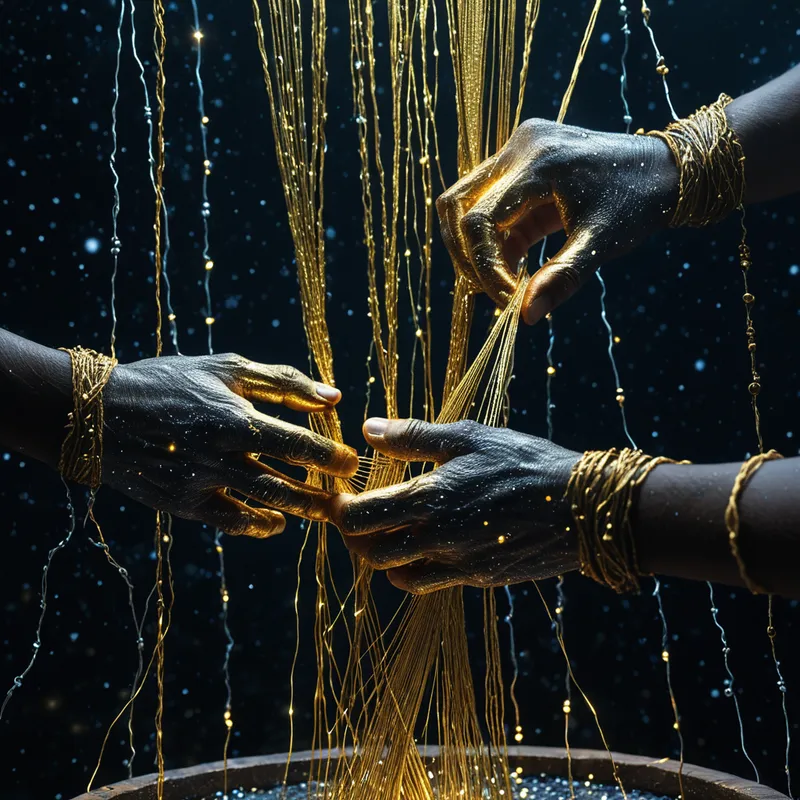
And they weave. Not on a loom you or I would know, but into the very bark of Yggdrasil, into the veins of the earth, into the breath of the wind. Their tapestry is the Wyrd. You can see it if you dare to look: a shimmering, living web that cradles the nine worlds. Here, a golden thread shimmers where Thor lifts his hammer. There, a thread of deep blue dims where a hero takes his final breath in a far-off land. A strand of iron runs to the bound wolf Fenrir, taut and straining.
The gods themselves come to the well, not to command, but to witness. Odin gave an eye for a sip from these waters, and he sees the web in his raven-dreams. He sees his own thread, a complex braid of spear-dark and wisdom-grey, leading inexorably to the gaping maw of the wolf at Ragnarok. He knows the pattern. The Norns do not speak to him. They simply weave. The wind in the high branches of the World Tree is the sound of their work—a sigh of what was, a hum of what is, and the silent, terrifying tension of what must be.
This is not a story with a battle or a theft. Its conflict is the quiet, immense tension of the loom. The rising action is the endless addition of every choice, every breath, every fallen leaf to the pattern. The resolution is the pattern itself—complete in every moment, yet forever unfolding. To stand before them is to feel the weight of all time, the exquisite terror of being both the thread and the tapestry.
Cultural Origins & Context
The concept of Wyrd is the bedrock of the Norse worldview, far older and more fundamental than the sagas of gods and heroes. It stems from a pre-literate, oral tradition where the world was perceived not as a collection of objects, but as a dynamic field of relationships and processes. This myth was not "told" in a single narrative but was breathed into every story, every law, and every personal oath.
It was the province of the völva, the seeress who could read the threads. In the hall, the skald might sing of great deeds, but it was understood that those deeds were patterns already present in the weave. The societal function was one of profound orientation: it created a cosmos that was neither chaotic nor ruled by capricious gods alone, but ordered by a deep, impersonal, and relational logic. Your honor, your luck (hamingja), your very family line were threads in this web. To act with honor was to strengthen your thread and its connections; to break oath was to fray the very fabric of reality. This myth provided a framework for accepting hardship and death not as meaningless, but as part of a vast, beautiful, and ultimately unfathomable design.
Symbolic Architecture
At its core, the myth of Wyrd dismantles our linear, cause-and-effect understanding of destiny. It presents fate not as a written script, but as a living, breathing matrix of interconnection.
Wyrd is the tapestry where the thread of individual will crosses the warp of ancestral past and the weft of collective consequence.
The three Norns represent the triune nature of time, but not as separate segments. Urðr is the given—the family, the culture, the trauma, the genetics, all that is sedimented into our being. Verðandi is the moment of choice—the perpetual now where we act, where the past becomes material for the future. Skuld is not merely "the future"; she is "debt" or "that which ought to be"—the ethical imperative, the consequences that lean into the present from what is to come. The well of Urðarbrunnr symbolizes the unconscious, the deep, murky waters of memory and origin from which all material (threads) arise.
Psychologically, this is a map of the psyche. We are all woven from the threads of personal and collective unconscious (Urðr), which we navigate and spin in our conscious lives (Verðandi), under the silent, often anxious pressure of potentialities, responsibilities, and life’s inevitable telos (Skuld). The web shows that no thread exists alone; to pull on one is to vibrate the whole. Our individuality is real, but it is a nodal point in a vast network.
The Dreamer's Resonance
When the pattern of Wyrd stirs in modern dreams, it often manifests as dreams of intricate networks: neural pathways, city grids, mycelial webs, or vast looms. One might dream of being a single point of light in a constellation, feeling both connected and insignificant. Alternatively, the dreamer may find themselves trying to follow or cut a specific thread in a tangled mess, representing a struggle with a life decision or a karmic relationship.
Somatically, this can feel like a deep, vibrational hum—a sense of being "plugged in" to a larger system. The psychological process is one of contextualization. The ego, which typically experiences itself as the solitary captain of its ship, is being shown it is also a vessel sailing in a pre-existing current. This can induce anxiety (a confrontation with Skuld’s shears) or profound relief (a sense of being held by Urðr’s tapestry). It is the psyche working to integrate the truth that we are not isolated selves, but processes within a field of other processes. Dreams of weaving, knitting, or untangling knots directly parallel the Norns’ work, indicating the dreamer is actively participating in shaping their destiny from the materials at hand.
Alchemical Translation
The alchemical work modeled by Wyrd is the transmutation of a fatalistic "my life is predetermined" into a participatory "my life is in relationship with all of destiny." The individuation process here is not about heroic ego-formation, but about conscious node-formation.
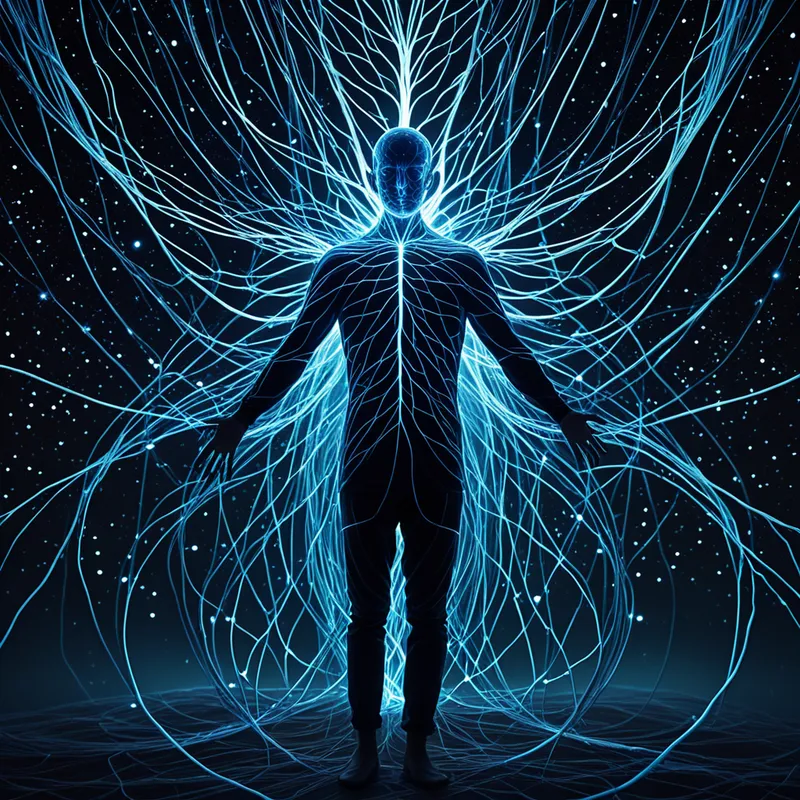
The goal is not to escape the web, but to become a conscious, luminous junction within it—where past is acknowledged, present is engaged, and future is met with ethical readiness.
The first stage (nigredo) is the drink from Urðarbrunnr: facing the murky waters of one’s origin story, family patterns, and unconscious drivers—the thread of Urðr. The second stage (albedo) is the work of Verðandi: spinning that raw material in the clear light of consciousness, making conscious choices that re-spin the thread. The third stage (rubedo) is the integration of Skuld: embracing one’s "debt" or responsibility—not as a burden, but as the shape of one’s unique contribution to the whole pattern. It is saying "yes" to the shears, to one’s finitude, which gives the tapestry its definition and beauty.
For the modern individual, this means moving from "Why is this happening to me?" to "What is happening through me, and how am I connected to it?" It is the alchemy of transforming fate into destiny—where destiny is fate met with consciousness and courage. We do not choose the threads we are given, but we are, in every moment, the weaver at the well, deciding the tension, the pattern, and the beauty of our small part in the infinite weave.
Associated Symbols
Explore related symbols from the CaleaDream lexicon: