Phaethon Myth Meaning & Symbolism
A mortal son of the Sun, granted a fatal wish to prove his lineage, loses control of the solar chariot and scorches the world before being struck down.
The Tale of Phaethon
Listen, and hear the story of a light that burned too bright.
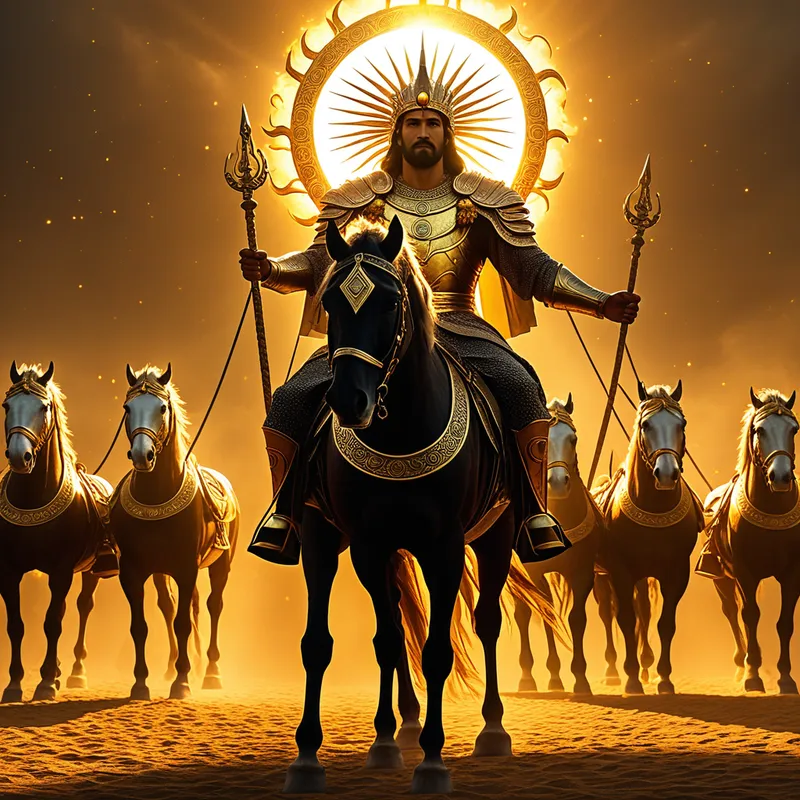
In the halls of his mother, the nymph Clymene, a young man named Phaethon burned with a secret fire. His mother whispered a truth that was both a blessing and a curse: his father was none other than Helios, the Sun himself, who drove his chariot of fire across the dome of heaven each day. But his companions mocked him, calling his claim the fantasy of a mother’s pride. The doubt was a poison in his veins. So, driven by a desperate need to know himself, Phaethon undertook the impossible journey to the far eastern palace of the Sun.
He arrived at a place where the air shimmered with latent dawn, before the gates of a palace wrought of polished gold and gleaming bronze, where light lived as a solid thing. And there he beheld his father, Helios, seated on a throne of emerald, his head wreathed in a blinding, painful radiance. Moved by the sight of his son, the Titan swore a sacred oath by the dark waters of the Styx to grant him any wish.
The youth did not ask for wisdom, or treasure, or long life. He spoke the desire that had scorched his soul since childhood: “Father, let me drive your chariot for a single day. Let me guide the Sun across the sky, so all the world will know I am truly your son.”
A shadow of profound dread fell across the shining face of Helios. He begged his son to choose another gift, any gift. He described the terror of the journey: the steeds were spirits of flame, their breath was heat; the path was steep and treacherous, passing the celestial beasts of the zodiac; the earth below was a fragile canvas that could not bear a wavering course. But an oath sworn by the Styx was unbreakable. With a heavy heart, the Sun anointed his son’s face with a protective salve and placed the golden reins in his unproven hands.
Dawn came. The gates of the east were flung open. The four immortal horses, sensing the weakness of the unfamiliar hand, burst forth not with disciplined power but with wild, untamed fury. Phaethon was lifted into the abyss of space, a speck of mortal terror clinging to a cosmic engine. The reins were like live serpents in his grip; the chariot bucked and swayed. He lost the sacred path. He drove too high, and the stars themselves shrank back in cold fear. He plunged too low, and the earth cried out.
The world began to burn. Great cracks opened in the plains. Rivers hissed into steam. Forests became torches. The skin of the Earth blistered, and legend says the peoples of Aethiopia were darkened by the scorching heat. To save all creation from utter annihilation, Zeus had no choice. He took up his weapon, the thunderbolt, the very instrument of order. With a sigh that echoed in the foundations of the world, he hurled it.
A flash of pure, white violence severed the chaos. The chariot shattered. The horses scattered. And Phaethon, his hair streaming fire like a comet’s tail, fell. He plunged from the zenith of heaven into the cold embrace of the river Eridanus, his ambition extinguished in its deep waters. His sisters, the Heliades, wept so long and so hard on the riverbank that they were transformed into poplar trees, their tears hardening into amber.
Cultural Origins & Context
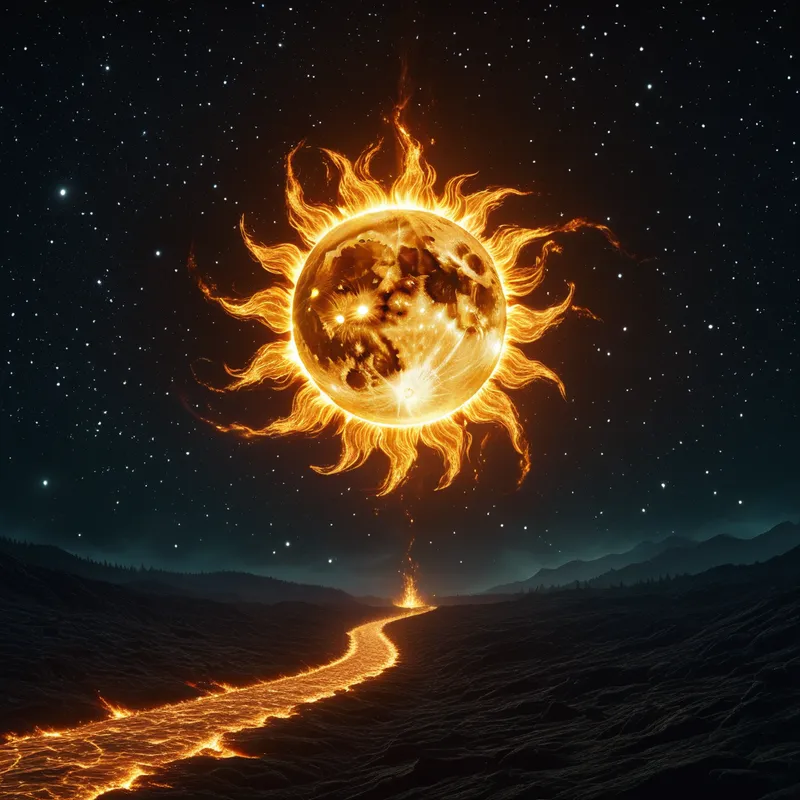
This powerful narrative comes to us from the Greco-Roman world, most comprehensively from the Roman poet Ovid’s Metamorphoses, a vast tapestry of myths concerned with transformation. While Ovid’s version is the most famous, the core of the story is older, appearing in fragments from Greek tragedy and earlier poetry. It was not a liturgical text but a foundational story, told by bards and poets to illustrate the immutable laws of the cosmos and the human condition.
Its societal function was multifaceted. On one level, it was an aetiological myth, explaining the origins of the Libyan desert, the dark skin of Ethiopians (in the ancient worldview), and the source of amber. On a deeper level, it served as a profound cautionary tale about the cosmic order. The Greeks understood the universe as a delicate balance (kosmos) maintained by divine law (themis). Phaethon’s rash act was the ultimate transgression of boundaries (hubris), a mortal attempting a divine function. The myth reinforced the hierarchy of being: there are realms and roles not meant for humanity, and to overreach is to invite catastrophic, world-altering consequences.
Symbolic Architecture
At its heart, the myth of Phaethon is not about astronomy, but about psychology. It is the archetypal drama of the unintegrated adolescent ego, the child of a luminous but absent father, seeking to prove its worth by seizing the ultimate symbol of power and identity.
The chariot of the Sun is not a vehicle, but the totality of one’s inherited life force and conscious power—the logos, the will, the brilliant but dangerous capacity to act in the world.
Phaethon represents the part of the psyche that inherits a grand potential (divine lineage) but lacks the corresponding inner development (the father’s skill and wisdom). His driving need is not for the chariot itself, but for the validation it symbolizes: to be seen as the true son. The father wound is central: Helios is radiant but remote, a biological fact more than an engaged mentor. His oath, while born of love, is a tragic abdication of true paternal guidance; he gives the boy the keys to the cosmos instead of the counsel to navigate his own soul.
The catastrophic ride is the inevitable result when untempered ambition is handed the reins of consciousness. To soar too high is inflation, a psychotic break from reality. To plunge too low is to be consumed by the unconscious, burning up in primal, unmediated instincts. The thunderbolt of Zeus is the necessary, brutal act of reality itself—the psyche’s self-regulating principle—striking down an ego-structure that has become a danger to the entire inner world.
The Dreamer's Resonance
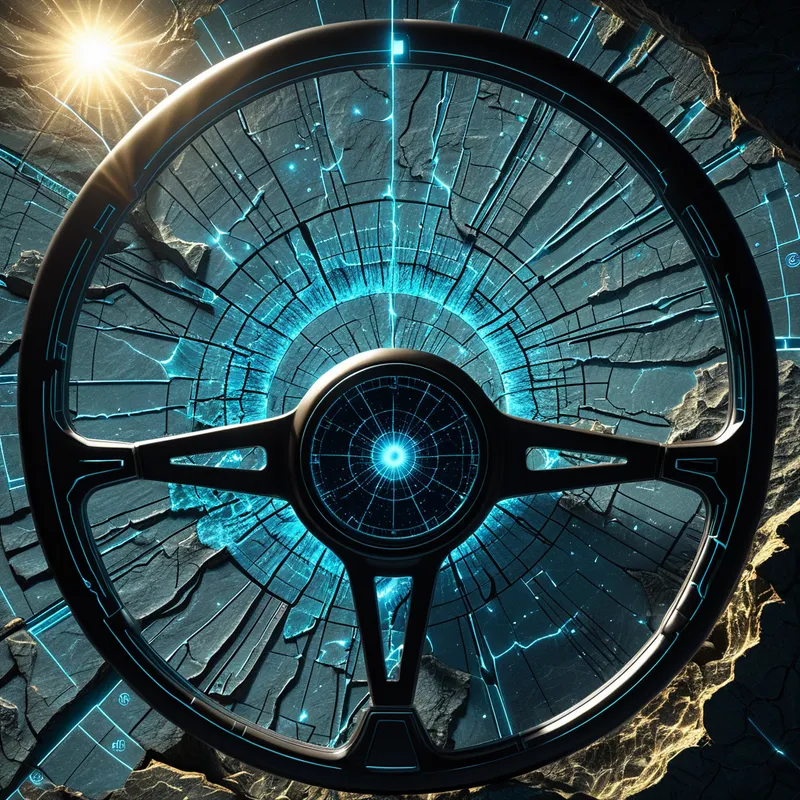
When this myth stirs in the modern unconscious, it often manifests in dreams of catastrophic driving or flying. The dreamer may be behind the wheel of a car that accelerates uncontrollably, hurtling toward a cliff or through a burning city. They may dream of piloting a plane or spacecraft they have no idea how to land, watching the fuel gauge plummet toward empty. The somatic feeling is one of sheer, helpless panic—a visceral knowing that one is in command of a powerful force but utterly devoid of control.
This dream pattern signals a critical phase in psychological development. The dreamer is likely in a situation where they have been granted, or have seized, a position, responsibility, or power for which they are not yet prepared. It is the promotion that feels fraudulent, the creative project that has grown monstrous, the identity built on a parent’s unfulfilled legacy. The psyche is sounding the alarm: the vehicle of the current life-direction is off-course and burning up the inner landscape. The dream is the thunderbolt warning, a call for a necessary, humbling correction before the entire system faces a crash.

Alchemical Translation
The alchemical journey modeled by Phaethon is the perilous but essential stage of inflation and its necessary mortificatio—the death of the inflated ego. In the process of individuation, one must eventually confront the “sun” within, the central source of consciousness and vitality. The mistake is to identify with it completely, to believe “I am the Sun-King,” rather than “I am a vehicle for a solar principle.”
The true alchemical goal is not to drive the chariot, but to learn its nature, to respect its path, and to find one’s rightful place in relation to its awesome power.
The first step is the recognition of the divine spark—the Phaethon moment of claiming one’s lineage. The fatal error is the attempt to possess it directly. The alchemical correction, the work following the thunderbolt, involves gathering the shattered pieces of the ambition from the waters of the unconscious (the river Eridanus). These pieces are the raw, humbled insights: the knowledge of one’s limits, the respect for the magnitude of natural law (both outer and inner), and the grieving of the grandiose self-image.
From this putrefactio in the deep river, a new substance can form—not amber tears of endless grief, but a solidified, translucent wisdom. The individual who integrates this myth does not become the Sun, but learns how to bear its light. They move from being the orphaned son desperately driving the chariot to becoming a conscious participant in the daily miracle of its rising and setting, understanding their role not as its master, but as a witness who has felt its heat and knows the price of its path. The father is reconciled not through imitation, but through understanding the distance between them, transforming the wound of absence into the space where one’s own authentic life can truly orbit.
Associated Symbols
Explore related symbols from the CaleaDream lexicon:
- Driver
- Spaceship
- Crash
- Shooting Star
- Heatwave
- Heat Index
- Chariot
- Rally Car
- Space Shuttle Launch
- Motorcycle Crash
- Abandoned Car
- Sports Car Race
- Etherial Spacecraft
- Chromatic Meteor
- Amber Stone
- Race Car
- Sports Car
- Shooting Star Game
- Racecar
- Screeching Tires
- Scorched Earth
- Ashen Skies
- Searing Heat
- Dry Heat
- Meteor
- Asteroid
- Perihelion