The Ladies of the Lake Myth Meaning & Symbolism
A mysterious, sovereign feminine power rises from the water, bestowing the sword of kings and claiming it back, embodying the deep, transformative unconscious.
The Tale of The Ladies of the Lake
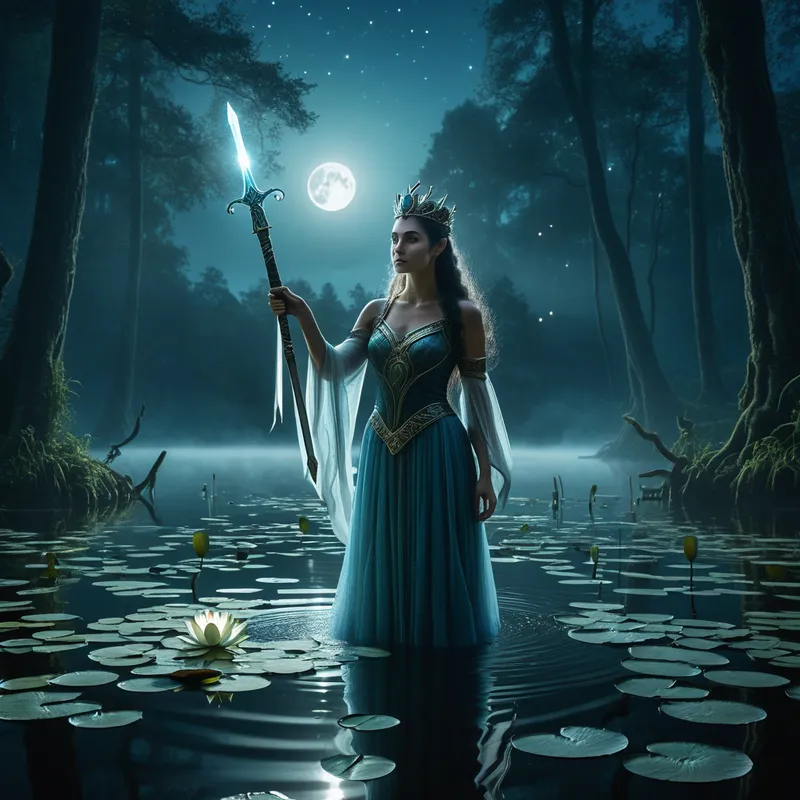
Listen, and hear a tale not of earth, but of the threshold. In the deep, silent heart of the ancient woods of Logres, where sunlight fractures into emerald dust, lies a lake that is no lake. Its waters are dark as polished obsidian by day, and silvered by the moon like a discarded mirror of the goddess. No bird sings on its shore. The very air holds its breath. This is the domain of the Ladies of the Lake.
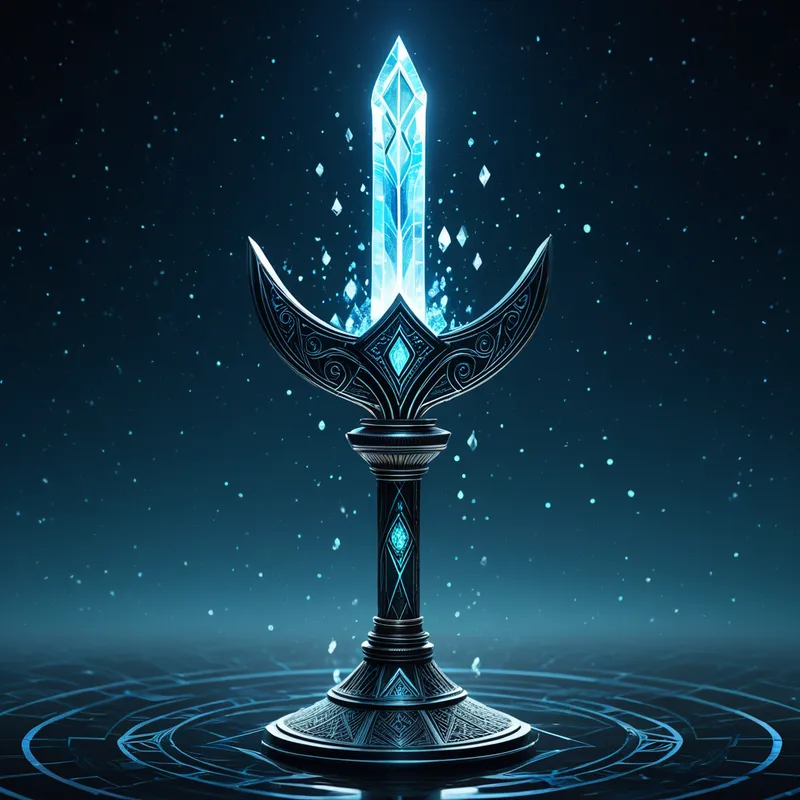
From these still waters, sovereignty is born. When the young Arthur Pendragon stood desperate, having drawn the sword from the stone yet lacking a blade to truly command a kingdom’s faith, it was to this place his mentor, the mage Merlin, led him. The mists coiled over the water, thick as wool. Then, a ripple—not from wind or fish—and an arm clad in samite, white as the heart of a lily, rose from the deep. The hand held a sword. Its hilt glittered with gems that held the light of drowned stars, and its blade was a shard of captured moonlight. Wordless, the arm offered it. Arthur, his heart pounding a rhythm older than his name, took the sword Excalibur, and with it, the mandate of heaven from a realm beneath the world.
But the waters give, and the waters claim. Years bled into legend. The great fellowship of the Round Table fractured, shattered by betrayal and a terrible, beautiful love. On the blood-soaked field of Camlann, Arthur lay mortally wounded, the world he built crumbling into twilight. His last loyal knight, Sir Bedivere, was given a sacred, unbearable command: cast Excalibur back into the water from whence it came.
Three times Bedivere went to the lake’s edge, the sword’s weight a world of guilt and glory. Twice, he could not bear the loss, hiding the blade among the reeds, claiming he had obeyed. But the dying king saw the lie in his eyes. “Do as I commanded,” he whispered, his voice the rustle of falling leaves.
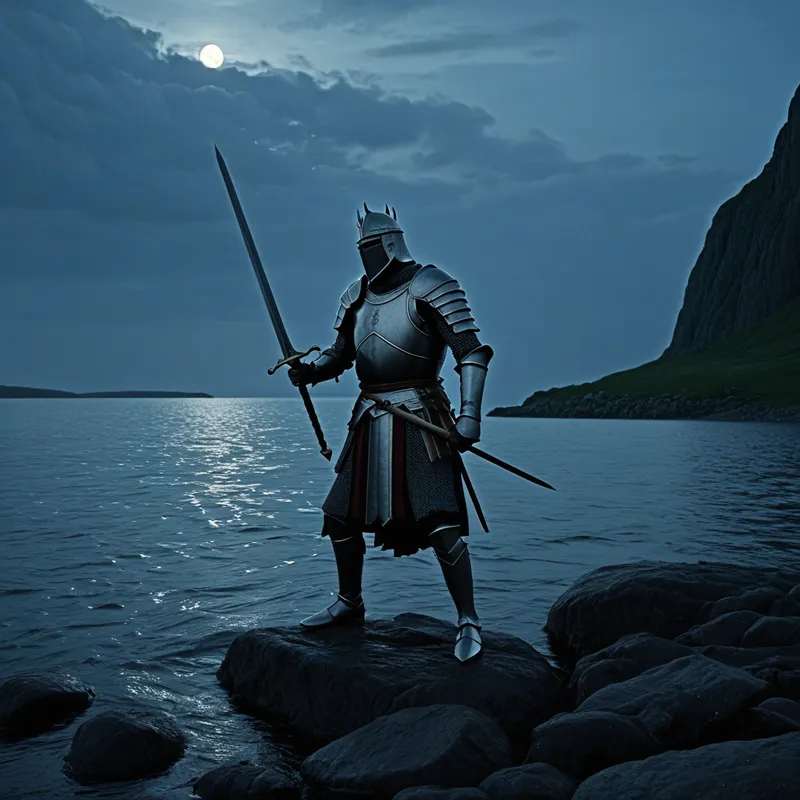
The third time, Bedivere stood on the cold shore, the lake a sheet of black glass under a ghostly moon. With a cry that was part grief, part release, he hurled the sword in a wide, spinning arc. Before it could touch the water, that same arm, clad in white samite, rose to meet it. A hand grasped the hilt, brandished the sword three times in a silent, sacred blessing, and then drew it down, down into the unfathomable dark. A final ripple, and the lake was still, holding its secret once more. The Lady had reclaimed her gift, her covenant fulfilled. The age of magic was withdrawing, sinking back into the deep, leaving the world to men and memory.
Cultural Origins & Context
The figure of the Lady of the Lake is a shimmering, elusive thread woven through the vast tapestry of Arthurian romance, primarily emerging in the later, more elaborate French prose cycles of the 13th century, such as the Vulgate Cycle and Post-Vulgate Cycle. Earlier Celtic mythology is rich with water deities and fairy women—like the Tuatha Dé Danann or the Welsh Gwragedd Annwn—who dwell in lakes and mounds, bestowing gifts and laying geasa (taboos) on heroes. The Lady is a direct descendant of these sovereign, often perilous, feminine powers of the Otherworld.
Her primary narrators were courtly poets and monastic scribes who transformed older oral bardic tales into written chivalric epics. Her societal function was multifaceted. For a feudal audience, she legitimized Arthur’s kingship through a supernatural, non-ecclesiastical authority, placing his right to rule beyond pope and peerage, rooted in the ancient land itself. For the knights and ladies listening, she embodied the mysterious, often inscrutable, court of love and fate—a feminine principle that could grant the ultimate tool of masculine power (the sword) and then demand its return, teaching a lesson in humility, cyclicality, and the transient nature of earthly glory.
Symbolic Architecture
The lake is the central symbol—it is the unconscious itself. Not a shallow pond of personal memory, but the vast, collective, primordial depths from which archetypal forms emerge. The Lady is the personification of the unconscious’s guiding, transformative aspect, what Jung might term the anima in her most developed, sovereign form. She is not a mother, but a queen of the deep.
The sword from the stone establishes a king in the world of men; the sword from the lake establishes a king in the world of soul.
Excalibur is more than a weapon; it is discriminative consciousness, the power to cut through illusion, to make decisive moral choices, to establish order (the kingly function). That it comes from the water is critical. True consciousness, this symbolism insists, is not born from brute will or intellect alone, but must be received from engagement with the deep, feeling, intuitive unconscious. The arm “clad in white samite” signifies this process: the unconscious reaches up, offering the tool of conscious differentiation. The final act, the return of the sword, is perhaps the myth’s most profound alchemical instruction. It signifies the necessary dissolution of a hardened, outworn conscious attitude (the king must die) and the reintegration of that conscious power back into the unconscious, completing the cycle. The ego’s greatest tool must be surrendered to the soul.
The Dreamer's Resonance
When this myth stirs in modern dreams, it often manifests in periods of profound transition or crisis of identity. To dream of a mysterious, calm body of water—a lake, a well, a pool in a forest—suggests the dreamer is at the shore of their own depths. The appearance of a helpful, yet authoritative, feminine figure offering a tool (a key, a book, a crystal) mirrors the gift of Excalibur. The dream-ego is being presented with a new capacity for discernment or a mandate for a psychological “rule” they feel unprepared for.
Conversely, dreaming of being commanded to throw something precious into water speaks to the process of sacrifice and release. The somatic feeling is often one of acute resistance, a clutching in the chest, followed by an immense, watery relief upon letting go. This is the Bedivere moment. The psyche is orchestrating the surrender of an outmoded complex, a long-held identity (“the hero,” “the leader,” “the one who has it all figured out”), back to the unconscious for recycling and renewal. The dream may not show the arm catching the gift; the anxiety lies in the act of trust itself.

Alchemical Translation
The myth of the Lady models the complete arc of individuation. It begins with the nigredo, the dark, confused state (Arthur without a true sword, the wounded king). The journey to the lake is the seeking, the solutio—dissolving into the watery realm of the unconscious. The reception of the sword is the albedo, the emergence of illuminating consciousness and a new, soul-anointed identity.
The final and most critical operation is the rubedo: the return of the achieved consciousness, now reddened with the blood of life experience, to its source, achieving the philosopher’s stone of integrated wholeness.
For the modern individual, this translates not to literal kingship, but to the achievement and subsequent surrender of any hard-won conscious position. We spend years forging an identity—the successful professional, the perfect parent, the enlightened seeker. This is our Excalibur. The alchemical work, as the myth dictates, is to know when that identity has served its purpose and become a prison. The “wounded king” is the part of us clinging to an old self. The healing requires the courageous, trusting act of throwing that prized identity back into the lake of soul, not knowing what will emerge. We must trust the Lady—the deep, Self-regulating psyche—to receive it. In that surrender, we are not left empty, but paradoxically made whole. The power is not lost; it is transmuted from a tool of ego into a quality of being. The lake holds it all, and we, having completed the cycle, become living vessels of its deep, still wisdom.
Associated Symbols
Explore related symbols from the CaleaDream lexicon: