Bayeux Tapestry Myth Meaning & Symbolism
A monumental embroidered chronicle depicting the Norman Conquest of England, a story of oaths, betrayal, and destiny woven into linen.
The Tale of Bayeux Tapestry
Hear now the tale that is not sung, but stitched. It is a story told in silence, with needle and thread, upon a cloth longer than a dragon’s shadow. In the year of our Lord 1066, the threads of fate were pulled taut.
In the land of the English, a king sat upon a throne of oak and sorrow. Edward the Confessor, his soul more bent toward prayer than progeny, let his life slip away like sand through an hourglass. And into that vacuum of power rushed the breath of giants. From the north came Harold Godwinson, swift and bold, seizing the crown with the assent of the witans. But from across the silver sea, from the duchy of Normandy, a storm was brewing. William the Bastard—soon to be called Conqueror—sharpened his sword and his claim. He swore that Harold, once his guest, had pledged an oath upon holy relics, vowing to support William’s right. An oath now shattered, a betrayal written in the very stars.
For the heavens themselves bore witness. A star with hair of fire, the comet, streaked across the vault of night. Men pointed with trembling fingers, reading in its silent scream a portent of kingdoms overturned. William heeded the sign. He called his carpenters, and the forests fell. The sound of adzes filled the air, and from the timber rose a forest of masts—a fleet of dragons born not of scale, but of oak and pine. Horses, snorting and wild-eyed, were led onto the decks, their hooves clopping on wood soon to be washed by salt spray.
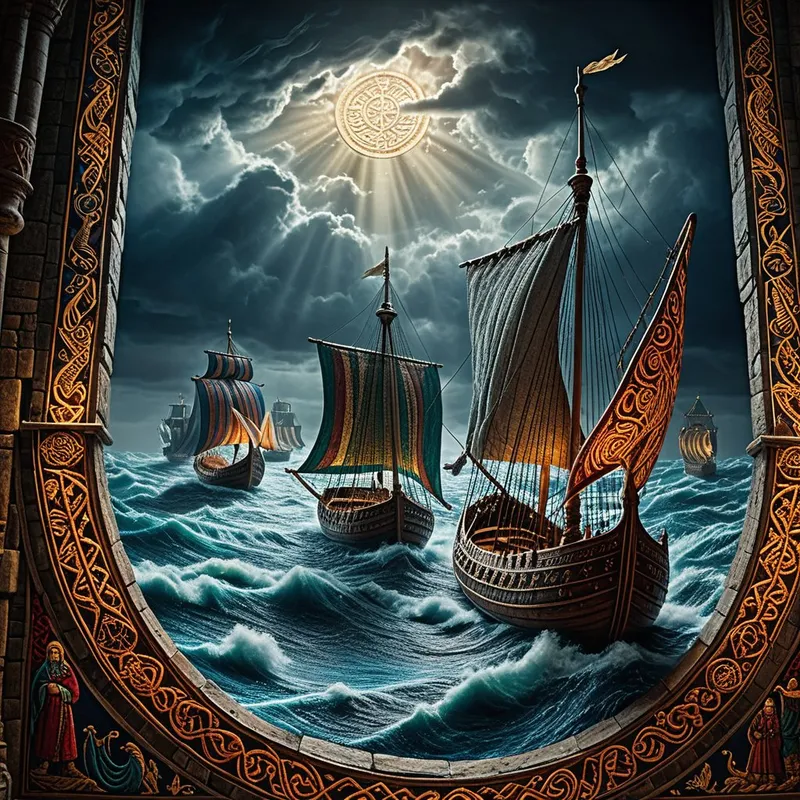
Then came the crossing. The Channel, that grey and moody moat, swallowed the fleet. The tapestry shows it not as a journey, but as a procession of destiny, each ship a stitch in a divine plan. They landed on the coast of Pevensey, unopposed, and William stumbled as he stepped onto the foreign shore. A gasp went through his men—a terrible omen! But the Duke, with a conqueror’s alchemy, grasped the earth and rose, crying, “See! I have taken England with both hands!” The bad omen was spun into a prophecy of possession.
The threads then lead us to the hill of Senlac, near Hastings. Here, the story is told in a frenzy of stitch-work. The English wall of shields, the huscarls standing shoulder to shoulder like a cliff. The Norman cavalry, a tempest of horse and lance, crashing against it again and again. The air thick with the thrum of arrows, the screams of men and beasts. And at the heart of the chaos, the fate of a kingdom hangs on a single, misread command. The Normans feign retreat; the English line breaks in pursuit. The trap is sprung. The tapestry shows the moment of Harold’s end—not with clear historicity, but with mythic ambiguity. Is he the figure struck in the eye by an arrow? Is he the warrior cut down by a knight’s sword? The threads do not say for certain; they only show the fall. The king is slain, and with him, an age of England dies.
The final panels are not of battle, but of coronation. In Westminster, William takes the crown. The English lords, their faces stitched with resignation, offer their allegiance. The story ends, but the cloth does not. Its final, frayed edge hints at more to come, an unfinished sentence in a thread. The conquest is complete, but the tale is forever being woven.
Cultural Origins & Context
The Bayeux Tapestry is a unique artifact, a hybrid of document, propaganda, and sacred narrative. Created likely in England within a decade of the events it depicts, probably for Odo, Bishop of Bayeux, it served a clear societal function: to legitimize a violent regime change. It is not a book for the literate few, but a public spectacle for the many—a “cinema” of the 11th century, to be unfurled along the walls of a cathedral or great hall.
Its storytellers were not bards, but needleworkers—likely teams of skilled embroiderers, perhaps in workshops like that at Canterbury. They translated a Norman-French perspective into a visual epic that could be “read” by both conqueror and conquered. It passed down not through recitation, but through display, teaching a newly subjugated people the official story: that William’s cause was just, Harold’s oath was broken, and God’s will was manifest in the comet and the victory. It is foundational myth-making in real-time, stitching a new political reality into the cultural fabric.
Symbolic Architecture
The Tapestry is less a simple chronicle and more a symbolic architecture of power, narrative, and fate. Its central entity is not a person, but the story itself—the curated narrative that justifies action and solidifies legacy.
The conqueror does not just win the battle; he wins the right to tell the story. The tapestry is the loom on which raw history is spun into the golden thread of legitimacy.
Harold represents the oath-breaker shadow, the man whose personal ambition (or political necessity) collides with a sworn vow, inviting divine and worldly retribution. William is the ruler archetype in its most decisive form, one who transforms a stumble into a symbol of possession, alchemizing accident into agency. The comet is the ultimate symbol of an impersonal, cosmic fate intersecting human affairs—a sign everyone sees, but only the destined can correctly interpret.
Most profoundly, the medium is the ultimate symbol. The linen strip, with its borders of fables and earthly concerns, frames the central narrative. It suggests that history is a constructed fabric, a selective weaving of events into a coherent, linear pattern. What is omitted is as telling as what is included. The violence is stylized, the bloodshed aestheticized. The Tapestry symbolizes the human urge to take the chaotic, brutal, and ambiguous stuff of reality and embroider it into a story with a beginning, a moral, and an end.

The Dreamer's Resonance
To dream of the Bayeux Tapestry is to dream of the stories that bind you. It may manifest as a vast, endless scroll unfurling in a dream space, depicting not Norman knights, but scenes from your own life—key decisions, broken promises, moments of conquest or defeat. You might be both the viewer and a figure within the embroidery, feeling the stiff pull of the thread that dictates your movement.
This dream points to a psychological process of narrative integration. The somatic feeling is often one of being scrutinized or of trying to read a text that is just out of focus. It asks: What is the official story you tell about your life? What oaths (to yourself or others) have been bent or broken in your rise? Where have you, like William, turned a stumble into a claimed victory, or where have you, like Harold, been blindsided by a consequence you thought you could avoid? The dream calls you to examine the “border scenes” of your psyche—the instinctual, animalistic, or mundane drives (often shown in the Tapestry’s upper and lower margins) that frame your central, conscious narrative.

Alchemical Translation
The alchemical journey modeled by the Tapestry is the transmutation of chaos into legacy. The prima materia is the bloody, contested, ambiguous event—the Battle of Hastings and its fraught prelude. The process is one of intense, meticulous narrative distillation.
Individuation requires us to become the weaver of our own tapestry. We must take the scattered, often warring, events of our personal history and consciously, deliberately, stitch them into a coherent whole—not to falsify, but to find meaning.
First, one must acknowledge the oath and the comet—the personal commitments and the external, fateful events that have shaped your path. This is the nigredo, the blackening, facing the shadow of betrayal and ambition. Then comes the crossing and the stumble—the decisive action into the unknown (albedo), and the subsequent “mistake” or crisis that must be consciously re-framed as part of the journey. William’s alchemy was to declare the stumble a taking of hold. Our psychological alchemy is to integrate failure and accident into our sense of self, not as flaws, but as formative threads.
Finally, the weaving of the crown (rubedo). This is the conscious act of creating your personal myth. It is not about claiming conquest over others, but about achieving sovereignty over your own story. It is the recognition that while you cannot control all events, you hold the needle and thread of meaning. You choose which scenes to emphasize, which borders to draw, and how to depict your struggles. The finished work—your integrated self—is not a lie, but a profound truth: the truth of a life rendered meaningful through the courageous act of its own narration. The Tapestry ends, but your weaving continues.
Associated Symbols
Explore related symbols from the CaleaDream lexicon: