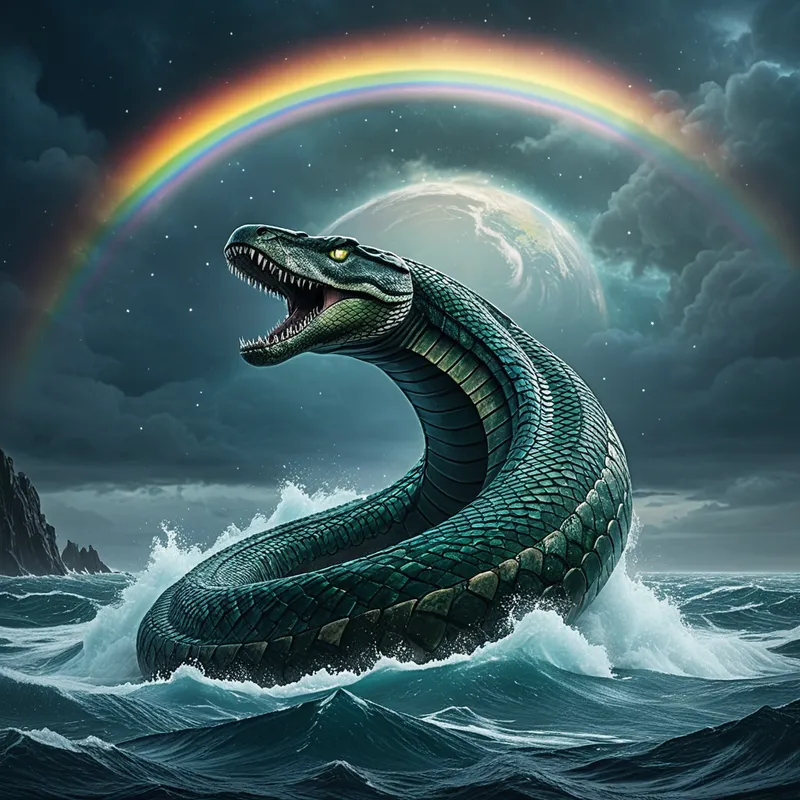
The serpent Jörmungandr in Nor Myth Meaning & Symbolism
The serpent that encircles the world, born of chaos, destined to rise and fight the gods at the end of all things, only to begin again.
The Tale of The serpent Jörmungandr in Nor
Listen, and hear the tale of the great encircler, the doom that sleeps in the deep. In the time before time, when the breath of the giant Ymir still misted the void, the gods of Asgard looked upon the children of Loki and saw only a gathering storm.
From the giantess Angrboða, Loki sired three: a wolf whose howl would crack the sky, a daughter half-alive and half-corpse, and a serpent. But this was no mere snake. It grew with a hunger that mirrored the void itself, its body lengthening, thickening, coiling with a power that was ancient and cold. The All-Father, Odin, saw its destiny written in the wells of Urd. This child of chaos and cunning would be the binder and the bound.
With a decree that shook the roots of Yggdrasil, Odin commanded the serpent be cast out, not to Jotunheim, nor to the misty halls of the dead, but into the great ocean that girdles Midgard. The waters, vast and salt-bitter, received the beast. And there, in the lightless deeps where Aegir’s halls glimmer with drowned gold, the serpent grew. It grew until its head could meet its tail, until its scalied spine formed a perfect, terrible ring around all the lands of men. Jörmungandr became the boundary, the living limit of the known world, sleeping with the weight of the deep upon it.
Yet fate is not a straight road. The thunder god, Thor, whose rage is the summer storm, became the serpent’s fated foe. Their enmity was written in the runes. Once, fishing with the giant Hymir, Thor baited his hook with the head of a great ox and cast his line into the serpent’s realm. The bite was a convulsion of the world-ocean itself. With godly strength, Thor hauled the horror to the surface—a mountain range of wet scale and primal muscle, eyes like poisoned moons, venom spraying from jaws wide enough to swallow the sun. The sea boiled. The sky wept. For a moment, the doom of the world was held aloft on a fishing line, and Thor raised his hammer, Mjölnir, to strike. But Hymir, in terror, cut the line. The serpent sank back with a sound that was the sigh of the abyss, and the waves closed over a grudge that would only deepen.
This is but a rehearsal. For the prophets whisper of Ragnarök, the twilight where all bonds break. Then, the great serpent will stir. Its coils will tighten, churning the oceans into a frothing maelstrom as it heaves its impossible bulk onto the land. The earth will shake loose from its embrace. And on that final, rain-lashed plain, Thor and Jörmungandr will meet for the last time. Thunder will clash with venom, the defender of order against the embodied chaos. Thor will strike the killing blow, crushing the serpent’s skull. But as the monster dies, it will exhale its final breath—a mist of such absolute poison that the god of thunder will stagger back nine paces and fall, his world saved and lost in the same moment. The circle will be complete, the ouroboros of existence biting its own tail, so that from the silence that follows, a new world, green and tender, may slowly uncoil.
Cultural Origins & Context
The myth of Jörmungandr is woven into the poetic and prose texts of Old Norse literature, primarily the Poetic Edda and the Prose Edda. These were not holy scriptures, but a tapestry of stories preserved by skalds (poets) and scholars in medieval Iceland, a culture with a deep, pragmatic relationship with a hostile sea and an unforgiving landscape. The myth functioned as a cosmological map and a philosophical framework. It explained the literal boundaries of the world (the ocean as a terrifying, infinite ring) and the metaphysical boundaries of order. In a worldview where chaos (Ginnungagap) was the first state, the gods’ act of casting out the serpent was an ongoing act of creation—imposing form on the formless. The story was told in halls smoky with firelight, a reminder that civilization is a temporary clearing in an eternal wilderness, and that the sea, the winter, and the unknown are always waiting to reclaim their own.
Symbolic Architecture
Jörmungandr is the ultimate symbol of contained chaos. It is not mindless evil, but a primordial, amoral force that exists in necessary tension with the structures of consciousness and society (represented by the gods of Asgard).
The serpent does not seek to destroy the world from without; it is the world, in its raw, unprocessed, and terrifying aspect. To encounter it is to encounter the unconscious foundation upon which the ego is built.
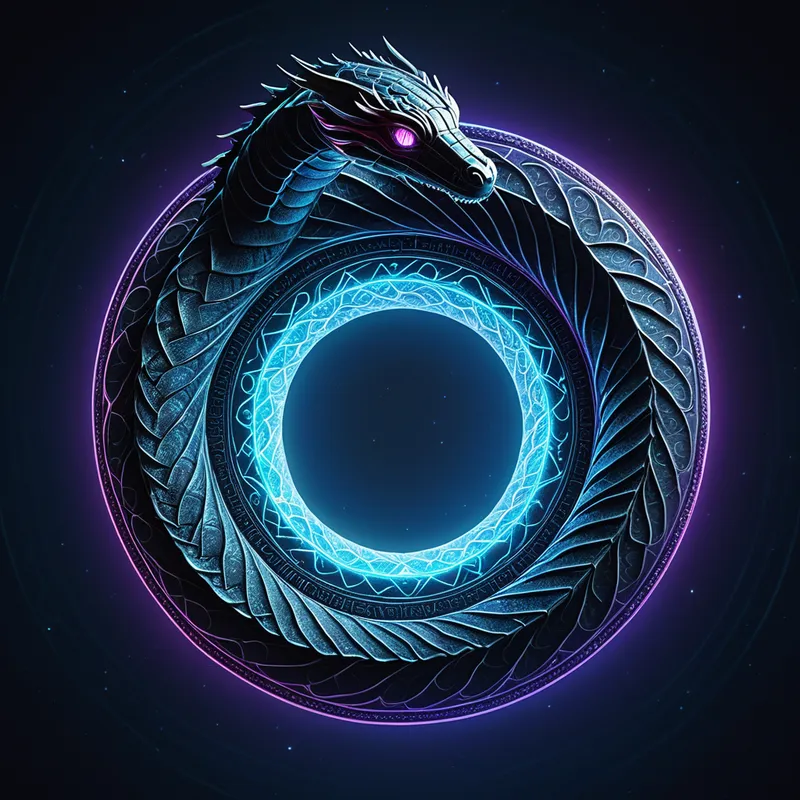
Psychologically, Jörmungandr represents the totality of the personal and collective shadow—all that we have cast out of our conscious lives into the "deep sea" of the unconscious. Its circular form, the Ouroboros, signifies self-containment, eternity, and the cycle of destruction and renewal. The myth tells us that we cannot kill this force without killing a part of ourselves (as Thor dies from its venom). The goal is not annihilation, but a dynamic, tense, and aware relationship with it. The serpent’s containment in the ocean is the necessary repression that allows culture to function; its release at Ragnarök is the inevitable return of the repressed, which, while catastrophic, is also the only path to renewal.
The Dreamer's Resonance
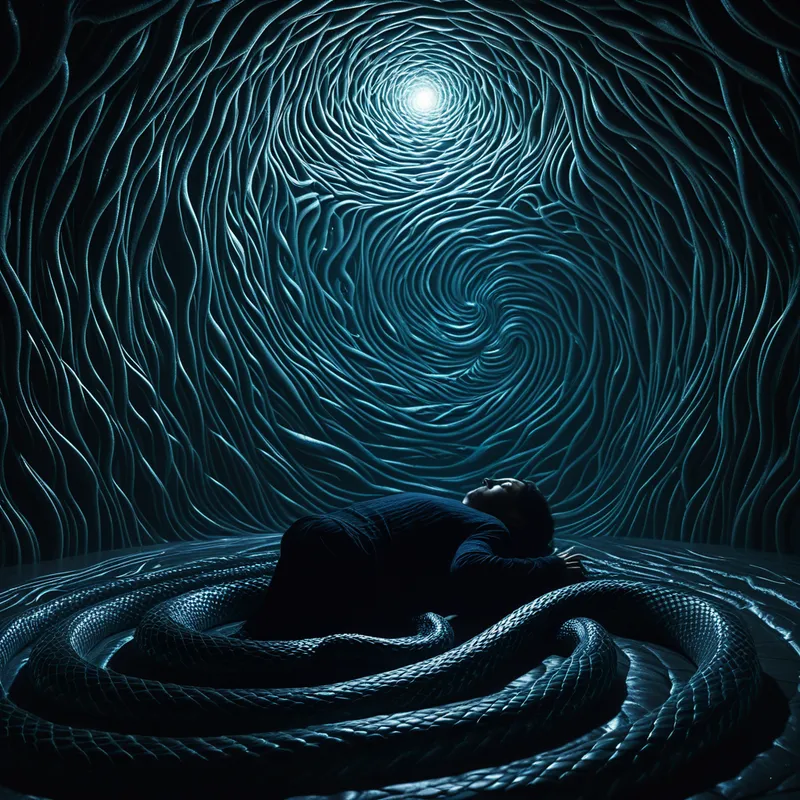
When the World Serpent surfaces in modern dreams, it rarely appears as a literal monster. Its presence is felt somatically: as a crushing pressure around the chest (the encircling coils), a feeling of being overwhelmed by a vast, impersonal force (the rising sea), or a confrontation with something so immense it defies comprehension. The dreamer may be in a boat on a suddenly hostile ocean, or see a dark, sinuous shape moving beneath the floorboards of their home—the unconscious rising into the architecture of the conscious mind.
This dream signals a profound psychological process: the ego’s defensive structures are being pressured by contents of the unconscious that have grown too large to ignore. The "fishing trip" with Thor is akin to a conscious attempt (perhaps through therapy, art, or crisis) to "hook" and confront this deep-seated material. It is a dangerous, volatile operation. The dream may end with the serpent sinking back down, suggesting the ego is not yet ready to integrate the sheer scale of what it has glimpsed. The somatic feeling of constriction points to an aspect of the dreamer’s life or self-concept that has become too tight, too limiting, and is now threatening to break apart from an inner pressure.
Alchemical Translation
The alchemical journey mirrored in this myth is the opus contra naturam—the work against nature, which is really the work of transforming nature (prima materia) into gold (the integrated self). Jörmungandr is the prima materia, the chaotic, poisonous, and foundational substance at the start of the work.
The first step is separatio: the casting out. The ego must differentiate itself from the undifferentiated swamp of instinct and archetype. This is Odin’s decree. It is necessary, but it creates the shadow.
The fishing expedition is the stage of solutio (dissolution) and coagulatio (coagulation). The ego (Thor) ventures into the watery unconscious (the sea) to retrieve and solidify the hidden content. This is the moment of confrontation, where the shadow is seen in its full, terrifying glory. The failed kill is crucial; it teaches that the goal is not to defeat the unconscious, but to engage with it.
The final alchemy is at Ragnarök, which represents the mortificatio and putrefactio—the death and rotting necessary for new life. The ego (Thor) and the shadow (Jörmungandr) mutually annihilate each other in their most rigid, identified forms. The poison that kills Thor is the toxic residue of the long repression; one cannot engage with the deepest shadow without being fundamentally altered by it.
The triumph is not in survival, but in the completion of the cycle. The serpent’s death loosens its grip on the world, allowing for the renovatio—the renewal. For the individual, this translates to the dissolution of an old, outworn personality structure (the world that was) so that a more conscious, more inclusive sense of self (the green, new world) can emerge from the waters. One does not slay their deepest chaos. One meets it, is transformed by it, and in that fatal embrace, makes room for a rebirth. The serpent’s tail, forever seeking its mouth, reminds us that this is not a linear path to perfection, but an eternal, spiraling process of becoming.
Associated Symbols
Explore related symbols from the CaleaDream lexicon: