The Nine Worlds Myth Meaning & Symbolism
A cosmic tree connects nine realms, from the gods' home to the land of the dead, embodying a universe in constant, sacred tension.
The Tale of The Nine Worlds
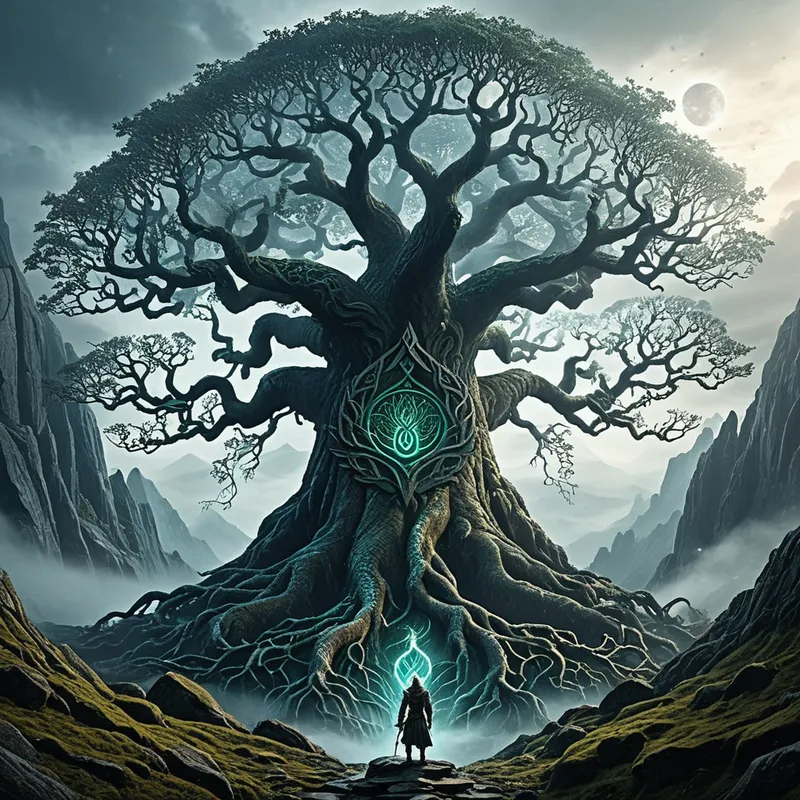
Listen. Before the first fire, before the first frost, there was the Ginnungagap—the yawning void. From its meeting of ice and flame, life stirred. And from that life grew a great ash, greater than any mind can hold. Its name is Yggdrasil, and it is the axis of all that is, was, and will be.
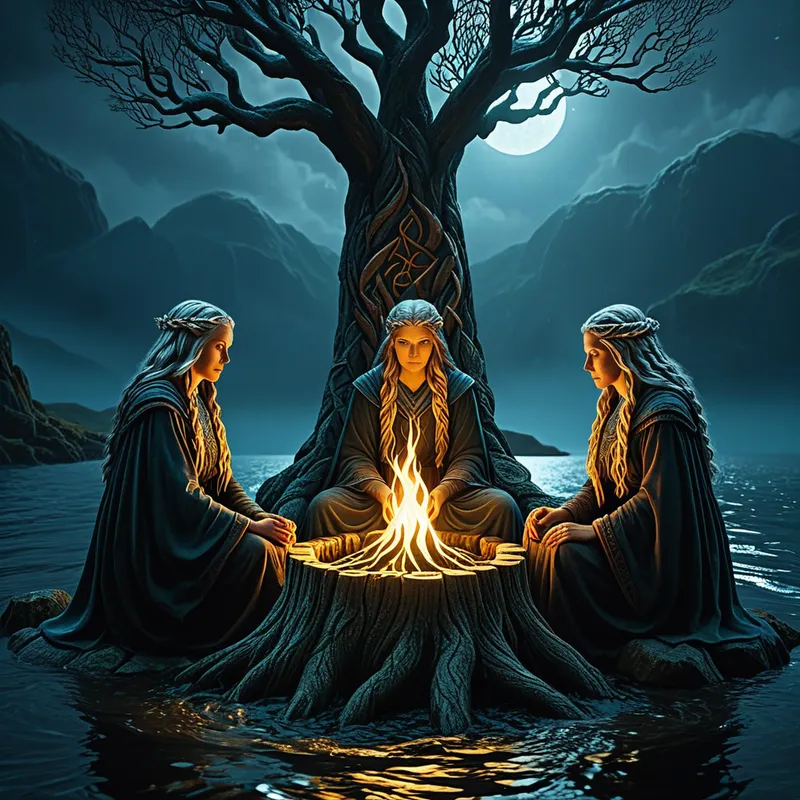
Its three great roots drink from three secret wells. One, the Well of Urd, is guarded by three ancient sisters, the Norns. Here, they weave the threads of destiny for gods and mortals alike, their whispers the law of the cosmos. Another root gnaws at the spring of Mimir, where wisdom and memory flow at a terrible price. The third seethes in the misty realm of Niflheim, where the great dragon Nidhogg chews relentlessly, its venom dripping into the dark waters.
High in the highest branches lies Asgard, home of the Aesir. Its halls of silver and gold—Valhalla, Fensalir—gleam in the eternal light. Here, Odin the All-Father sits upon his high seat, his one eye seeing across all the worlds. Below, connected by the shimmering bridge Bifrost, is Midgard, our world, encircled by the great world-serpent Jormungandr.
To the east lies Jotunheim, a land of raw mountains and ancient, cunning giants. To the west is Vanaheim, home of the fertile and wise Vanir. Below, in the earth's warmth, the dwarves toil in Svartalfheim, forging wonders and curses from the bones of the world. In the light-soaked heavens, the elves dance in Alfheim. And in the cold, silent north, the dead who did not die in battle journey to Hel, a realm of quiet mist and remembrance.
This is not a static picture. It is a living, breathing, suffering organism. The eagle screams from the highest bough; the serpent hisses from the deepest root. Between them, the squirrel culture.") Ratatoskr runs, carrying messages of malice, feeding the strife. Four great stags nibble at the tree's leaves. The dragon never ceases its gnawing. The tree groans, but it holds. It must hold. For this delicate, agonizing balance is the cosmos. It is a world always on the verge of collapse, yet sustained by a sacred, dynamic tension—a tension that one day, the prophecies say, will finally snap.
Cultural Origins & Context
This cosmological map was not written in a single sacred text, but breathed into existence across centuries in the cold, fierce lands of the Norse peoples. It was carried on the breath of skalds—poet-bards—around crackling longfire hearths, recited in the rhythmic, alliterative verses of the Eddic poems. These stories were the framework of reality, explaining not just the where of things, but the how and why.
The myths were recorded later, primarily in 13th-century Iceland, in texts like the Prose Edda by Snorri Sturluson. Snorri was a Christian scholar trying to preserve a fading pagan tradition, which means our view is filtered, yet it remains the most comprehensive window we have. The societal function was profound: the Nine Worlds model enforced a worldview of interconnectedness, sacred duty, and inevitable conflict. It taught that order (orlog) was not a given state but a constant achievement, maintained by the gods through sacrifice, wisdom, and force, against the ever-present entropy of the giants and the void.
Symbolic Architecture
The myth of the Nine Worlds is not merely a map of places, but a profound blueprint of the psyche and the nature of existence.
The cosmos is not a hierarchy with heaven at the top and hell at the bottom. It is an ecology—a single, wounded, sacred system where every realm, from the highest god to the gnawing worm, is essential to the whole.
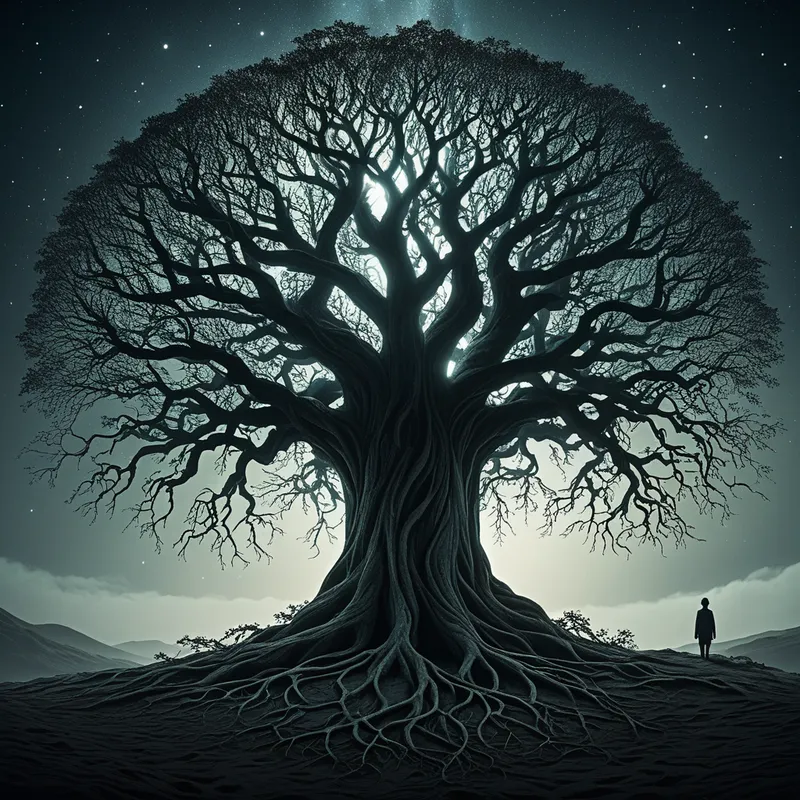
Yggdrasil is the ultimate symbol of the interconnected Self. Its roots in the wells of fate, memory, and primordial chaos represent the deep, often unconscious foundations of our being—our inherited patterns, our traumas, our ancestral wisdom. Its trunk is the conscious ego, holding the space. Its branches are the aspirational heights of spirit, intellect, and culture we reach toward.
The realms are not separate "places" but interdependent states of consciousness. Asgard is the realm of conscious ideals, order, and sovereignty—the part of us that seeks to rule and understand. Midgard is our lived, embodied experience. Jotunheim is the raw, chaotic, and creative power of the unconscious, the home of giants who are both destroyers and the source of all new life. Hel is not a place of punishment, but of necessary dissolution, where what is no longer needed is composted into memory.
The constant strife—the eagle and serpent, the gnawing dragon, the gossiping squirrel—symbolizes the essential tensions that drive growth. Consciousness versus the unconscious, order versus chaos, memory versus forgetting. The system is not peaceful; it is alive precisely because it is under stress.
The Dreamer's Resonance
When the architecture of the Nine Worlds appears in modern dreams, it signals a profound reorganization of the psyche. The dreamer is not just having a dream; they are mapping their inner cosmos.
To dream of climbing a vast, suffering tree whose roots are in dark waters is to confront the foundational layers of the self. The somatic feeling is often one of immense weight and simultaneous uplift—a literal feeling of being stretched between depths and heights. To find oneself in a cold, misty hall (Hel) may reflect a necessary psychological "death," a period of depression or stagnation where an old identity is being stripped away. A dream of a shimmering, fragile bridge (Bifrost) breaking underfoot speaks to a crisis of connection between one's ideals and one's reality.
These dreams indicate the psyche is actively working to perceive itself not as a single, monolithic "I," but as a constellation of different realms of being, each with its own inhabitants (complexes, archetypes) and laws. The terror and awe in such dreams come from the realization of this vast, internal multiplicity and the sacred duty to maintain the connections.
Alchemical Translation
The individuation process—the alchemical work of becoming a whole, integrated Self—is perfectly modeled by the myth of the Nine Worlds. It is not about ascending to a pure, spiritual Asgard and rejecting the lower realms. That is a fatal spiritual pride the Norse called hubris.
True wholeness is not the victory of light over dark, but the conscious stewardship of the entire tree, from the highest leaf to the deepest, most gnawed-upon root.
The alchemical journey begins in Midgard, our conscious life. The call to adventure is the realization that this middle world is connected to others. The seeker must, like Odin, make a descent—a sacrifice of a naive worldview (the "eye") to drink from the well of Mimir, integrating painful wisdom and memory. They must journey to Jotunheim to confront the chaotic, creative giants of the shadow, and to Hel to accept mortality and loss.
The goal is to become the Yggdrasil itself. The integrated individual is the one who can hold the tension between the soaring eagle of spirit and the chthonic serpent of instinct. They acknowledge the squirrel Ratatoskr—the inner critic, the gossip, the provocateur—as a part of the system, not an enemy to be silenced. They understand that the dragon Nidhogg's gnawing is a necessary corrosive force, dismantling what is rotten so new growth can occur.
In the end, the myth teaches that wholeness is dynamic, fragile, and earned through constant attention. The cosmos is a tree that groans, and our individuated Self is the same: not a state of perfect, static peace, but a living, breathing, sacred struggle that holds all nine worlds within.
Associated Symbols
Explore related symbols from the CaleaDream lexicon: