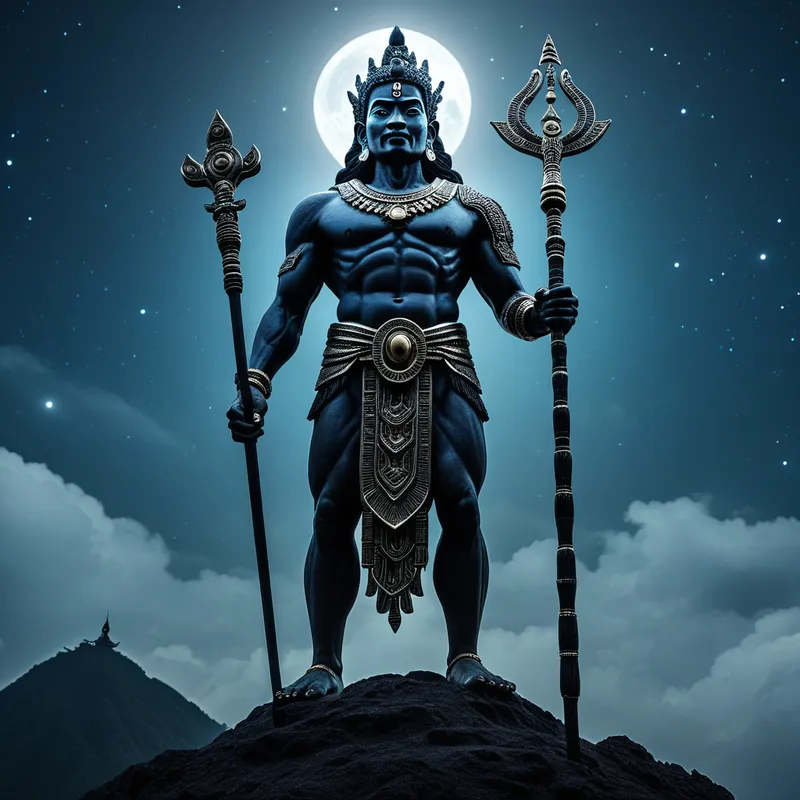
Sidapa Myth Meaning & Symbolism
The myth of Sidapa, the god who measures life on a sacred tree, explores the cosmic balance of fate, time, and the inevitability of death.
The Tale of Sidapa
Listen, and hear the tale whispered by the winds of Mount Madja-as. In the time before memory, when the world was young and the sky was closer to the earth, there lived a god whose name was spoken in hushed tones. He was Sidapa, lord of the final journey, keeper of the great ledger.
He did not dwell among the glittering courts of the sky gods, nor in the sun-drenched realms of the harvest deities. His domain was the silent, mist-shrouded peak of Madja-as, a place where clouds clung to ancient stone and the air grew thin with eternity. There, upon that lonely summit, grew a single, colossal balete tree. Its roots gripped the mountain’s heart; its branches were a lattice against the stars. This was no ordinary tree. It was the Tree of Life, the sacred scroll upon which all destinies were written.
When a new soul was breathed into the world, when a child drew its first gasp, Sidapa would feel the tremor in the mountain’s bones. He would ascend to his lonely post. From the folds of his dark cloak, he would produce a tool of cosmic measure—some say a blade, others a stylus of pure starlight. With a hand that was neither cruel nor kind, but utterly precise, he would carve a single, deep mark into the living bark of the great balete. That mark was the measure of that soul’s days. Its height upon the trunk was the span of its life.
The people below would look up at the shrouded peak, feeling the weight of that invisible inscription. They lived their lives in the shadow of the mountain, their joys and sorrows unfolding beneath the silent gaze of the measurer. They knew that when the mark reached its ordained end, when the final grain of sand fell in the celestial hourglass, Sidapa would descend. Not as a fearsome reaper, but as a solemn guide. He would come to claim the soul, to sever the silver cord that bound it to the flesh, and escort it across the final threshold to Saad.
This was the eternal order, the rhythm of the cosmos—the carving, the waiting, the claiming. Until the day the cosmic balance was challenged. For there was another god, Bulalakaw, a deity of fire and conquest. He looked upon Sidapa’s quiet, absolute authority with envy and rage. He saw not order, but a prison. He vowed to shatter the tree and burn the ledger of fate, to make men immortal and subject only to the glory of battle.
The conflict was cataclysmic. Bulalakaw, in the form of a fiery comet, hurled himself against the slopes of Madja-as. The world shook. Forests burned. But Sidapa stood firm upon his mountain. He did not meet fire with fire, but with the implacable, chilling certainty of the void. He wielded the cold of the grave, the silence of the deep earth. Where Bulalakaw’s heat sought to expand and destroy, Sidapa’s power contracted and preserved—the ultimate preservation of the natural law.
The battle ended not with a victor’s shout, but with a reaffirmation of the cosmic design. Bulalakaw was cast down, his fiery ambition cooled. And the great balete tree, though scarred, stood firm. Sidapa returned to his vigil, his mark-making uninterrupted. The myth tells us that to this day, if you listen very closely in the deep silence of the mountain night, you might hear the faint, deliberate sound of a god carving another destiny into the living wood of the world.

Cultural Origins & Context
The myth of Sidapa originates from the pre-colonial Visayan peoples, specifically those of Panay Island. It was not a story confined to parchment, but one carried in the oral traditions of the babaylan—the priestesses and keepers of ancestral wisdom. Recited during rituals, invoked in times of pestilence or birth, the tale served as a fundamental cosmological map.
Its societal function was profound. In a world without written contracts or insurance, the myth provided a framework for understanding the most terrifying of human unknowns: death. Sidapa was not a monster to be feared irrationally, but a divine administrator of a necessary, natural law. His existence explained the "why" of mortality, transforming a random tragedy into a part of a sacred, measured order. It taught acceptance, not fatalistic resignation, but a conscious alignment with the rhythms of existence. The myth also reinforced the sacredness of the natural world—the mountain and the tree were not mere settings but active, divine participants in the drama of life and death.
Symbolic Architecture
At its core, the myth of Sidapa is a profound meditation on the architecture of existence, where time, fate, and consciousness intersect.
The sacred tree is not a calendar but the living body of time itself; each mark is a soul’s unique rhythm within the symphony of the cosmos.
Sidapa represents the archetypal principle of Moira or Wyrd—the impersonal, non-negotiable law of limits. He is not death as decay, but death as the defining boundary that gives shape and meaning to life. The Tree of Life symbolizes the axis mundi, the world pillar connecting all realms of being. Its bark is the interface where the formless potential of a soul becomes a manifested, temporal journey.
The act of "measuring" is the central alchemical image. It signifies that a life is not an accident but a specific quantity of experience, a destined portion of the world’s story. The conflict with Bulalakaw is the eternal psychic struggle between the ego’s desire for limitless expansion (the solar, heroic principle) and the soul’s necessity for a defined, meaningful form (the saturnine, structuring principle). Sidapa’s victory affirms that consciousness requires a vessel, and a vessel, by its nature, has edges.

The Dreamer's Resonance
When this myth stirs in the modern unconscious, it often manifests in dreams of measurement, final deadlines, or silent, authoritative figures. You may dream of finding a tree with your name on it, of anxiously watching a candle burn down to a specific mark, or of being in the presence of a calm, unfathomable entity who is "checking your records."
Somnatically, this can feel like a tightening in the chest, a pressure of time, or a profound, eerie calm. Psychologically, this is the psyche confronting its own temporality. It is not necessarily a prophecy of physical death, but of an impending psychic death—the end of a phase, an identity, a way of being. The dream is the soul’s Sidapa, carving a mark on your inner tree, signaling that a chapter must conclude for the next to begin. It is the unconscious enforcing its own law of limits, asking the dreamer to acknowledge what is finished, to release what has reached its natural end, and to prepare for the guide who will lead you across the threshold of your own becoming.

Alchemical Translation
The individuation process, the journey toward psychic wholeness, requires us to become both the measured soul and the god who measures. Sidapa’s myth provides a stark, beautiful model for this inner transmutation.
The first alchemical stage is Recognition of the Tree—discovering the inner axis, the core Self around which your identity grows. This is the difficult work of distinguishing the authentic Self from the tangled roots of persona and complex.
The second is Submission to the Measure. This is the ego’s humbling. It is accepting that your life, your consciousness, is a specific project with a unique duration and purpose. It is surrendering the Bulalakaw-like fantasy of infinite possibility and embracing your finitude as the very ground of your creativity and love.
To embrace your measure is not to be diminished, but to be defined. In the acceptance of your limit, you find the shape of your soul.
The final, most profound translation is Becoming the Measurer. This is the apex of inner authority. It is no longer passively awaiting fate but consciously inscribing your destiny onto your inner world through choice, value, and action. You take up the stylus of awareness and actively participate in carving the meaning of your days. You become the ruler of your inner kingdom, administering the law of your own nature with the solemn, compassionate precision of Sidapa. In doing so, you do not cheat death, but you integrate its principle, transforming the anxiety of endings into the wisdom of conscious living.
Associated Symbols
Explore related symbols from the CaleaDream lexicon:
- Tree — The cosmic axis and the living record of fate; represents the structure of the psyche and the timeline of the soul's journey.
- Mountain — The sacred, isolated place of divine law and perspective; symbolizes the arduous climb to self-knowledge and confrontation with ultimate truths.
- Death — The necessary boundary and transition presided over by Sidapa; signifies the end of cycles, the release of form, and the journey to the underworld of the unconscious.
- Fate — The impersonal, measured destiny inscribed on the tree; represents the soul's inherent blueprint and the non-negotiable limits that give life shape.
- Shadow — Sidapa as the ruler of the unseen realm and the measure of limits; embodies the unconscious structures that define and contain the conscious ego.
- Ritual — The solemn, precise act of marking the tree; symbolizes the conscious practices that honor life's transitions and acknowledge cosmic order.
- Order — The cosmic law upheld by Sidapa against chaos; represents the internal structures and principles necessary for a coherent psyche and a meaningful life.
- Time — The substance measured by the marks on the tree; symbolizes the soul's incarnation in a temporal vessel and the value of a finite experience.
- God — Sidapa as the archetypal ruler of a fundamental domain; represents the internal authority of the Self that administers the laws of one's own being.
- Journey — The soul's passage from birth-mark to death-claim; signifies the entire arc of individuation, from emergence to integration.