The Discus of Fate Myth Meaning & Symbolism
Apollo's perfect throw of a discus, guided by fate, strikes and kills his beloved Hyacinthus, transforming grief into a flower of remembrance.
The Tale of The Discus of Fate
Hear now of the day the sun itself learned the weight of sorrow. It was in the bright, hard land of Sparta, where the air smells of crushed thyme and hot stone. There, the god Apollo, he who drives the chariot of day, found a beauty that rivaled his own light: Hyacinthus, a youth whose form was like a young cypress, graceful and strong.
For a time, the world was their playground. Apollo laid aside his silver bow and his golden lyre. He taught the boy the arts of prophecy, of music, of the hunt. Their laughter was a counterpoint to the stern Spartan drills. But another watched, his heart a cauldron of envy. Zephyrus, the West Wind, who also loved the prince, saw their joy and felt the cold breath of neglect.
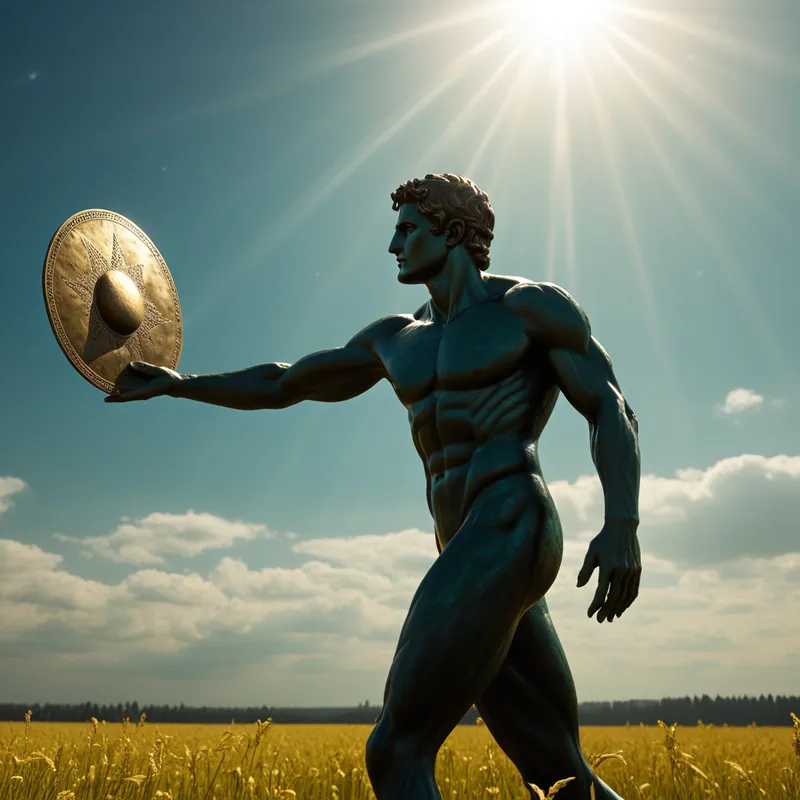
On a day when the sun was at its zenith, turning the world to a bowl of light, Apollo and Hyacinthus went to the broad meadow by the river Eurotas to test their strength. Apollo, to show his favor, took up a discus of polished bronze, heavy and flawless. "Watch," he said, his voice warm as summer, "how the sun lends its strength to the throw."
He took his stance, a figure of perfect geometry. Muscles coiled like sunlit ropes, he spun, a blur of divine motion, and released. The discus sang as it flew, a sharp, clean note cutting the air. It was a throw of impossible beauty, a line drawn by a god’s will, destined to land far across the field as a testament to his power.
But Zephyrus, hiding in the stands of reeds, saw his moment. With a jealous, focused breath, he blew. Not a wild gale, but a precise, malicious gust. It caught the perfect discus in its flight, the one object in all the world whose path was ordained by a god’s skill. The bronze plate veered, its song turning to a shriek.
Hyacinthus, eager to retrieve the prize, had already run forward. He did not see the correction of the wind. The discus, now an agent of fate, struck him a terrible blow on the temple. The sound was not of metal on earth, but a dull, final crush. He fell, a beautiful statue toppled, his dark hair already spreading in the grass like a stain.
Apollo was at his side in an instant, cradling the broken form. The god of healing, who could cure plagues with a word, found his arts useless. The life bled out between his fingers, as unstoppable as time itself. He cried out, a sound that dimmed the very sun, "Would that I could die with you, or for you!" But the Moirai had measured Hyacinthus’s thread, and it was cut.
As the blood of the beloved soaked into the Spartan earth, Apollo spoke a spell of remembrance. "You will not fade," he whispered. "You will return each spring, and my grief will give you voice." Where the blood fell, a flower sprang forth, swift and vivid—a deep purple bloom with markings that seemed to spell AI AI, the cry of grief. The hyacinth was born from that divine, tragic love, its scent forever the perfume of a moment too perfect to last.
Cultural Origins & Context
This poignant myth finds its roots in the pre-classical traditions of Greece, likely arising from older archaic vegetation rituals that sought to explain the death and rebirth of plant life. It was a tale told not in grand epic, but in lyric poetry and local cult. The primary literary sources are the poet Ovid in his Metamorphoses and the slightly earlier Greek poet Theocritus*.
The myth served multiple societal functions. On one level, it was an aetiological myth for the hyacinth flower and its associated spring festival, the Hyacinthia. This three-day festival blended mourning with celebration, mirroring the myth’s structure of death leading to renewal. On a deeper level, it was a cautionary narrative about the dangerous intimacy between gods and mortals—a theme central to Greek thought. It illustrated that even the purest divine love could not override mortal fragility, and that the attention of the gods, while glorious, was often fatal. The story was a tool for processing the capriciousness of fate (moira) and the human experience of sudden, inexplicable loss.
Symbolic Architecture
The myth’s power lies in its stark, perfect symbols. The discus itself is the central artifact. It represents perfected skill, divine intention, and the trajectory of destiny. In Apollo’s hands, it is an extension of his will, a symbol of order, beauty, and measured force. Yet, once released, it leaves his control. It becomes an object in the world, subject to other forces—here, the chaotic envy of Zephyrus.
The Discus of Fate is the moment our best intention, our most skilled action, leaves our hands and enters the realm of accident, consequence, and the wills of others. It is the point of no return.
Apollo embodies the conscious, luminous principle—the ego, the striving for perfection and control. Hyacinthus represents the beautiful, fleeting aspect of the mortal soul, the innocent life-force that is attracted to that light but is inherently vulnerable. Zephyrus is the shadow, the unconscious, disruptive force—often jealousy, resentment, or forgotten trauma—that waits to deflect our conscious aims. The tragedy is not born from malice, but from the intersection of these three archetypal forces: the striving consciousness, the fragile life, and the compensatory shadow.
The transformation into the flower is the key. It signifies that what is lost to literal, physical life is not annihilated, but transmuted into a symbolic, enduring form. The grief (AI AI) is inscribed onto the new life, becoming part of its identity.
The Dreamer's Resonance
When this myth stirs in the modern psyche, it often manifests in dreams of perfect actions gone awry. You may dream of throwing a ball, a spear, or a key with perfect aim, only to watch it veer off course to cause an unintended, devastating result. The somatic feeling is one of suspended horror—the body remembers the fluid power of the throw, then the gut-wrenching lurch as the trajectory bends.
Psychologically, this dream pattern signals a confrontation with the limits of agency. The dreamer is likely processing an event where their skilled effort, their "perfect throw" in career, relationship, or creative endeavor, led to an outcome they did not foresee or desire, often hurting someone (or a part of themselves) they cherished. It is the psyche working through the trauma of accident, the burden of unintended consequences, and the painful dissolution of the fantasy of total control. The dream asks: What beautiful, fragile thing did you accidentally strike down in your pursuit of excellence or love? And how is that loss asking to be remembered, to be transformed?

Alchemical Translation
The individuation process modeled here is the alchemy of accepting the tragic flaw in perfection. The first stage is the coniunctio, the beautiful union of the conscious striving self (Apollo) with a valued potential or relationship (Hyacinthus). This is the "golden age" of a project, a love, or a phase of life.
The crisis is the throw—the act of enacting that union into the world. This is where the shadow (Zephyrus), previously ignored or repressed, asserts itself. The shadow is not evil; it is the unintegrated part of the psyche that demands recognition. Its intervention feels like sabotage, but it is actually a brutal form of correction, forcing a confrontation with the illusion of control.
The killing blow is also the initiation. It is the shattering of the naive fantasy that life can be lived without error, without fate, without the interference of the unknown self.
The true alchemical work begins in Apollo’s posture of grief—holding the dying form. This is the nigredo, the blackening, the descent into despair and acknowledgment of mortal limitation. The god must feel helpless. The transmutation (albedo and rubedo) occurs not in reversing the death, but in performing the act of poetic creation: "You will not fade." The ego, having faced its catastrophic failure, must now become a poet of its own experience. It must find the symbolic, enduring form for what was lost—the flower that grows from the blood-soaked earth.
For the modern individual, this means that our deepest failures, our tragic accidents of fate, are the very ground from which our most authentic symbols grow. We do not "get over" the loss of the Hyacinthus in our lives. We learn the art of Apollo: to inscribe our grief onto our continuing existence, to let it give color, scent, and pattern to who we become. The perfect throw is forever missed. The flower, however, blooms perennially.
Associated Symbols
Explore related symbols from the CaleaDream lexicon: