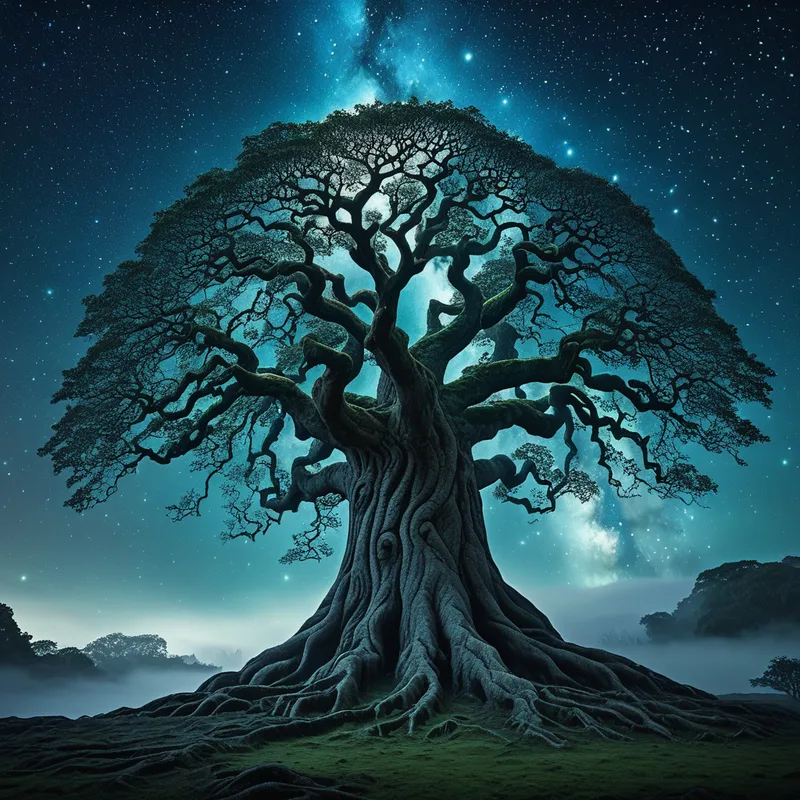
Yggdrasil - the World Tree con Myth Meaning & Symbolism
A cosmic ash tree connects nine worlds, suffering decay while gods seek wisdom. Its fate is tied to the world's end and renewal.
The Tale of Yggdrasil - the World Tree con
Listen. In the time before time, in the Ginnungagap, the yawning void, there was a sound—a deep, resonant hum that was not a sound at all, but a becoming. From this, the first things stirred: fire and ice, mist and clay. And from their meeting, from the dripping rime and the molten spark, life quickened. Not as we know it, but as a seed of all-that-is. It grew. It did not simply sprout; it unfolded, reaching with roots of impossible depth and branches of infinite span. This was Yggdrasil, the World Ash, and its name means “Odin’s Horse,” for the All-Father would ride it to the farthest shores of being and non-being.
Its bark is scarred and ancient, a tapestry of ages. High in its crown, an eagle sits, wise and watchful, and between its eyes perches a hawk, Vedrfolnir. At its deepest root, which coils around the spring of Urd, sit the three Norns. They are Urd (What Once Was), Verdandi (What Is Coming into Being), and Skuld (What Shall Be). Their hands are never still, carving runes into the tree’s trunk, drawing water from the well to mix with sacred clay to keep the tree from rotting. But rot it does. For from the spring of Mimir, a wisdom bought with a terrible price, another root drinks. And from the dark realm of Niflheim, a third root is gnawed upon, ceaselessly, by the great dragon Nidhogg and countless serpents. Their venom drips, a slow, seeping poison.
Up and down the trunk runs the squirrel culture.") Ratatoskr, a needle-thread of malice, carrying insults from the eagle above to the dragon below, stoking an eternal, foundational hatred. The tree groans. It holds the nine worlds in its embrace: Asgard, Vanaheim, Midgard, and all the others, each a trembling leaf in its vast canopy. It is the axis, the spine of the cosmos, and it is dying of a living death, sustained only by the Norns’ care and its own immense, silent endurance.
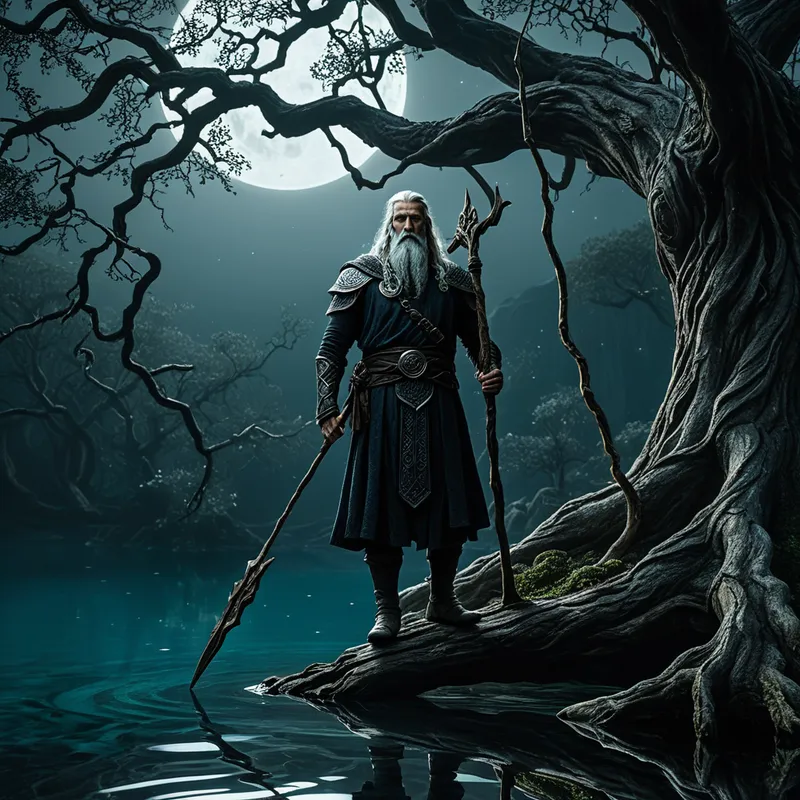
And then, the seeking. The one-eyed wanderer, Odin, came to the tree. He did not come to worship, but to wrestle. He took his own spear, Gungnir, and he pierced his own side, hanging himself from a mighty bough of Yggdrasil. For nine nights and nine days, a sacrifice to himself, he hung between the worlds, between life and death, staring into the dark waters of Mimir’s well below. On the final night, with a gasp that was both a death rattle and a birth cry, he saw them. The runes blazed up from the depths, searing themselves into his being. He reached down, his sacrifice complete, and took them up. The tree had given him the secret language of reality, but the cost was etched into its very wood, another wound in its eternal flesh.
Cultural Origins & Context
This myth is the central pillar of the Norse cosmological vision, primarily preserved in the Poetic Edda and later systematized in the Prose Edda by Snorri Sturluson. It was not a dogma, but a living poetic framework passed down by skalds (poets) and elders around hearth-fires in the long, dark winters of Scandinavia and Iceland. Its function was profoundly practical and philosophical: it mapped a universe that was organic, dynamic, and perilously interconnected. It explained the nature of time (the Norns), the source of sacred knowledge (Odin’s sacrifice), and the inherent fragility of order amidst chaotic, entropic forces (Nidhogg’s gnawing). The myth served as a cultural anchor, teaching that existence is not a given but a sustained, and ultimately doomed, effort—a concept that resonated deeply with the harsh realities of the Viking Age.
Symbolic Architecture
Yggdrasil is the ultimate symbol of the axis mundi, the world pillar. It represents the structure of the psyche itself and the interconnectedness of all states of being.
The tree is not the world; it is the process that makes a world, the living conduit between the depths of the unconscious and the heights of consciousness.
Its three roots tap into three fundamental wells: Urd (the past, fate, the causal chain of memory), Mimir (wisdom, which requires the sacrifice of a part of the self), and Niflheim (the cold, primal chaos, the unformed potential and the pull of dissolution). The creatures inhabiting it—the eagle of lofty intellect, the serpent of chthonic instinct, and the squirrel of internal gossip and neurosis—model the internal conflicts within an individual and a culture. Odin’s auto-sacrifice is the archetypal act of ego-surrender for transpersonal knowledge. He does not conquer the tree; he submits to it, allowing its structure to become the scaffold for his transformation.
The Dreamer's Resonance
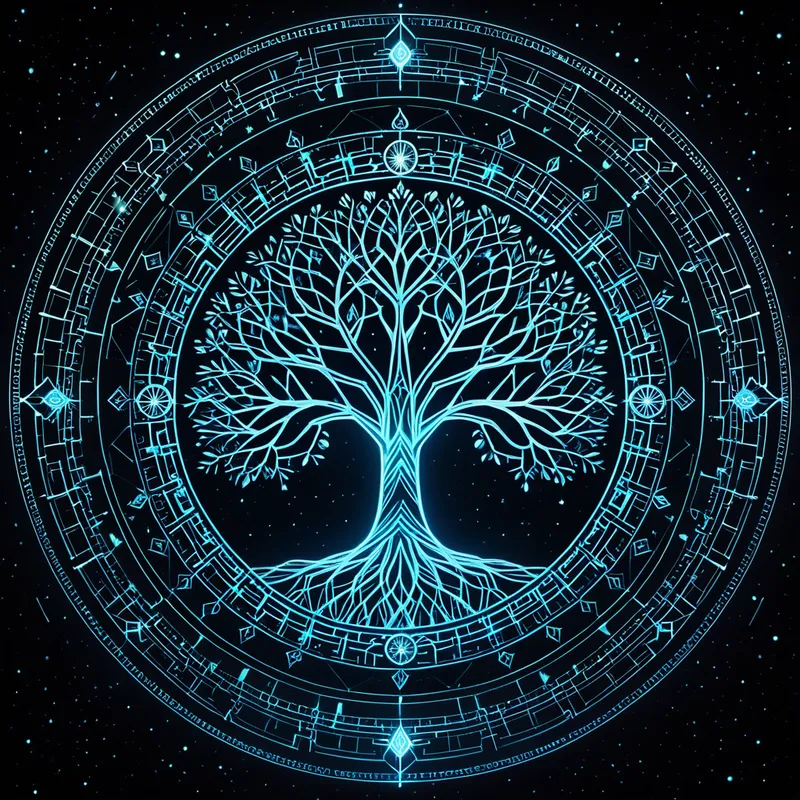
When Yggdrasil appears in modern dreams, it often manifests not as a literal tree, but as a feeling of being a nexus—a person upon whom too many demands are placed, or through whom conflicting energies flow. One may dream of a central pillar in a house that is cracking, of a spine that feels corroded, or of a network of glowing lines (like neurons or mycelium) that is simultaneously beautiful and under attack. This is the somatic signal of the psyche’s foundational structure straining under the weight of its own complexity. The dreamer is experiencing the “gnawing of Nidhogg”: perhaps a deep-seated resentment, an addiction, or a chronic anxiety that feels like it is undermining their very core. Alternatively, dreaming of hanging in a tree or seeking a hidden well points to an active, often painful, process of seeking deeper wisdom, a readiness for a profound sacrifice of old identities.
Alchemical Translation
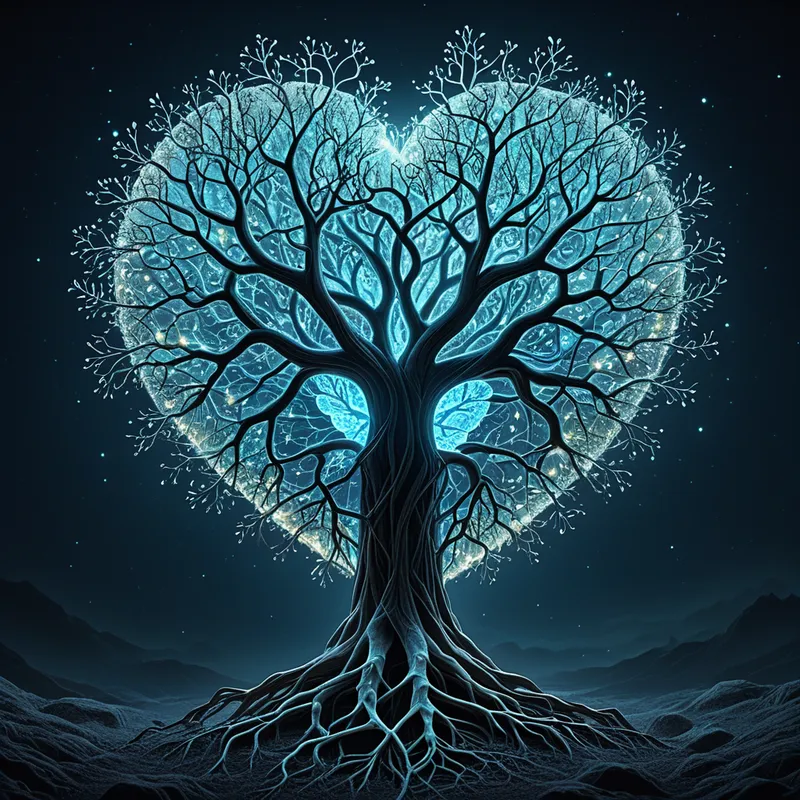
The alchemical journey modeled by Yggdrasil is not about achieving a static perfection, but about learning to inhabit the tension of a living, suffering system. The individuation process it outlines is cyclical and sacrificial.
The goal is not to kill the dragon or silence the squirrel, but to recognize them as essential tenants of your inner world, whose conflicts fuel the very dynamism of the soul.
The first operation is Nigredo—confronting the rot, the gnawing dragon (Nidhogg), the shadow material that seems to poison our foundations. The second is Albedo—the cleansing, mirrored in the reflective waters of Mimir’s well, requiring the sacrifice of an eye (a one-sided perspective) for holistic sight. The third is Rubedo, the reddening, which is not a final cure but the achieved state of enduring the tension: holding the eagle’s vision and the dragon’s hunger simultaneously, becoming the tree that can bear its own wounds and still connect heaven, earth, and hell. The ultimate “con” of the World Tree is the revelation that wholeness is found not in escaping suffering, but in understanding that you are the arena where all opposites meet, are sustained, and are ultimately transformed.
Associated Symbols
Explore related symbols from the CaleaDream lexicon: