Manat Goddess of Fate Myth Meaning & Symbolism
The myth of Manat, the pre-Islamic Arabian goddess of time, fate, and death, whose sacred black stone embodied the inescapable weave of destiny.
The Tale of Manat Goddess of Fate
Listen, and hear the whisper of the oldest wind. It does not speak of beginnings, for fate has no beginning. It speaks of what is.
In the time before the Prophet’s call, when the desert was a scripture written in sand and stone, the people knew a truth as hard and real as the bedrock beneath the dunes: life was not a path one chose, but a thread one was given. And the weaver of those threads was not a distant, faceless force. She had a name. She was Manat.
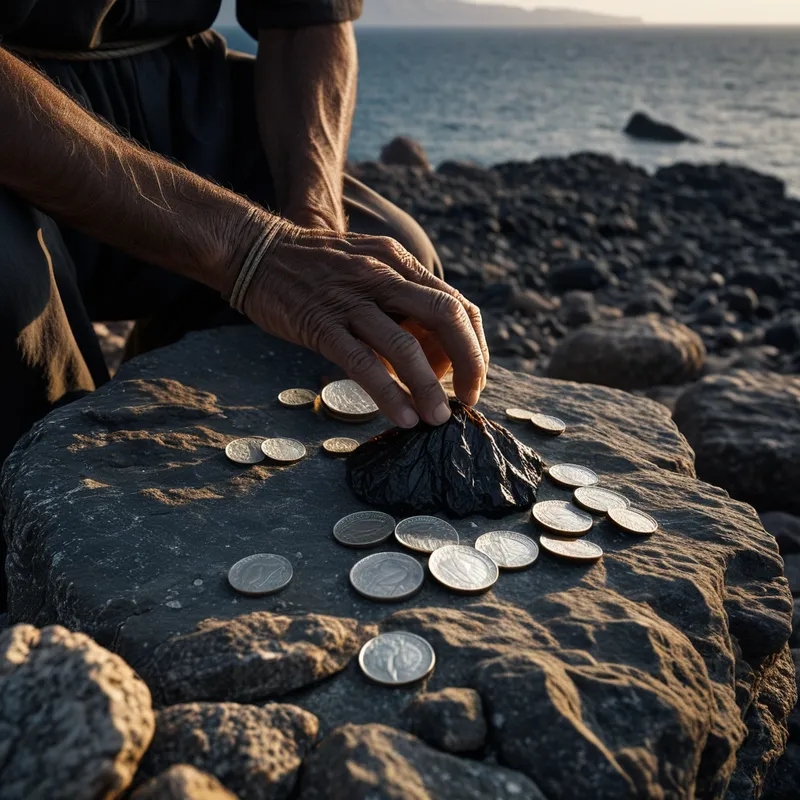
Her dominion was not the lush oasis or the bustling caravan city. Hers was the liminal space—the rocky coast where the Red Sea’s breath met the land’s relentless thirst, near the sacred city of Makkah. There, upon a barren outcrop, her symbol stood: a simple, unadorned black stone. It was not beautiful by the standards of men. It absorbed the sun’s fury by day and the cold of the void by night. It did not reflect; it consumed. To touch it was to touch the cold, smooth skin of destiny itself.
Pilgrims came, their feet dusty, their hearts heavy with hope and dread. They did not come to ask for favors from a benevolent mother. They came to acknowledge. To bow before the inevitable. They would trace the stone’s contours with trembling fingers, leaving offerings not of gold, but of personal tokens—a lock of hair from a firstborn, a broken weapon from a lost battle, a vial of tears. These were not bribes, but signatures. Admissions. I am here. My thread is in your hand.
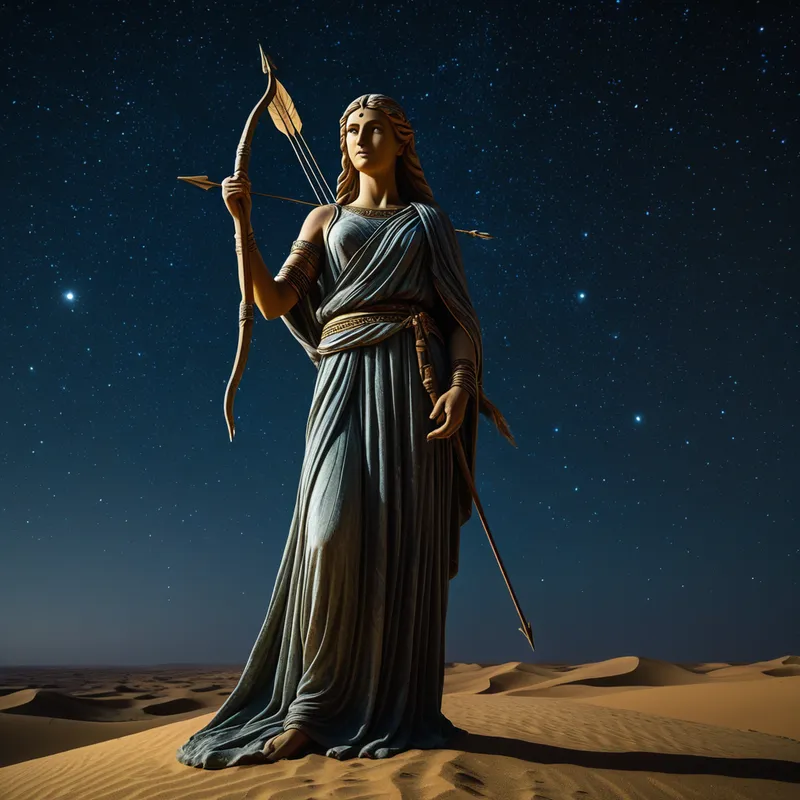
She was the eldest of the three great goddesses, the al-ṯalāṯ. While her sisters, Al-Lat and Al-Uzza, governed the visible powers of protection and sovereignty, Manat governed the invisible architecture beneath them all: Time. The moment of death. The full measure of a life, from its first cry to its last sigh. She held a sheaf of arrows, used not in battle, but in divination—to cast the lots, to read the unchangeable pattern. Sometimes she was shown with a severed hand, the ultimate symbol of a completed action, a destiny fulfilled.
The tale is not one of her adventures, for fate does not adventure. It is. The drama was in the hearts of those who approached her. A mighty warrior would come, chest puffed with pride from a dozen victories, only to feel his courage turn to water as he stood before her silent stone. He saw not an enemy to conquer, but the horizon of his own end. A mother would come, clutching an amulet for her sick child, and in the stone’s darkness, she would see not a promise of healing, but the terrifying, beautiful fragility of the thread she begged to be lengthened.
The resolution was always the same, and it was never a victory in the heroic sense. It was a sigh that emptied the lungs. It was the softening of a clenched jaw. It was the pilgrim turning away from the stone, back toward the world of the living, carrying not a guarantee, but a burden of truth. They walked back into the shimmering heat of their lives, having touched the cold core. They had looked into the eyes of the weaver and, in that look, found a terrible kind of freedom—the freedom that comes only when one stops wrestling with the unchangeable.
Cultural Origins & Context
The veneration of Manat was deeply embedded in the practical and spiritual life of pre-Islamic Jahiliyyah Arabia. She was not a myth told merely for entertainment around a fire; she was a fundamental pillar of a worldview that understood the universe as a web of predetermined forces. Her cult was widespread, particularly among the tribes of the Yathrib and the Khazraj, and her shrine at al-Mushallal was a major pilgrimage site, rivaling even the Kaaba.
Historical and archaeological evidence, including references in the Qur'an (Surah An-Najm 53:19-20) and in early Islamic historiographies that recorded the "idols" destroyed by the Prophet Muhammad, place her as one of the most significant deities. Her worship was transactional in the deepest sense: it was an act of cosmic accounting. By honoring Manat, individuals and tribes were acknowledging their debt to time and destiny, seeking to align themselves with the inevitable rather than foolishly defy it. Her myth was passed down not as a narrative with a plot, but as a ritual, a set of practices, and a palpable presence embodied in her stone. The storytellers were the priests at her sanctuary and the elders of tribes, for whom Manat explained the inexplicable—the sudden death of a leader, the failure of a raid, the end of a lineage.
Symbolic Architecture
Manat represents the psychological archetype of Fate or Wyrd—not as a random force, but as the inherent, unfolding pattern of an individual’s existence. She is the personification of life’s ultimate boundary: time itself, and the death that gives time its meaning.
To encounter Manat is to encounter the limit. She is the stone wall at the end of every path, the silent answer to the question, "And then what?"
Her black stone is the central symbol. It is the axis mundi for the concept of fate—tangible, cold, and immutable. It does not sparkle with illusion or promise; it is the bedrock of reality after all illusions are stripped away. The severed hand signifies a finished deed, a fate fulfilled, the irreversible nature of the past. It is the finality of every action, every choice, once it has entered the tapestry. The arrows are not weapons but tools of discernment, representing the random yet fateful "lot" that falls to each person. They symbolize the moment of revelation when the hidden pattern becomes clear, often at a crossroads.
Psychologically, Manat symbolizes the super-ego in its most impersonal, cosmic form—not the voice of parental authority, but the voice of existential law. She is the internalized awareness of mortality, of consequence, of the finite nature of our power. To make peace with Manat is not to defeat her, but to integrate this awareness, moving from a life of arrogant defiance or anxious denial to one of conscious, humble participation in one’s own destined journey.
The Dreamer's Resonance
When the archetype of Manat stirs in the modern shadow, it often manifests in dreams of profound, impersonal systems. One might dream of a vast, silent machine with incomprehensible gears; of a computer algorithm that has already determined one’s life choices; or of standing before a vast, dark, still body of water or a featureless stone wall.
Somatically, this can feel like a heavy pressure on the chest, a chilling coldness, or a sense of being utterly small and transparent before something vast. Psychologically, this dream pattern emerges during life phases where one confronts immutable limits: a diagnosis, the end of a relationship, the passing of a life stage, or the crushing weight of societal or familial expectations that feel like a predetermined script. The dream is not necessarily a nightmare, though it can be terrifying. Its core function is to initiate a somatic surrender—a deep, bodily recognition that some forces are beyond one’s control. The psyche is forcing a confrontation with its own Ananke, compelling the dreamer to stop wasting energy on a futile struggle and to begin the more nuanced work of adaptation and meaning-making within the given constraints.

Alchemical Translation
The individuation process, as modeled by the myth of Manat, is not the heroic journey of slaying dragons. It is the alchemical mortificatio—the blackening, the dissolution of the ego’s grand fantasies of control and immortality.
The first and most profound alchemy is the transformation of ignorance into acknowledgment, of resistance into reverence for the pattern.
The pilgrim’s journey to the black stone is the ego’s journey toward self-knowledge. The initial, often arrogant, desire is to change one’s fate (the nigredo). The confrontation with the stone—the cold, hard truth of one’s limits—is the crushing of that egoistic hope. This is the necessary death. From this ashes, however, arises not despair, but a new consciousness.
The offering left at the stone is the symbolic sacrifice of the ego’s claim to omnipotence. In return, the individual does not receive a new fate, but a new relationship to fate. This is the albedo—the clarity that comes after the black night. One begins to see one’s life not as a script to be rewritten, but as a unique thread with its own color, texture, and place in the grand tapestry. The power is no longer in controlling the weave, but in consciously living the thread one has been given, with dignity and awareness. The triumph is not over destiny, but within it. One becomes, in a sense, a co-weaver—not by changing the pattern, but by fully embodying one’s part within it, thus granting it its complete and destined meaning.
Associated Symbols
Explore related symbols from the CaleaDream lexicon:
- Fate — The core concept embodied by Manat, representing the predetermined, inescapable pattern of events that governs both cosmic order and individual destiny.
- Stone — Symbolizes the immutable, enduring, and foundational nature of fate, as manifested in Manat's sacred black stone—cold, hard, and unchanging.
- Goddess — Represents the divine feminine aspect of fate as an ancient, implacable, and generative force that measures, allots, and ends all life.
- Destiny — The specific, personal manifestation of fate, the unique thread allotted to an individual from the greater tapestry woven by deities like Manat.
- Circle — Represents the cyclical nature of time and fate that Manat governs—the unbroken loop of birth, life, death, and the completion of all things.
- Death — The ultimate domain and most potent symbol of Manat's power, representing the final cut of the thread, the fulfillment of the allotted measure.
- Tapestry of Fate — The complex, interwoven fabric of all destinies, for which Manat serves as both the weaver and the measure of each thread's length.
- Altar — The sacred space, like the rocky outcrop holding her stone, where humanity ritually acknowledges and makes offerings to the impersonal forces of fate.
- Ritual — The prescribed acts of pilgrimage and offering performed to honor Manat, serving to align human consciousness with the accepted reality of cosmic order.
- Shadow — The psychological counterpart to Manat, representing the unconscious acceptance of limits, mortality, and the parts of our destiny we initially reject.
- Mana — The spiritual power or numinous presence inherent in Manat and her stone, the potent, impersonal force that commands awe and reverence.
- Well of Urðr (Fate Well) — A Norse parallel, representing the source from which destiny springs and is drawn, akin to Manat's function as the origin and arbiter of all allotted life-threads.