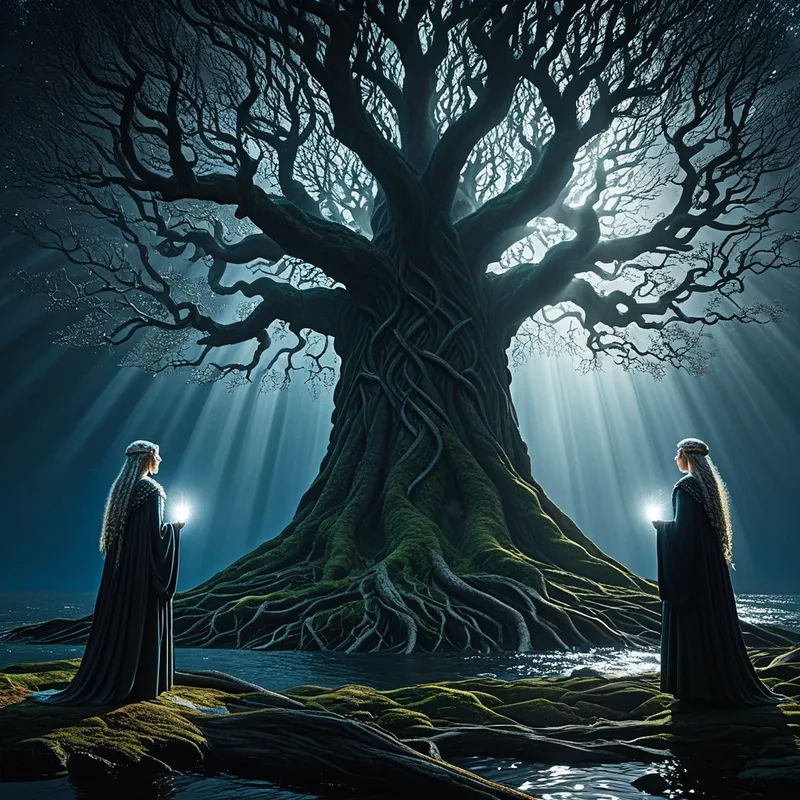
The Norns' Tapestry Myth Meaning & Symbolism
Three sisters weave the tapestry of fate at the root of the world tree, their threads dictating the lives of gods and mortals alike.
The Tale of The Norns' Tapestry
Listen, and hear the whisper from the roots of the world. Not from the sun-drenched branches of Yggdrasil, but from its deepest, darkest hold, where the primal waters of Urðarbrunnr seep into the soil of being. Here, in the perpetual twilight, three figures move with a rhythm older than the first breath of wind. They are the Norns, and their work is the work of all that is, was, and shall be.
Urd, whose name means What Once Was, is ancient. Her back is bent like the root she sits upon, her fingers gnarled but impossibly steady. She draws the thread from the well itself, a strand soaked in memory, in deed, in consequence. It is heavy with the weight of all that has passed. Verdandi, What Is Coming into Being, stands in the fullness of her power. Her eyes are clear, her movements fluid as she takes the thread from her sister. She weaves it into the ever-unfurling now, the present moment that is both a gift and a sentence, her shuttle moving with the sound of a heartbeat. And Skuld, What Shall Be, is veiled, a figure of stern youth. She holds shears, and her task is the most terrible: to cut the thread when the pattern demands it. Yet, sometimes, she merely twists it, or adds a strand of her own, for what shall be is not always a simple end, but a debt to be paid, a necessity born of the woven past.
Their tapestry is not cloth. It is a living, breathing pattern of light and shadow, of color and void. You can see the shimmering threads of the Æsir, strong and bright but strained. You can see the coarse, vital strands of the Vanir. And if you look closer, with a sight granted by no mortal eye, you see the countless, fragile filaments—each a human life, a bird's flight, a leaf's fall—being woven in and out of the grand design. The loom’s sound is the hum of the cosmos. The snap of Skuld’s shears is the sound of a star dying, a king falling, a story ending.
Even Odin, who gave an eye for wisdom, who hung on the World Tree for nine nights to grasp the secrets of the runes, comes here. He rides Sleipnir down the trembling root to this sacred ground. He does not command. He asks. He seeks to read the pattern, to understand the weave of his own doom and the fate of Asgard. The Norns do not look up. They weave. They offer no comfort, only the relentless, beautiful, terrifying truth of the tapestry. For they do not decree fate from on high; they spin it from what is given. They weave with the threads the gods and all beings provide through their actions, their oaths, their very natures. The pattern is fixed not by their whim, but by the unalterable logic of the weave itself.
Cultural Origins & Context
This vision of fate is not a story told around a fire for mere entertainment. It is the bedrock of the Norse cosmological worldview, preserved in the Poetic Edda, particularly in the Völuspá (The Prophecy of the Seeress) and detailed in the later Prose Edda. The Norns are distinct from the ørlög of an individual; they are the active weavers of that destiny, the personified forces of time and causality.
They were likely invoked in ritual and private contemplation, a way for the Norse people to conceptualize the harsh, often inexplicable turns of life in a volatile world. In a culture that valued personal courage (drengskapr) and decisive action, the idea of a fixed tapestry could seem fatalistic. Yet, the myth contains a crucial nuance: the Norns weave from the well of past action. Your deeds become the thread. This creates a profound ethical framework: while the overall pattern (one's ultimate fate, perhaps the time and manner of death) might be set, the quality of the thread—its strength, its color, its place in the weave—is forged by how one lives. The myth thus served to instill both a sober acceptance of life's limits and a powerful motivation to live with honor, to create a thread worthy of being woven into the great saga of the world.
Symbolic Architecture
The Norns and their tapestry represent the human psyche's encounter with the fundamental principles of existence: Time (past, present, future), Causality, and the emergence of Order from Chaos.
The tapestry is not a prison of predestination, but the visible anatomy of consequence. Every choice is a thread; every life is a pattern emerging from the interplay of a million such choices.
Urd, Verdandi, and Skuld are not external goddesses but internalized psychic functions. Urd is the function of memory and the past—the personal and collective unconscious, where all our experiences, traumas, and inheritances are stored, forming the base material of our being. Verdandi is the function of consciousness and present-moment actualization—the ego's task of taking that raw material and weaving it into the ongoing narrative of our lives. Skuld is the most complex: she is the function of necessity, closure, and futurity—the self-regulating principle of the psyche that demands resolution, ends unhealthy patterns ("cutting the thread"), and imposes the logical outcomes of our actions ("the debt").
The Yggdrasil is the structure of the Self, the axis of a personal cosmos. The Well of Urd is the source, the deep, nourishing, and often murky waters of the unconscious. Weaving at the root means that our destiny, our psychological wholeness, is not found in lofty ideals alone, but is rooted in and grows from our darkest, most primal material.
The Dreamer's Resonance
When this myth surfaces in modern dreams, it often signals a profound engagement with the themes of fate, agency, and life direction. To dream of weaving, or of a tapestry, suggests the dreamer is actively involved in constructing their life's narrative, feeling the weight and potential of their choices. To dream of tangled, frayed, or broken threads indicates a sense of chaos, a life pattern that feels incoherent or out of control, often related to anxiety about the past (Urd) or future (Skuld).
Dreaming of the Norns themselves, especially the veiled Skuld or the cutting of a thread, can be a powerful somatic experience. It may accompany life transitions—the end of a relationship, a career, or an identity. The psyche is presenting the necessary, if painful, process of ending. It is the dream-ego confronting the internal "Norn" that says, "This pattern is complete. To continue weaving it is to create a flaw. It is time to begin a new section." The dreamer may wake with a sense of dread, but also with a potential for profound release, as if a debt has been paid.
Alchemical Translation
The alchemical process mirrored here is the opus contra naturam—the work against nature—which in psychological terms is the work of consciousness engaging with the unconscious to transmute base material (instinct, trauma, inherited patterns) into the gold of individuated Self. The Norns' work is the archetypal model for this individuation process.
Individuation is not creating a self from nothing. It is the conscious participation in the weaving of one's own tapestry, learning to handle the shuttle of Verdandi with wisdom drawn from Urd's well, and developing the courage to allow Skuld to cut away what no longer serves the greater pattern.
First, one must journey to the root (confront the personal shadow, the complexes stored in the personal Urd). Then, one must draw water from the well (engage with the deep, often painful truths of one's past and the collective unconscious). This provides the raw thread. The weaving is the lifelong work of integration—taking those insights, memories, and drives and consciously, deliberately weaving them into the fabric of daily life, creating a coherent identity (Verdandi's domain). The most difficult stage is accepting the shears. This is the alchemical mortificatio, the necessary death of outmoded attitudes, dependencies, and ego-identifications. It is the self-regulation of the psyche, pruning the self for greater growth. To become whole is not to avoid Skuld, but to recognize her as an essential part of the creative triad. The fully realized individual does not flee from fate but, like Odin, seeks to understand its weave, then stands responsible for the quality of thread they contribute to the grand, terrible, and beautiful tapestry of being.
Associated Symbols
Explore related symbols from the CaleaDream lexicon: