Bellerophon Myth Meaning & Symbolism
A hero tames the winged Pegasus to slay monsters, but his ambition to reach Olympus leads to a devastating fall back to mortal earth.
The Tale of Bellerophon
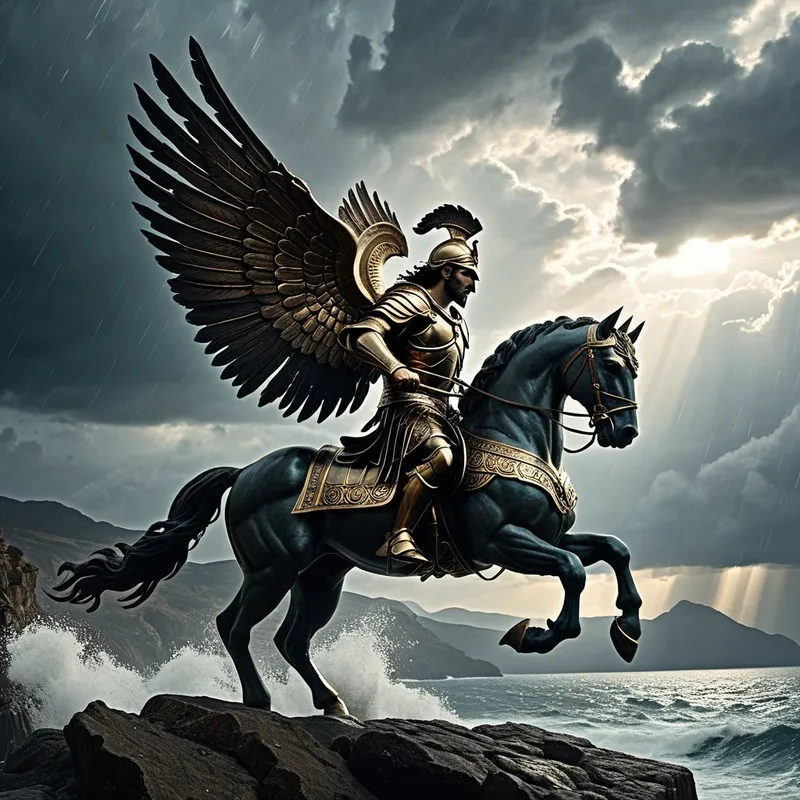
Hear now the story of a man touched by the gods and cursed by fate, a tale of soaring heights and crushing depths. It begins in the shadow of a grave error. Bellerophon, a prince of Corinth, found himself stained with the blood of his own brother, or some say a man named Bellerus—a death that earned him his name, "Bellerophon," the slayer of Bellerus. Exiled and polluted, he fled to the court of King Proetus of Tiryns, who purified him.
But in that palace, a new shadow grew. The queen, Anteia (or Stheneboea), burned with a forbidden passion for the noble exile. When Bellerophon, in duty and honor, refused her, her desire twisted into venomous hate. She went to her husband, tears of deceit staining her cheeks, and accused the hero of attempting to violate her. Proetus, bound by the laws of hospitality not to kill a guest under his own roof, seethed with a king’s rage. He devised a cunning death. He sent Bellerophon to his father-in-law, King Iobates of Lycia, bearing a sealed tablet of folded wood—a silent message that read, "Kill the bearer of this."
Iobates, also bound by hospitality, read the deadly message and saw the trap. To kill a guest was an offense to Zeus himself. So, he too chose a cunning path: he would set the young man impossible tasks, certain to bring his doom. First, he commanded Bellerophon to slay the Chimera, a terror that ravaged the Lycian lands. Despairing, Bellerophon sought the counsel of a seer, who told him he would need the aid of the immortal, winged horse, Pegasus.
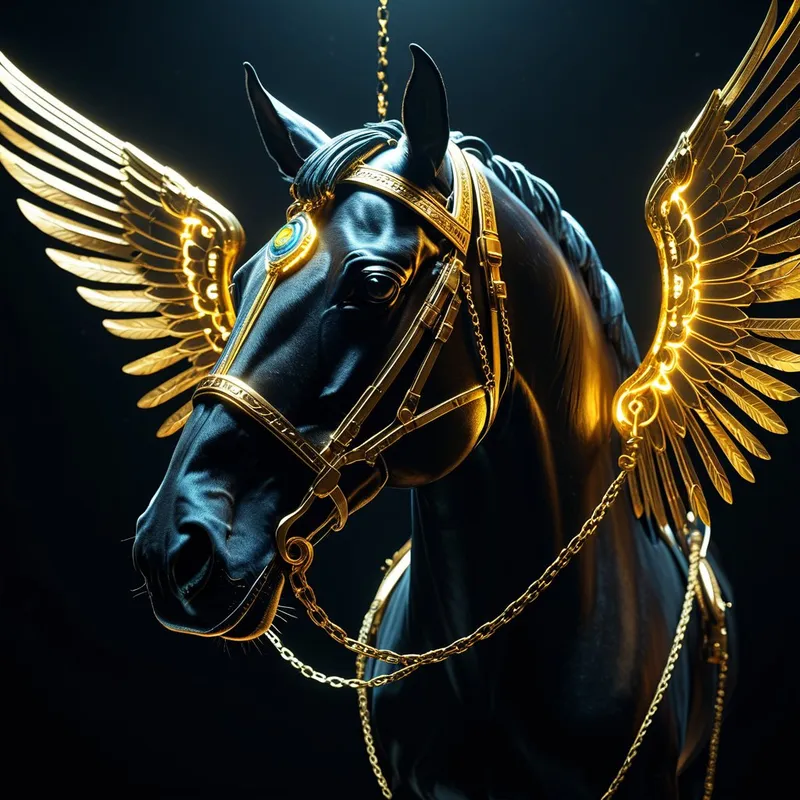
Guided by the seer’s words, Bellerophon spent a night in the temple of Athena. As he slept, the goddess placed beside him a golden bridle. At dawn, he found it and went to the spring where Pegasus descended to drink. With the divine bridle, he did not force, but tamed, offering partnership. Pegasus, recognizing the gift of the goddess, allowed himself to be mounted. From the sky, Bellerophon rained down arrows and lead upon the Chimera, the monster’s own fire melting the lead to choke it. The beast was slain.
Iobates, undeterred, sent him next to fight the fierce Amazons. From the back of Pegasus, Bellerophon triumphed. Then the king set an ambush of his own finest Lycian warriors. Bellerophon, from the air, defeated them all. Finally, Iobates saw the truth: this man was favored by the gods. He showed him the deadly tablet, begged forgiveness, and gave him his daughter in marriage and half his kingdom.
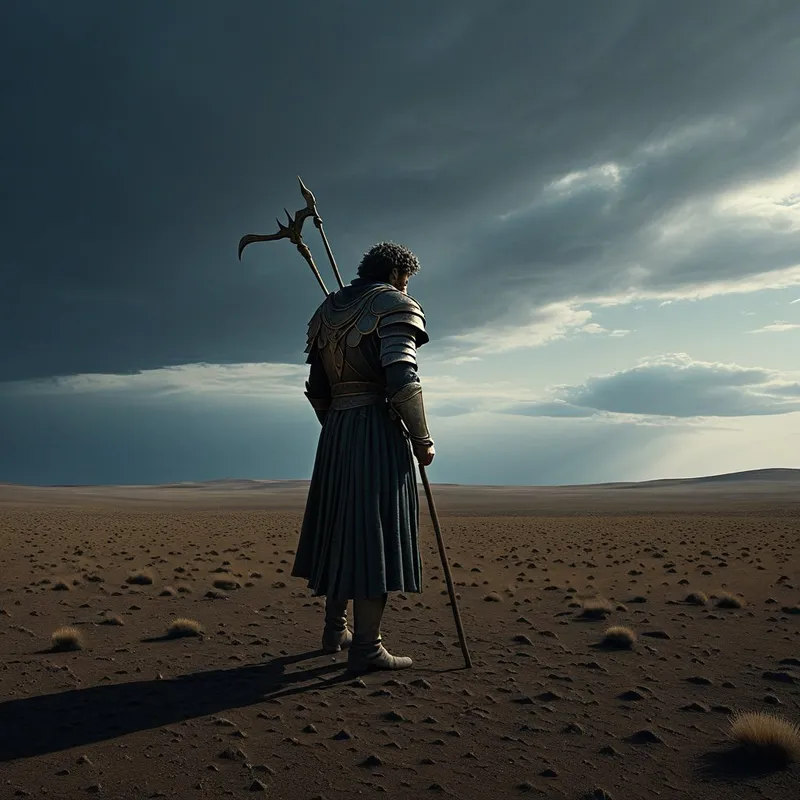
For a time, Bellerophon knew glory, prosperity, and honor. But the seed of his old flaw remained. The man who had tamed the sky grew restless with mortal limits. He mounted Pegasus not for a task of justice or defense, but for his own glory. He pointed the winged horse toward the home of the gods themselves, Olympus, seeking to dwell among the immortals. Zeus, witnessing this ultimate hubris, sent a gadfly to sting Pegasus. The noble horse reared in shock, and Bellerophon, the great hero, lost his grip. He fell. He fell through the vast, empty air, down, down to the hard earth of the <abbr title="The "Wandering Plain," a desolate place in Asia Minor">Aleian Plain. He did not die, but lived on—crippled, blinded, and broken. He became a wanderer, shunning the paths of men, a living testament to the fall that follows the flight too high. And Pegasus? He flew on, alone, to Olympus, to carry the thunderbolts of Zeus, leaving his rider to the dust.
Cultural Origins & Context
The myth of Bellerophon is a foundational narrative from the Greek epic cycle, most famously recounted in Homer’s Iliad (Book 6), where the hero Glaucus recounts his lineage. This places the story firmly within the oral tradition of the Archaic period (c. 800-500 BCE), a time when myths served as the bedrock of cultural identity, explaining the human condition, the nature of the gods, and the consequences of moral and social transgression. It was a tale told by bards and later elaborated by poets like Pindar and tragedians, each iteration reinforcing its core warnings.
Societally, the myth functioned as a powerful didactic tool. It explored the complex Greek concepts of miasma (ritual pollution from bloodshed), xenia (the sacred guest-host relationship), and the delicate balance between human ambition (aretē, excellence) and divine law (themis). Bellerophon’s initial exile and purification reflect real social and religious practices for dealing with homicide. His ultimate fall served as a stark, public lesson on hubris—the overweening pride that seeks to transgress the boundaries set for mortals, inevitably attracting nemesis, the retributive justice of the cosmos. It was a story that affirmed the world order: gods are immortal, humans are mortal, and the line between them is absolute.
Symbolic Architecture
The myth is a masterclass in symbolic psychology. Bellerophon represents the aspiring ego, born from a lineage of cunning (his grandfather is Sisyphus) and stained by an initial, perhaps unconscious, violence. His journey is one of purification through ordeal.
The Chimera is not merely a monster, but the fragmented, chaotic psyche itself—the lion of raw aggression, the goat of base desire, the serpent of chthonic poison—that must be confronted and integrated from a higher perspective.
The golden bridle, a gift from Athena, symbolizes divine inspiration, the logos, or conscious principle that allows for the taming and direction of immense psychic energy. Pegasus is that sublime energy: the soaring spirit, poetic inspiration, and the libido that connects the earthly to the heavenly. He is born from the blood of the slain Gorgon, meaning this transcendent force arises only after confronting and overcoming the petrifying face of the deepest terror (the Medusa).
Bellerophon’s successful partnership with Pegasus represents a sublime moment of psychic integration, where the conscious ego (the rider) is rightly aligned with the powerful, instinctual, and spiritual forces of the unconscious (the horse). His subsequent tasks—battling the Amazons (the repressed feminine/animus) and the Lycian warriors (externalized shadow projections)—are further stages of this heroic integration. The fatal flaw is the ego’s inflation. Believing it is the power it rides, it seeks to become god-like, to inhabit Olympus permanently. This is the inflation of consciousness that severs its vital connection to the instinctual, grounding source. The fall is not a punishment, but an inevitable psychological law: an inflated consciousness loses its connection to reality and is dashed upon the rocks of the literal world, the "Aleian Plain"—the plain of wandering, of aimless, conscious existence devoid of spirit.
The Dreamer's Resonance
When this myth stirs in the modern dreamer, it often signals a critical juncture in the relationship between conscious ambition and unconscious support. Dreaming of riding a powerful, winged creature may reflect a period of successful creative or spiritual "ascent," where projects flourish and one feels in sync with a larger flow. The dreamer feels "mounted" on their potential.
Conversely, dreams of the fall are more common and poignant. They may manifest as dreams of losing control of a vehicle, slipping from a great height, or being abandoned by a guiding animal or figure. Somatically, this can coincide with feelings of anxiety, vertigo, or a sudden loss of energy and meaning—a "crash" after a manic or highly productive phase. Psychologically, the dreamer is experiencing the consequences of identification with the archetype. They believed they were the hero, the genius, the special one, and the unconscious withdraws its sanction. The dream is a corrective, a brutal but necessary re-grounding. It says, "You are not the power; you are its steward. Remember your mortal ground."
Alchemical Translation
The alchemical journey mirrored in Bellerophon’s tale is the entire opus, from the nigredo to the potential of the rubedo, which is catastrophically failed. The initial blood guilt and exile are the blackening, the dissolution of the old, arrogant persona. The seeking of purification is the beginning of the work.
The taming of Pegasus with the golden bridle is the coniunctio, the sacred marriage of spirit and matter, consciousness and the sublime unconscious. It is the creation of the Philosopher's Stone in potentia—the integrated Self.
The slaying of the Chimera and subsequent victories represent the albedo, the whitening, where the integrated psyche successfully masters internal and external conflicts. The hero enjoys the "kingdom," a symbol of psychological wholeness and social integration.
The fatal flight toward Olympus is where the alchemy fails. It is the attempt to skip the final stage—the return to the mundane with the treasure—and instead hoard the gold in the realm of pure spirit. In Jungian terms, it is the refusal of the last stage of individuation, which is not to become a god in a transcendent realm, but to embody the Self humbly in the ordinary world. The gadfly sent by Zeus is the sting of reality, the autonomous psyche’s self-regulating function that prevents a permanent psychotic inflation. The fall is the mortificatio, a second, far more devastating blackening. The wanderer on the Aleian Plain is the ego that has tasted the Self but failed its final test, now condemned to a conscious existence aware of the paradise lost, carrying the crippling knowledge of its own hubris. The true alchemical goal is not to fly to Olympus, but to bring a reflection of its harmony back to earth. Bellerophon’s story is the most profound warning of what happens when that sacred return is refused.
Associated Symbols
Explore related symbols from the CaleaDream lexicon: