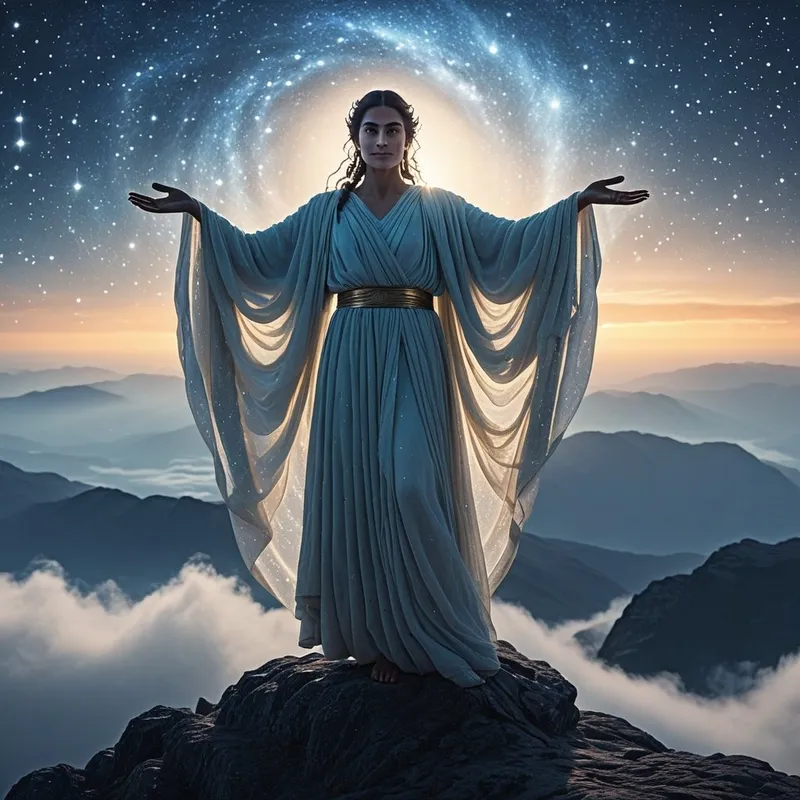
Daemon Myth Meaning & Symbolism
The Daemon is a divine guiding spirit, a personal genius and fateful companion, representing the soul's call to its unique destiny within Greek cosmology.
The Tale of Daemon
Before gods were distant and fate was a chain, the world breathed with a different kind of presence. It was not in the thunder of Zeus nor the salt-spray of Poseidon that a mortal’s life found its truest compass. It was in the whisper that came not on the wind, but from within the very marrow of the soul.
In the beginning, when the Protogenoi still shaped the clay of existence, a covenant was woven into the fabric of every life. As a soul prepared to descend from the starry meadows of Elysium and drink from the River Lethe, it was not abandoned. A companion was chosen—or perhaps, it was the other half of the soul itself. This was the Daemon.
Picture the moment of birth, not in a sterile room, but on a rocky Theban hillside at first light. The infant wails, taking its first bitter taste of mortal air. Unseen by the midwife, a shimmer gathers in the air above the child, a presence of quiet warmth and immense antiquity. It has no form you could describe, yet it feels like the essence of a lifelong mentor, a guardian who remembers all you have forgotten. It does not speak in words, but in nudges—a sudden certainty in the heart, a pull towards a certain path in the woods, a chill warning that turns your head from a hidden snake.
This Daemon walks the mortal road beside you, a silent witness to every choice. It is there when the young shepherd, tending his flock, feels an inexplicable urge to look up and see the strange, beautiful pattern of birds in flight, sparking a thought that will become philosophy. It is there when the soldier, spear trembling, feels a surge of courage that is not his own, a fierce love for his city that makes him stand his ground. It is the source of the artisan’s inexplicable skill, the lover’s profound recognition, the leader’s moment of clemency.
Its voice is the nagging discontent in prosperity, the stubborn hope in despair. It is the “why” that haunts you in the quiet hours. To follow its promptings is to walk in harmony with Moira—your allotted fate. To ignore it, to clog your ears with the noise of greed, fear, or hubris, is to feel your life grow thin, brittle, and lost, like a ship drifting ever further from its guiding star. The Daemon does not command; it beckons. The tragedy and the glory of the mortal condition is that you alone must choose to listen.

Cultural Origins & Context
The concept of the Daemon (δαίμων) is foundational, threading through Greek thought from the epics of Homer to the dialogues of Plato. In Homer, daimon is often used interchangeably with theos (god) to describe an unspecified divine force or moment of divine intervention—a sudden shift in battle, an unexpected opportunity. It was a way of acknowledging the numinous, the divine, in everyday experience without naming a specific Olympian.
By the time of the pre-Socratic philosophers and the tragic playwrights, the idea had crystallized into a more personal entity. Heraclitus declared, “A man’s character is his daimon.” Here, the external force begins its journey inward. For Aeschylus and Sophocles, a person’s daimon could represent their destined lot, for good or ill—an inborn trajectory of fortune or doom.
The most profound personalization comes from Socrates, who famously spoke of his daimonion—his “divine something.” This was not a full-fledged spirit, but a sign, a voice of prohibition that warned him against certain actions. It was a negative guide, a divine check on his behavior that he trusted utterly. Plato further philosophized the concept, suggesting in The Republic that before birth, souls choose a daimon who will be their guardian and the executor of their chosen life pattern. This was not a myth told in the agora for entertainment; it was a living, breathing framework for understanding the intersection of free will, destiny, and the divine within the human psyche.
Symbolic Architecture
The Daemon is the ultimate symbol of the authentic self in dialogue with the cosmos. It represents the portion of the divine, the universal, that is uniquely apportioned to the individual.
The Daemon is not the voice of society, nor the cry of instinct, but the whisper of the cosmos personalized—a star mapped onto a soul.
Psychologically, it embodies the transpersonal core of the personality, what Carl Jung might call the Self. It is the organizing principle of the psyche that guides one toward wholeness and fulfillment of their innate potential. The Daemon is the antithesis of the shadow; it is the luminous, calling aspect, whereas the shadow is the trailing, rejected aspect.
Its “guidance” is symbolic of intuition and inner knowing—that gut feeling, the synchronicitous event, the dream image that will not fade, the creative idea that arrives unbidden. The struggle to hear it amidst the din of the persona (social mask) and the superego (internalized rules) is the central human drama the myth portrays.
The Dreamer's Resonance
When this mythic pattern stirs in the modern unconscious, it rarely appears as a classical figure. The Daemon manifests in dreams as the Unknown Guide. This could be a mysterious, calming figure who appears at a crossroads, an animal that leads the dreamer through a labyrinth, or a voice (often one’s own, yet not) that gives a single, cryptic piece of advice.
To dream of desperately trying to hear a whisper in a storm, or of following a faint light in a deep forest, signals a somatic process of re-orientation. The psyche is attempting to recalibrate, to shut out external noise (the demands of work, family, society) and tune into a deeper, more authentic frequency. There is often a feeling of anxiety mixed with profound longing—the anxiety of losing one’s socially-constructed self, and the longing to become who one truly is. The body may respond with a sense of lightness or opening in the chest (the thymos, or spirit, in Greek) when the connection is made, or with constriction and dread when it is ignored or severed.
Alchemical Translation
The myth of the Daemon is a blueprint for the alchemical process of individuation. The “base metal” of the unexamined life, driven by convention and reaction, must be transmuted into the “gold” of a life lived in accord with the Self.
The first operation is mortificatio: the death of the illusion that we are only our persona. This is the painful, necessary silence in which the Daemon’s whisper can first be discerned.
The Daemon’s call often feels disruptive. It pulls the individual away from safe, known paths—the secure job, the expected life script—and toward the risky, the unique, the uncertain. This is the nigredo, the dark night of the soul, where one feels lost. Following it requires trust in the non-rational, a leap of faith in one’s own inner authority.
The ongoing dialogue with the Daemon is the coniunctio, the sacred marriage between the conscious ego and the transpersonal Self. The ego does not become the Daemon; rather, it becomes its willing vessel and collaborator in the world. The triumph is not wealth or fame, but authenticity and integrity—a life that feels, in its essence, true. One becomes, as the Greeks might say, eudaimon: possessed of a good Daemon, which we translate imperfectly as “happy,” but which truly means living in a state of blessed alignment with one’s deepest nature and destiny.
Associated Symbols
Explore related symbols from the CaleaDream lexicon: