Andvari's Ring Myth Meaning & Symbolism
A cursed ring of power, forged from greed and stolen from a shape-shifting dwarf, unleashes a cycle of betrayal, murder, and doom upon gods and heroes.
The Tale of Andvari's Ring
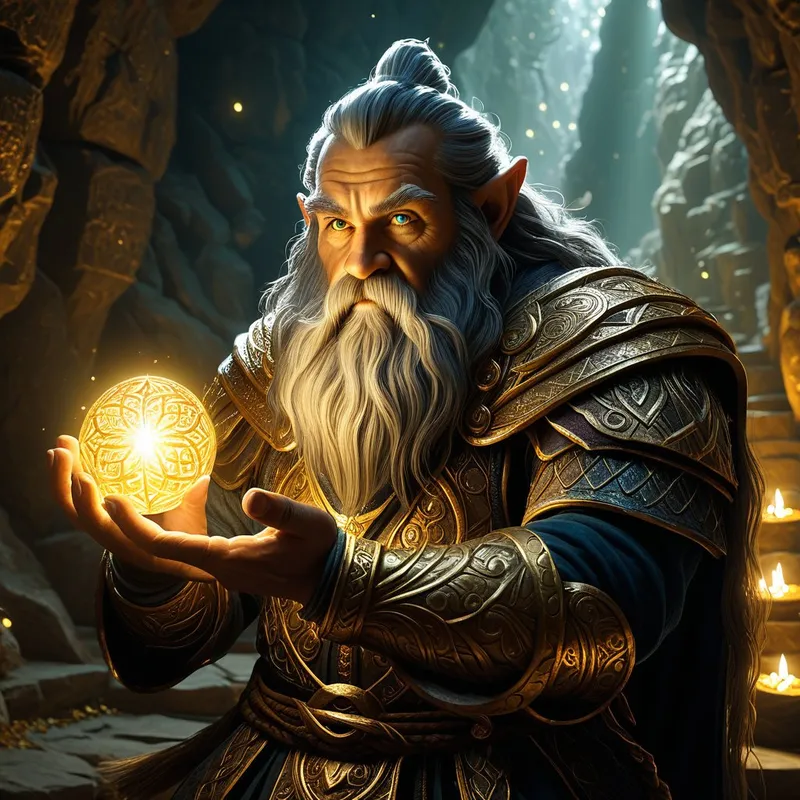
Listen, and hear the tale of gold that bleeds and a ring that remembers. It begins not in the sunlit halls of the gods, but in the cold, wet dark beneath the roots of the world. There, in the echoing caverns of Svartálfheimr, lived Andvari. He was a master of metal and magic, a being whose soul was woven into the veins of gold he coaxed from stone. His greatest treasure was a hoard of radiant gold, and at its heart lay a single ring, Andvaranaut. This ring was no mere bauble; it was the seed of his hoard, a magical loom that could spin gold from the very air. It was his life’s breath, his silent companion in the deep dark.
But fate’s net was being woven far above. The gods Óðinn, Þórr, and Loki had killed an otter, not knowing it was the son of a powerful sorcerer, Hreiðmarr. Enraged, Hreiðmarr captured the gods and demanded a ransom: they must fill the otter’s skin with gold and cover its outside completely, leaving not a single hair exposed.
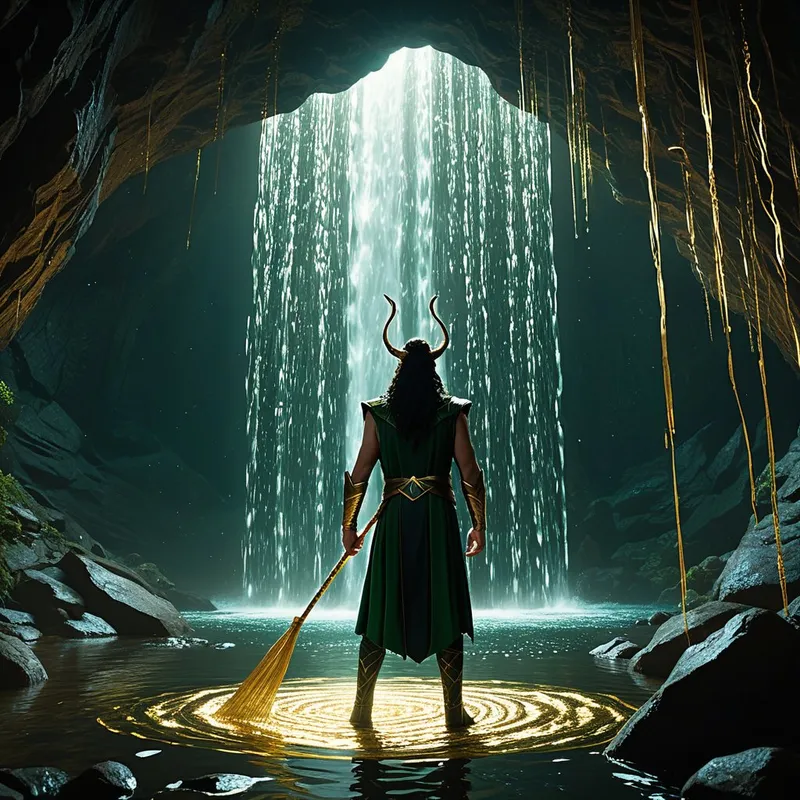
The gods turned to Loki, the shape-shifter, the finder of ways. His path led him down, down to the waterfall where Andvari, in the form of a silvery pike, swam. Using a magical net borrowed from the sea goddess Rán, Loki snared the dwarf. To buy his freedom, Andvari, with a heart of lead, was forced to surrender his entire hoard. He poured the glittering, cursed wealth into Loki’s sacks. But as the last coin left his hand, Andvari made one desperate plea. He held up the ring, Andvaranaut. “This alone, let me keep. From this, all else can be regrown.”
Loki’s eyes, sharp as flint, saw the ring’s power. He snatched it. The last piece of gold left the dwarf’s possession. As Loki turned to leave, a voice, cold and clear as a mountain stream, echoed in the cavern. It was Andvari’s curse, spoken not in rage, but with the terrible certainty of a prophet. “That gold, and the ring that commands it, shall be the death of all who possess it. It shall drown its owners in blood and sorrow. My curse is upon it.”
The gods paid Hreiðmarr his blood-price, stuffing the otter-skin and covering it with Andvari’s gold. One whisker remained exposed; Loki placed the ring, Andvaranaut, upon it to hide it. The debt was paid, but the curse was now attached. Almost at once, greed took root. Hreiðmarr, gazing upon the hoard, refused to share it with his own sons, Fáfnir and Regin. Fáfnir, consumed by the dragon-sickness the gold bred, murdered his father in his sleep to claim it all. The curse had claimed its first life. Fáfnir then fled, his greed transforming him not just in spirit but in body. He became a great, venomous dragon, lying upon his hoard in a desolate wasteland, guarding Andvari’s gold with paranoid fury for ages untold. The ring’s doom had begun its long, slow, inevitable spiral.
Cultural Origins & Context
This myth is a vital strand in the great tapestry of the Völsunga saga, and is also recounted in the Prose Edda. It was not a standalone fireside tale, but a crucial prelude to the greatest hero-saga of the North: the story of Sigurd the Dragon-Slayer. The skalds and storytellers who wove this narrative understood it as an explanation of origin—the origin of a cursed treasure, a dragon, and a heroic destiny.
Its societal function was multifaceted. On one level, it was a stark, poetic warning against the all-consuming nature of greed (græðgi) and the breaking of kinship bonds, the worst of crimes in Norse society. The gold transforms a brother into a patricide and then a monster. On another level, it establishes the inescapable nature of fate (ørlög). The curse is spoken, and from that moment, the chain of events is set. The gods themselves, even Loki, become mere agents in its fulfillment. It taught that some burdens, once taken up, cannot be put down, and that wealth without honor is a poison that unravels the soul and the family line.
Symbolic Architecture
At its core, the myth of Andvari’s Ring is a profound map of the psychology of possession and the shadow. The ring is not merely a symbol of wealth, but of autonomous psychic power.
The cursed gold is not money, but congealed life-force, hoarded potential that has turned malignant because it was taken, not earned.
Andvari represents the primal, creative force of the unconscious—the inner dvergr or smith who can shape raw instinct and potential (ore) into works of art and power (the ring, the hoard). His transformation into a pike signifies his fluid, elusive, instinctual nature. To steal from him is to raid the unconscious without respect, to plunder one’s own depths for quick gain without integrating the cost.
Loki is the trickster aspect of the ego, clever and resourceful but amoral, capable of delving into the unconscious (the net, the waterfall) to extract what the conscious mind needs (the ransom gold). Yet, in his cleverness, he is blind to the poison he carries back. He brings the shadow-content (the cursed gold) into the realm of the personal psyche (the family of Hreiðmarr).
Fáfnir’s transformation is the most potent symbol: the psychic complex, once formed by trauma and greed, becomes the monster. It isolates itself (the wasteland), becomes paranoid (guarding the hoard), and its very nature turns destructive (venomous dragon). The hoard he guards is now worthless; its only function is to be guarded. It is a perfect image of a neurosis: a painful pattern we cling to long after it has ceased to have any value, simply because we have identified with it.
The Dreamer's Resonance
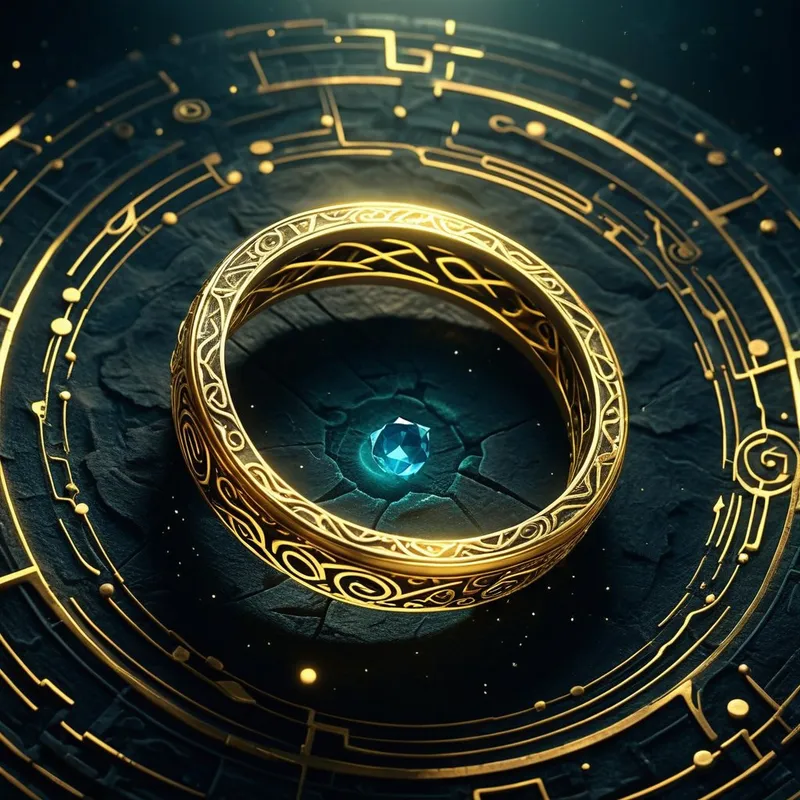
When this myth stirs in the modern dreamer, it often signals a profound encounter with a "cursed inheritance" or a "dragon’s hoard" within the psyche. Dreaming of a ring that feels powerfully attractive yet ominous, or of a cave filled with treasure one is compelled to touch but fears, points to this pattern.
The somatic process is one of gripping and contraction—a feeling of being possessed by an idea, a legacy, a grudge, or a source of security that simultaneously sickens the soul. Psychologically, the dreamer is at the point where a long-held complex, perhaps inherited from family dynamics (like Fáfnir’s patricidal greed), has fully formed. It has become a dragon: an autonomous, destructive entity within the personality that consumes vast amounts of energy (guarding the hoard) and isolates the individual. The dream is an announcement that the heroic ego (the Sigurd who is not yet present in Andvari’s tale) must eventually be summoned to confront this inner beast. The curse is felt as a repetitive, doomed cycle in one’s life—relationships that always fail in the same way, financial windfalls that bring misery, ambitions that turn to ash upon attainment.
Alchemical Translation
The alchemical journey modeled here is the nigredo—the blackening, the initial stage of confronting the raw, leaden, and cursed material of the soul. Andvari’s gold is the prima materia: the base, unconscious content that holds both supreme value and deadly poison.
The curse is not a punishment from without, but the inherent property of unlived life, of power that is seized and hoarded rather than circulated and transformed.
The process begins with a necessary "theft"—an ego-driven incursion into the unconscious (Loki’s mission) prompted by a debt, a fault, a sense of lack. This is often a crisis. But the critical error is the failure to honor the source. Loki shows no reverence for Andvari; he extorts and mocks. In psychological terms, this is attempting to use insight or spiritual power for purely egoic ends—to pay off a debt, to look good, to gain an advantage—without genuine humility or willingness to be changed by the encounter.
The curse is then the inevitable backlash: the complex, once activated, operates autonomously by its own ruthless logic. The alchemical work lies not in avoiding the cursed gold, for it is often our greatest talent or our deepest wound, but in undergoing the full transformation it demands. Fáfnir’s path is the warning: to identify with the complex is to become the dragon. The goal is to become the slayer of the dragon, which requires a higher consciousness (the godly advice Óðinn will later give Sigurd) and a reforging of the stolen elements.
The ring, Andvaranaut, is the fixed center of the complex. The alchemical transmutation occurs when one can finally "re-forge the ring"—not to own it, but to understand its nature, honor its origin in the deep self (Andvari), and break its autonomous, cursed cycle by integrating its power consciously. This means accepting the curse as part of one’s story, seeing the dragon as a part of oneself that needs to be met and understood, not just slain, and ultimately circulating the hoarded gold—transforming stagnant potential into lived, creative life. The curse ends not when the gold is destroyed, but when its nature is truly seen, and its power is no longer used for possession, but for creation.
Associated Symbols
Explore related symbols from the CaleaDream lexicon: