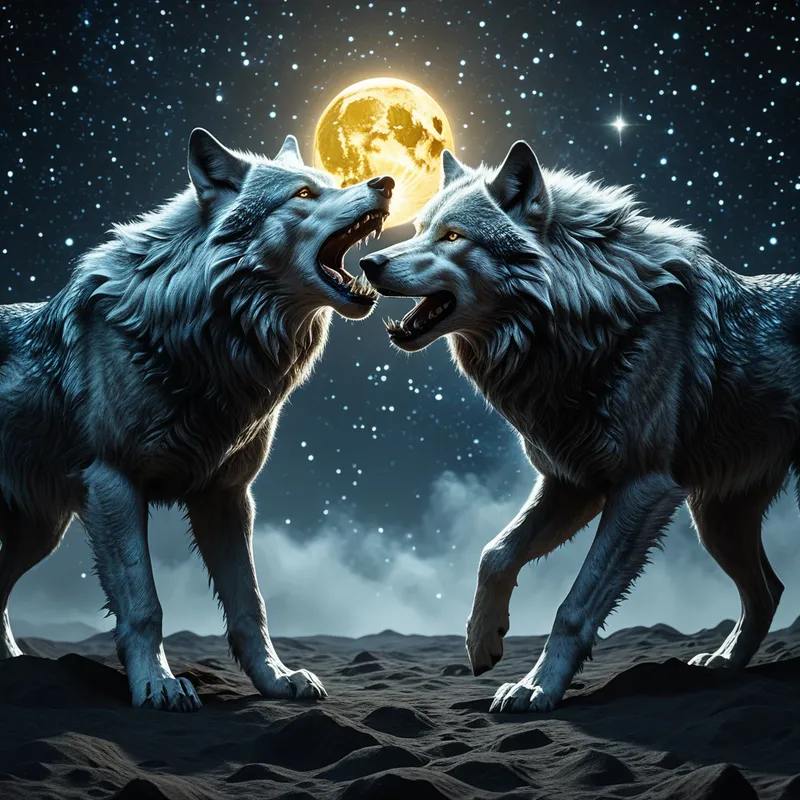
Sköll and Hati Myth Meaning & Symbolism
Two cosmic wolves eternally pursue the sun and moon, foretelling the end of an age and the necessity of confronting primal, devouring forces.
The Tale of Sköll and Hati
Listen. The world is not still. Even in its seeming order, there is a hunger that paces at the edge of all things.
In the high, cold branches of the Yggdrasil, the great eagle watches. Below, in the roots, the serpent Nidhogg gnaws. And between them, running through the misty realms, are two wolves born of a giantess in the ironwood of Járnviðr. Their names are Sköll and Hati Hróðvitnisson. They are not beasts of forest and field, but of sky and destiny.
Each day, Sól drives her chariot across the arch of heaven, drawn by the horses Árvakr and Alsviðr. Her light is a shield against the creeping things, a giver of life and measure. But behind her, silent and relentless, comes Sköll. His fur is the colour of a burnt-out hearth, his eyes like empty sockets that drink the light. He does not bark. He does not howl. He only runs, his paws striking the void with a sound like distant thunder, his jaws dripping with anticipation for the day they will close.
And when Sól flees below the horizon, trembling, her brother Máni takes his place, guiding his own pale chariot. His light is a ghost of his sister’s, a time for secrets and frost. And for him, there is Hati. The Moon-Hunter. Where Sköll is shadow, Hati is the colour of tarnished silver and cold marrow. He follows the erratic path of Máni, his breath frosting the stars, his pursuit just as certain.
The gods of Asgard know this chase. They hear the panting of the wolves on the wind. They see the fleeting, fearful glances of the celestial siblings. It is a law woven into the tapestry of the worlds, a doom set in motion at the dawn of time. The wolves will run, and the sun and moon will flee, in an endless, terrible circuit.
But this is not a story of eternal stalemate. It is a story of an ending foretold. For the old seeress whispered it, and the runes cut into bone confirm it: there will come a time, at the climax of the Ragnarök, when the chase ends. Sköll will finally seize the sun. The sky will gush with her blood, and the world will be plunged into a darkness deeper than any night. Hati will catch the moon, and his jaws will shatter its pearl-like light into a million useless fragments.
This is their tale. Not of malice, but of function. They are the jaws of time. They are the hunger that makes the light precious. They are the inevitable shadow that gives shape to every day and defines the boundary of every night.
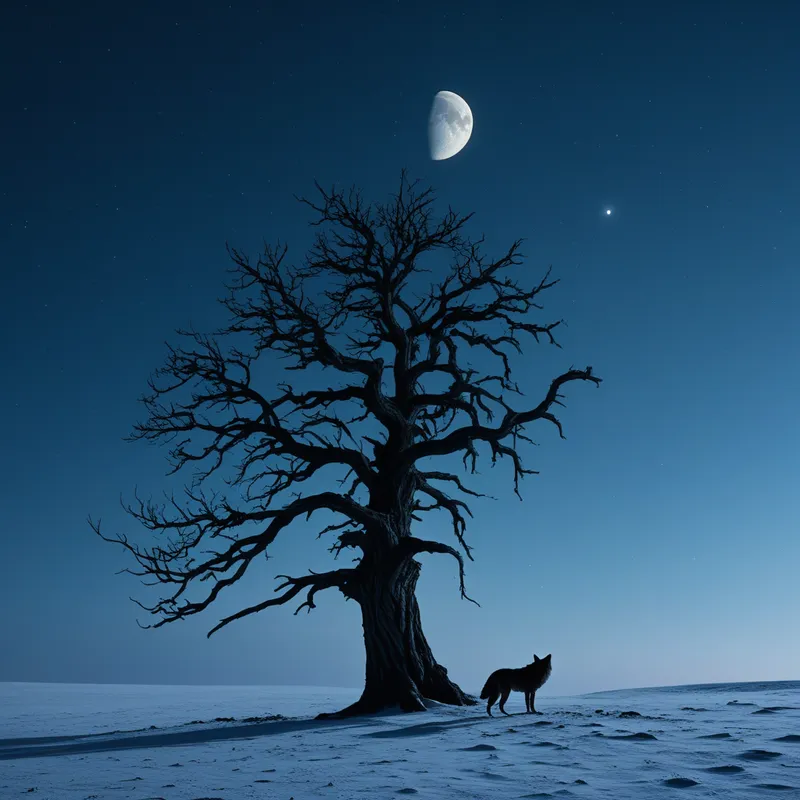
Cultural Origins & Context
This myth reaches us primarily through the Prose Edda of Snorri Sturluson, a Christian scholar writing centuries after the Viking Age. He drew from older, now-lost poetic sources, meaning the tale of Sköll and Hati is a fossil of a much older, oral tradition. It was not a bedtime story for comfort, but a cosmological truth sung by skalds and discussed in the long, dark winters.
In the Norse worldview, the cosmos was dynamic, fragile, and permeated by opposing forces. Order (örlög) was not a default state but a temporary clearing in a forest of chaos. The myth of the wolves served a critical societal function: it explained the celestial mechanics in animistic terms, but more importantly, it instilled a profound cultural psychology. It taught that even the most reliable constants—the rising sun, the cycling moon—were under threat. This fostered a worldview of courage, urgency, and a deep appreciation for the present moment, as nothing, not even the gods themselves, was eternal. The myth was a memento mori on a cosmic scale, preparing the mind for the ultimate inevitability of Ragnarök.
Symbolic Architecture
At its core, the myth is a masterful depiction of the psyche's relationship with time, consciousness, and the unconscious.
Sköll and Hati represent the devouring quality of time itself. They are Chronos, the father who eats his children. Every day is consumed by night, every month ends, every life concludes. The wolves make literal the anxiety that time is running out, that our light—our vitality, our consciousness—is being pursued by an insatiable shadow.
The wolf at the heels of the sun is the shadow cast by every moment of brilliance, the reminder that all things culminate and are consumed.
Psychologically, they embody the Shadow, in the Jungian sense. They are not "evil" in a simplistic way, but the totality of the unrecognized, instinctual, and often terrifying aspects of the self that the conscious ego (the shining, guiding light) flees from. Sól and Máni represent the differentiated conscious mind—the persona, the rational self, the light we project onto the world. The endless chase is the ego's futile attempt to outrun the contents of the personal and collective unconscious. The prophecy of their capture is the inevitable moment of confrontation, when the repressed material can no longer be avoided.
Furthermore, they symbolize polarities in tension: day/night, conscious/unconscious, order/chaos, life/death. The myth does not present a victory of one over the other, but a necessary, if terrifying, interdependence. The light has meaning only because the darkness pursues it. The structure of time exists only because of the force that seeks to dismantle it.
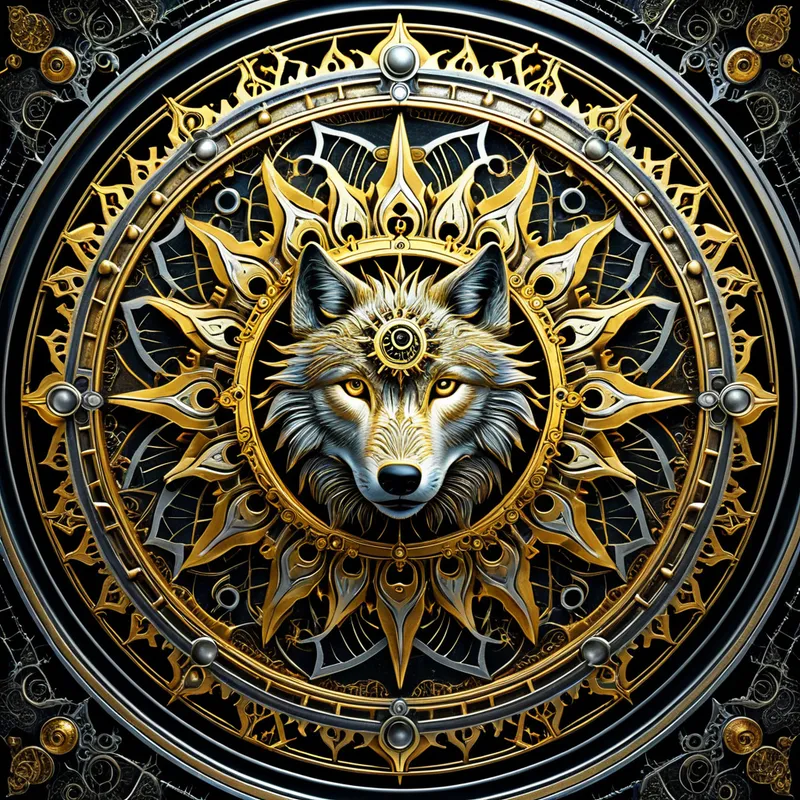
The Dreamer's Resonance
When this myth pattern emerges in modern dreams, it seldom appears as literal Norse wolves. Instead, the dreamer may experience:
- Being relentlessly chased by a silent, powerful animal or vague, looming threat.
- Watching a cherished light (a lamp, a star, a child) be swallowed by advancing darkness.
- Feeling that time is accelerating, that a deadline or ending is rushing toward them with predatory speed.
- A recurring motif of something beautiful and vital being "hunted down" in their life.
Somatically, this can feel like a low-grade panic, a tightening in the chest, or a sense of breathless running. Psychologically, it signals that the dreamer's conscious attitude is out of balance. They may be over-identifying with a radiant, perfect persona (the "sun") while ruthlessly suppressing natural instincts, anger, grief, or wildness (the "wolf"). The dream is the psyche's attempt to correct this, forcing a recognition of the pursuing force. It is the unconscious announcing, "You cannot outrun me forever. The energy you expend fleeing is the very energy that fuels my pursuit."
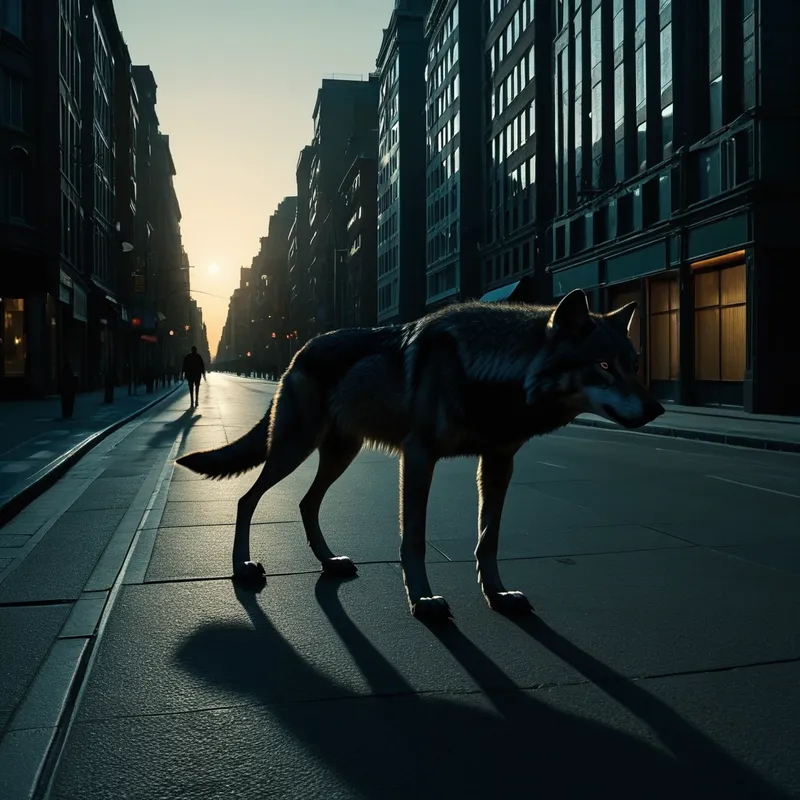
Alchemical Translation
The individuation process, the alchemical journey toward wholeness, is perfectly modeled in this myth's arc. The initial state is one of separation: the bright, conscious principle (sun/moon) is split from and terrified of its dark, instinctual counterpart (the wolves). This is the nigredo, the blackening, a state of depression and conflict where one feels hunted by one's own nature.
The work of alchemy is not to help the sun run faster. It is the sacred reversal. The goal is to turn, to face the pursuing wolf, and in that moment of terrifying confrontation, to integrate it.
The culmination of the chase is not annihilation, but a horrific, necessary marriage. The sun must be swallowed so a new, integrated consciousness can be born from the belly of the beast.
This is the albedo and rubedo—the whitening and reddening. When Sköll finally catches Sól, the world is not simply destroyed; it is cleansed in preparation for the new world that rises from the sea after Ragnarök. Psychologically, this is the ego's surrender to a greater Self. The conscious mind stops fleeing its shadow and instead incorporates its power, its primal energy, its timelessness. The wolf's hunger is transformed from a force of consumption into a force of motivation, passion, and grounded instinct. The individual who does this work no longer feels hunted by time or their own darkness. They understand they are both the light and the wolf, the runner and the pursuit, and in that paradoxical unity, they find a peace more profound than any unchallenged day.
Associated Symbols
Explore related symbols from the CaleaDream lexicon: