Odin's Throne Hliðskjálf Myth Meaning & Symbolism
Odin's high seat grants him vision across all realms, a power born of sacrifice, revealing the terrible burden and necessity of seeing the whole truth.
The Tale of Odin's Throne Hliðskjálf
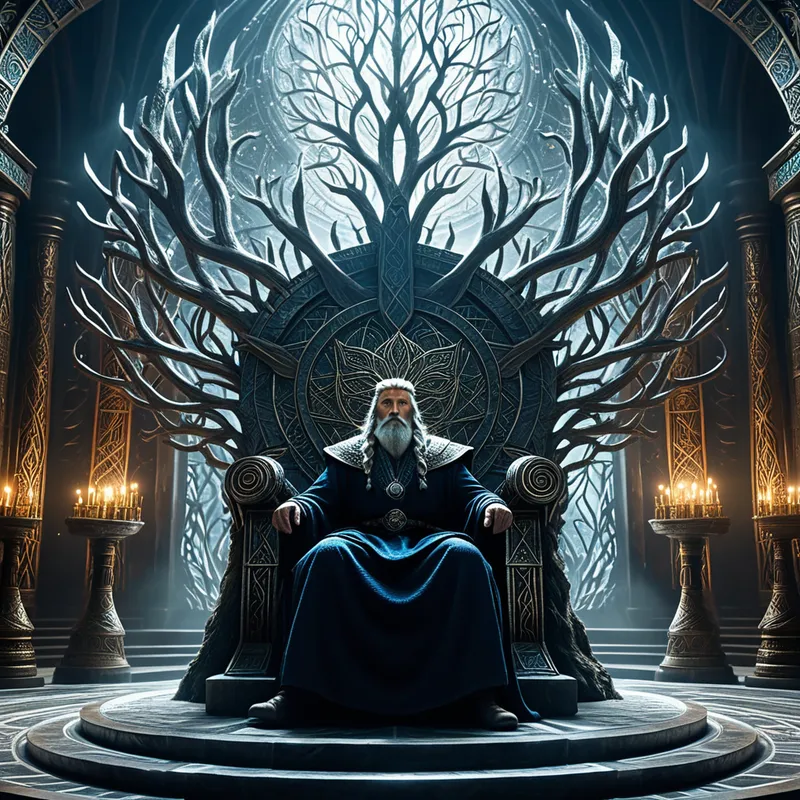
Hear now, and listen well, by the crackle of the long-fire and the whisper of the Yggdrasil's roots. In the highest reaches of Asgard, where the air is thin with starlight and the silence is that which comes before a storm, stands the hall Valaskjálf. Its roof is thatched not with straw, but with pure, beaten silver that casts a cold, unwavering light. And within this hall of terrible stillness, there is a seat.
They call it Hliðskjálf. It is no mere chair of rule. It is a vantage point, a nexus of perception woven into the very fabric of the worlds. When Odin Allfather ascends to it, a change comes over the realms. The chatter of the landvættir falls silent. The winds from Jötunheimr hold their breath. The seething cauldron of Muspelheim seems to dim for a heartbeat.
On this day, the weight upon the Allfather is a mantle of lead. He has drunk from Mímisbrunnr, but the wisdom is a sharp stone in his gut. He has hung nine nights on the windy tree, a sacrifice to himself, but the runes whisper only of endings. He settles onto Hliðskjálf, the silver strands of the roof humming in resonance. He does not look with his one remaining eye alone. He turns the seat, and his vision—the vision paid for with his own flesh and blood—unfurls.
He sees across the Bifröst, not as a rainbow bridge, but as a trembling thread of fate. He sees into the deep, pine-scented forests of Midgard, where a king, bloated with pride, signs a decree that will see his own son slain. He sees into the glittering caves of the dvergar, where a hammer is being forged whose name will be Mjölnir, and he sees the hand that will one day wield it fall still at Ragnarök. He gazes into the icy mists of Niflheim, watching the slow, inevitable procession of shades. He sees the serpent Jörmungandr stir in the deep, and the wolf Fenrir strain at his silken bonds.
And in that moment of omniscient sight, he sees her. In a sun-dappled clearing in Midgard, a woman with hair like ripe wheat sings to her child. It is a simple song, of harvest and home. For a fleeting second, Odin’s gaze softens. Here is a moment untouched by destiny’s grim weave—a fragment of pure being. But Hliðskjálf does not allow for sentiment. Its gift is the whole truth. His vision pierces forward, and he sees the fever that will take the child with the next moon, the grief that will bend the woman’s back, the song forever silenced. The knowledge is an ash-taste in his mouth. He sees the beauty and the ruin bound as one, the seed and the rot in the same apple.
A low groan escapes him, a sound that seems to vibrate through the silver thatch. He sees it all—the glorious rise, the tragic fall, the petty squabbles, the great loves, the slow decay, and the final, consuming fire. The throne gives him everything and demands everything in return. It offers no comfort, only the unbearable clarity of a god who must bear the weight of all he sees, yet cannot change the final pattern of the tapestry. He remains there, a sovereign of sight, a prisoner of vision, until the stars themselves begin to wheel overhead.
Cultural Origins & Context
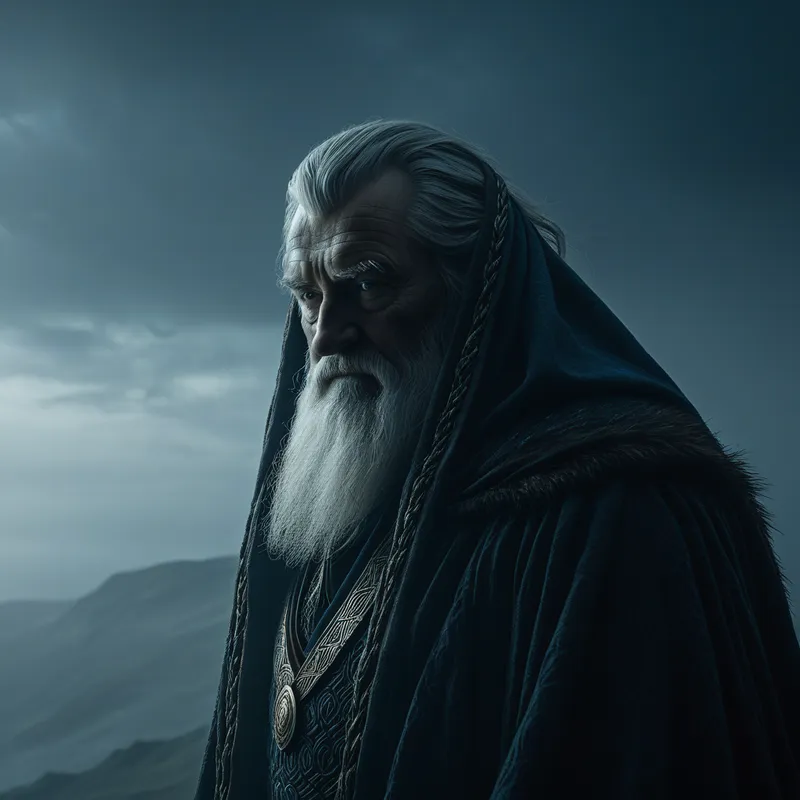
The myth of Hliðskjálf is not a single, contained story but a potent recurring motif woven through the Poetic Edda and the later Prose Edda. It was not a tale for the marketplace, but for the hall of a jarl or king, told by skalds who understood the weight of sovereignty. In a culture where knowledge was power, but also peril—where the runes held magic and the future was glimpsed in the blood of sacrifice—the image of the Allfather on his high seat served a profound societal function.
It modeled the ideal and the burden of leadership. A chieftain, like Odin, was expected to have fjölkyngi—much-cunning, a wide-ranging knowledge and foresight. He needed to see threats from afar, understand the hearts of allies and enemies, and perceive the hidden currents of fate. The myth of Hliðskjálf sanctified this necessity, but it also served as a stark warning. This vision was not free. Odin’s knowledge came at the cost of an eye, of self-torture, of constant seeking. It implied that true sovereignty, the right to sit in the high seat, required immense personal sacrifice and carried the lonely burden of foresight. The leader sees the coming famine, the potential betrayal, the cost of war, and must bear that knowledge alone before acting for the tribe.
Symbolic Architecture
Hliðskjálf is the ultimate symbol of conscious awareness elevated to its zenith. It is not merely observation, but total, unimpeded perception. It represents the pinnacle of the cognitive function, the seat of the ego that believes it can, and must, see and control everything.
The throne is the illusion of the omniscient self, a psychic structure built from the silver of ambition and the thatch of accumulated knowledge. To sit upon it is to believe one can see all angles, manage all outcomes, and bear the truth of existence without flinching.
Psychologically, it maps onto the development of the observing ego. In individuation, we must construct a "seat of consciousness" from which to view the contents of our psyche—our personal Midgard, our inner Jötunheimr of chaotic impulses, our shadowy Niflheim. This is a necessary and heroic act. However, Hliðskjálf represents the danger of this seat becoming a place of isolation and inflation. Odin’s loneliness upon the throne is the loneliness of the ego that has separated itself too completely from the raw, experiencing, suffering world below. He sees the woman’s joy and impending grief, but he cannot feel it with her. The vision is analytical, not empathetic. The throne grants perspective but at the risk of connection.
The throne’s location in Valaskjálf, the "Hall of the Slain," is no accident. It suggests that this level of detached, sovereign vision is purchased through a kind of psychic death—the "slaying" of naive identification with the world. One must sacrifice a part of one’s own living connection (Odin’s eye) to gain this overview.
The Dreamer's Resonance
When this myth stirs in the modern unconscious, it may manifest in dreams of panoramic vistas, towering observation decks, control rooms with endless monitors, or simply finding oneself in a position of overwhelming visibility and responsibility. The dreamer might feel exposed, seeing too much, or burdened by knowledge they cannot share.
Somatically, this can feel like a pressure at the crown of the head or behind the eyes—a "third eye" strained from overuse. Psychologically, it signals a process where the dreamer’s consciousness has ascended too high. They may be in a state of hyper-vigilance, over-analysis, or intellectual dissociation, trying to mentally manage and foresee every detail of their life, relationships, or work. The dream is a corrective image from the psyche, showing the cost of this inflation: profound isolation and the melancholic burden of seeing life’s tragic patterns without the mitigating grace of embodied participation. It asks: From your high seat, what warmth have you lost? What simple song can you no longer hear?
Alchemical Translation
The alchemical journey modeled by Hliðskjálf is not about attaining the throne, but about integrating its vision and then descending from it. The initial stage (nigredo) is Odin’s sacrifice—the willing gouging out of an old way of seeing (literal-mindedness, ignorance) to gain insight. The construction of the throne and the attainment of overview is the albedo, the whitening, where consciousness is purified and elevated.
The true transmutation occurs when the sage learns that the throne is not a destination, but an instrument. The gold (rubedo) is forged when panoramic vision is married to grounded heart, when seeing all does not preclude feeling deeply.
For the modern individual, this translates to the process of developing wise discernment without succumbing to cynical detachment. We must build our Hliðskjálf—our capacity for reflection, foresight, and big-picture thinking. This is crucial for navigating a complex world. But the myth insists we must also remember the price. The goal is not to live permanently in the cold, silver hall of analysis. It is to periodically ascend, gather the vision, and then return to the muddy, joyful, tragic, and beautiful world of Midgard—the world of embodied experience.
The final alchemical secret of Hliðskjálf may be this: its greatest gift is not the vision of fate, but the vision of choice within fate. Odin, seeing all, still chooses to seek knowledge, to father sons, to prepare for an end he cannot avert. He transmutes the burden of sight into the dignity of conscious action. So too must we use our hard-won overview not to freeze in despair at life’s inevitable sufferings, but to choose how we meet them—with greater compassion, wisdom, and perhaps, having seen the pattern, to sometimes step off the throne and join the song in the sun-dappled clearing while it still lasts.
Associated Symbols
Explore related symbols from the CaleaDream lexicon: