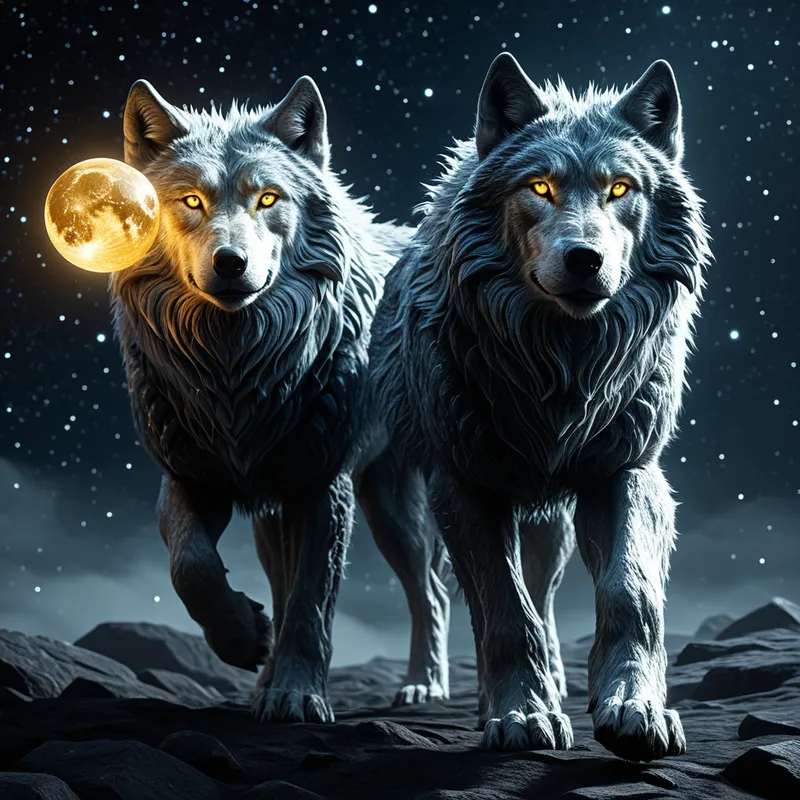
Skoll and Hati Myth Meaning & Symbolism
Two cosmic wolves eternally pursue the sun and moon, a myth of primal chase and the cyclical nature of shadow and light within the psyche.
The Tale of Skoll and Hati
Listen, and hear the tale of the sky’s great hunger.
Before the first breath of wind, in the time when the bones of the earth were still settling, there was a silence so deep it was a sound. From this silence, in the high, cold branches of the Yggdrasil, two sparks were kindled. Not by the hands of the Aesir, nor the cunning of the dvergr, but by the world’s own longing for motion. They were born as gaps in the fabric of things, as voids that learned to howl. Their names were Skoll and Hati, and they were hunger given form.
Their mother was a giantess, old as the grinding of glaciers, who dwells in the ironwood, Járnviðr. She bore many wolves, but these two were destined not for the forests of Jotunheim or the battles of gods. Their destiny was written in the trackless paths of the sky. The great chariots had begun their runs—Sol, the sun, a wheel of brilliant, life-giving flame, and Mani, the moon, a disc of cool, reflective silver. They raced across the dome of the heavens, driven by swift horses, pursued by unseen terrors.
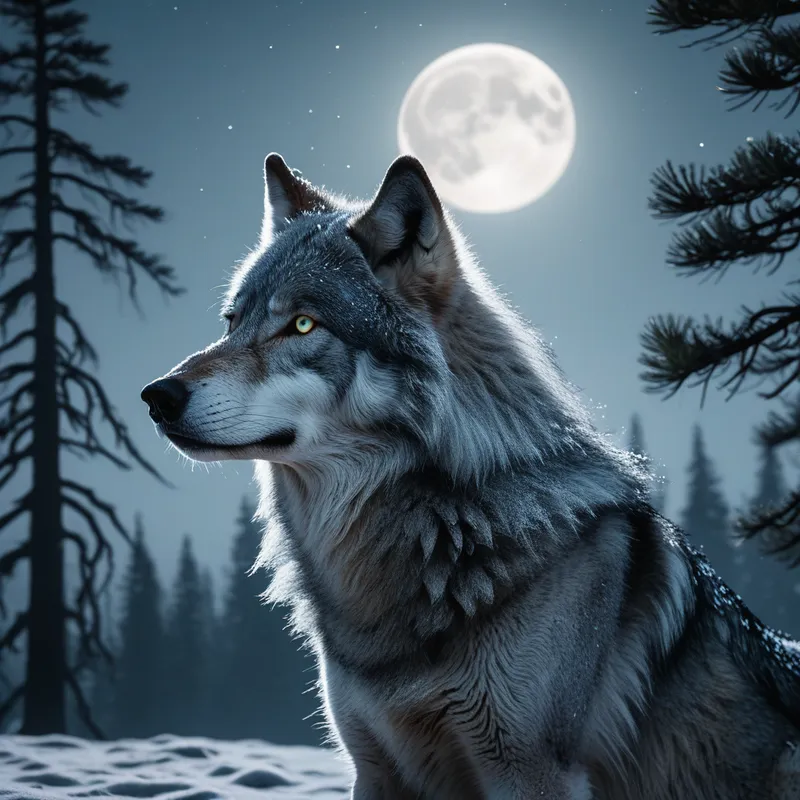
And so the chase began. It was not a hunt of malice, but a law of existence, as inevitable as tide drawn by the moon. Skoll, whose pelt seemed to drink the light, fixed his amber eyes on the sun’s blazing chariot. His lope ate the leagues of the sky, his jaws ever-gaping for that searing heat. Behind Sol, the sky bore the scorch-mark of his pursuit, the path we call twilight. Hati, lighter of foot and colder of heart, ran with the silence of hoarfrost. His silver-grey form flowed like mist after the moon’s pale cart, his hunger a silent, pulling vacuum that drew the tides of the world and the minds of men.
They never rest. Their paws beat a rhythm against the curve of the world, a drumming that marks the hours and the days. The gods hear it in their halls. Mortals feel it in the quickening of their hearts at dusk, in the deep unease of the moonless night. It is the sound of time itself being consumed. And the prophecy, whispered by the Norns at the root of the Tree, hangs over all: at the end of all things, at Ragnarök, their hunger will finally be sated. The sky will go dark. The stars will vanish. And the great wolves will, at last, taste their prey.
Cultural Origins & Context
This myth survives primarily in the Poetic Edda, specifically in the Grímnismál and Vafþrúðnismál. It was not a story for children at bedtime, but a piece of a vast, interlocking cosmological framework recited by skalds and wise individuals. Its function was explanatory, but not in a simplistic way. It did not just explain solar and lunar eclipses (though it certainly did that for the Norse mind); it explained the fundamental nature of reality as a precarious balance maintained through eternal, dynamic conflict.
The myth was told in halls smoky with firelight, under a roof that felt terribly thin against the vast, wolf-haunted sky outside. It served as a cultural mnemonic for the fragility of order (örlög) and the ever-present threat of chaos. The daily journey of the sun was not a given; it was a victory, narrowly won, that had to be won again tomorrow. This instilled a worldview of courage, resilience, and a profound awareness of cyclical time—not as a neat circle, but as a desperate, glorious race against an inevitable end.
Symbolic Architecture
At its core, the myth of Skoll and Hati is an archetypal drama of the psyche’s fundamental polarity. The sun and moon are not merely celestial bodies; they are the primordial symbols of consciousness and the unconscious, of the diurnal ego and the nocturnal soul.
The wolf is the shape of that which the light of consciousness flees, yet by fleeing, defines its own path.
Skoll, chasing the sun, represents the shadow that pursues our conscious identity, our public self, our logos and reason. He is the repressed rage, the unacknowledged ambition, the savage instinct that we outrun every day by keeping busy, by staying in the light. Hati, chasing the moon, is a subtler, more chilling force. He is the shadow that pursues our soul-life, our intuition, our dreams and reflective capacities. He is the cold fear that haunts our inner stillness, the cynicism that devours hope, the void that threatens meaning.
Their eternal chase signifies that these shadows are not aberrations to be destroyed, but dynamic, integral parts of the whole system. They provide the tension that creates the orbit. Without the wolf’s hunger, the sun would stand still—a static, scorching tyranny of consciousness. Without the chase, there is no cycle, no day and night, no process.

The Dreamer's Resonance
When this myth pattern stirs in the modern dreamer, it often manifests as dreams of being chased, of relentless pursuit, or of a celestial event gone wrong—a black sun, a bleeding moon. The dreamer may feel a somatic sense of dread, a racing heart, or a profound fatigue from running.
This is not merely anxiety. It is the psyche signaling that a long-outrun aspect of the self is gaining ground. The "wolf at the door" is the neglected instinct, the unlived life, the grief or anger swallowed down. The dream is the unconscious insisting on a more honest relationship. The chase in the dreamscape mirrors the internal process where a repressed complex (the wolf) is actively seeking integration with the guiding principle of the psyche (the sun or moon). The terror of the dream is the ego’s resistance to this necessary, alchemical encounter.
Alchemical Translation
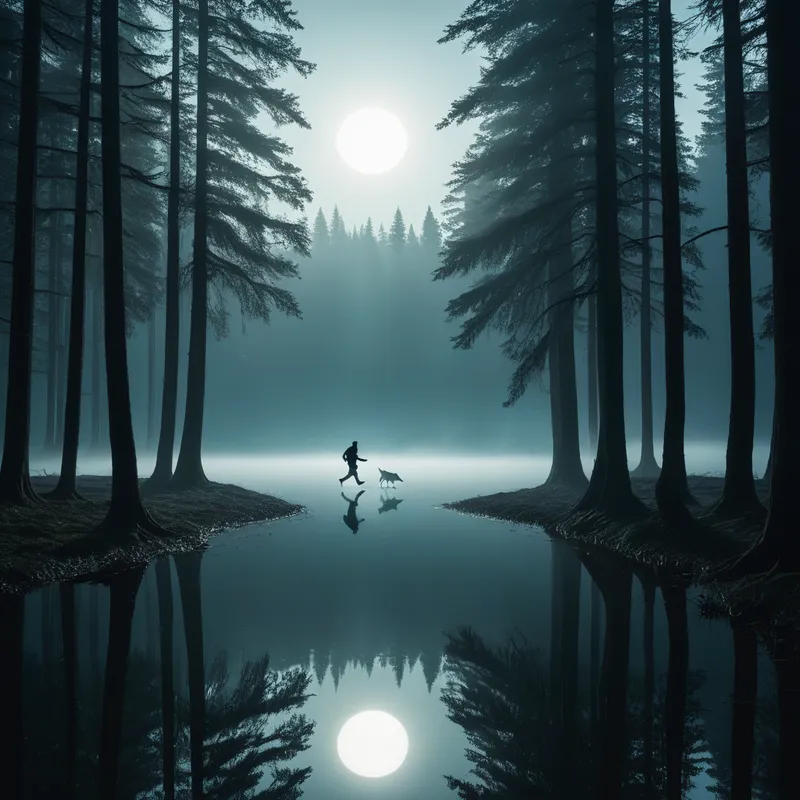
The individuation process, the journey toward psychic wholeness, is modeled not in the capture of the wolves, but in the conscious acknowledgment of the chase itself. The modern individual is both the charioteer and the wolf.
The goal is not to outrun the shadow, but to turn and face the runner, to recognize one's own face in the jaws of the beast.
The first alchemical step is Nigredo, the blackening: to stop, feel the hot breath of Skoll on your neck, and admit the existence of the rage, the pettiness, the greed you have disowned. The second is Albedo, the whitening: to stand in the cool light of the moon and let Hati’s silent presence reveal the fears that freeze your intuition, the despair that tarnishes your soul.
The transmutation occurs when you realize you are not just the prey, but also the predator. The wolf’s hunger is your hunger—for wholeness. Its endless run is your soul’s journey. To integrate this myth is to consent to the chase as the very motion of your life, to carry the shadow as part of your own substance. In doing so, you do not prevent Ragnarök—the personal crisis, the ego-death—but you meet it not as a victim of an external monster, but as a participant in a sacred, if terrifying, cosmology of the self. The darkness that falls is then not an end, but the necessary night from which a new, more conscious day can be born.
Associated Symbols
Explore related symbols from the CaleaDream lexicon: