Hlidskjalf Myth Meaning & Symbolism
The myth of the high seat from which Odin sees all, a story of forbidden vision, cosmic sovereignty, and the perilous burden of ultimate awareness.
The Tale of Hlidskjalf
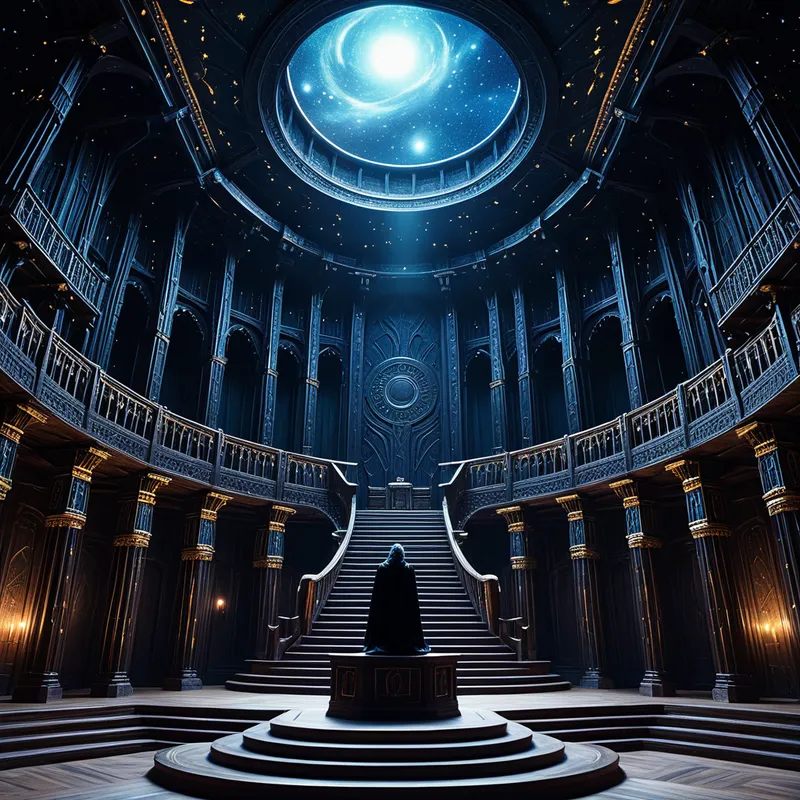
Hear now a tale not of thunderous battle or serpent’s doom, but of a seat, a silence, and a sight that shatters souls. In the realm of the Aesir, where the mead of poetry flows and the roots of the world-tree drink from deep wells, there stands a hall. Its name is Valaskjálf, and its roof is thatched with silver shields that catch the cold light of a thousand stars. Within this hall of echoes and whispers, there is a place apart. A dais rises, and upon it rests Hlidskjalf.
It is no ordinary throne. Fashioned from wood that remembers the first forests and adorned with silver that holds the memory of the moon, it is a seat of sovereignty. But its power lies not in splendor, but in sight. To sit upon Hlidskjalf is to see. Not with the eyes of flesh, but with the eye of the cosmos itself.
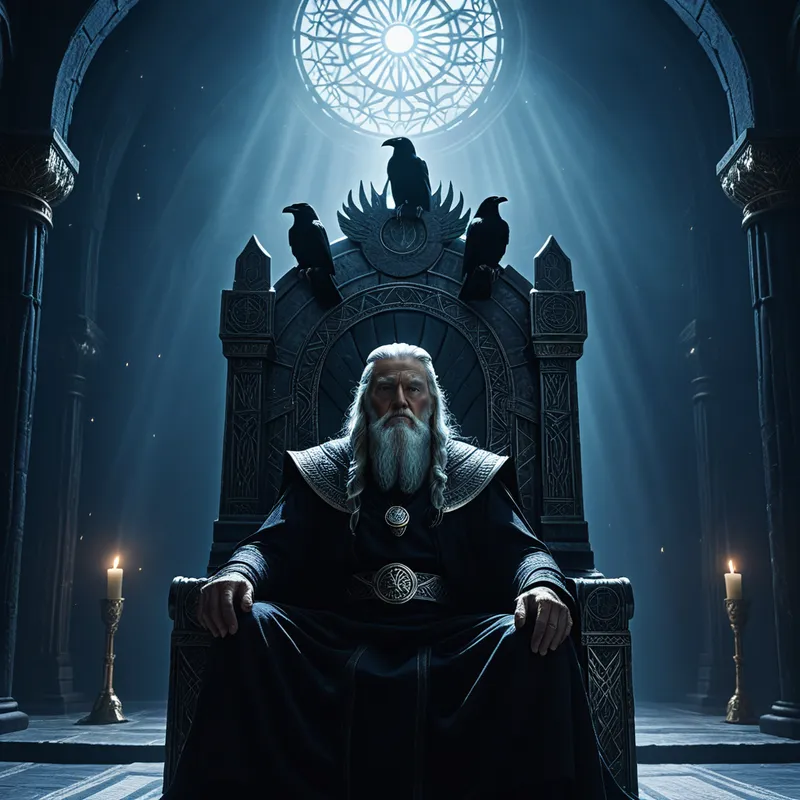
Only one has the right, and the will, to bear its burden: Odin, the All-Father, the Hooded One. We see him ascend the steps, his gait heavy not with age, but with purpose. His ravens, Huginn and Muninn, are silent on his shoulders. He lowers himself onto the ancient wood. For a moment, there is nothing. Then, the hall falls away.
The silver walls dissolve into mist. The floor becomes a pane of glass over an abyss of stars. From Hlidskjalf, his gaze unfolds like a vast, invisible net. It flies over the nine worlds cradled in the branches of Yggdrasil. He sees the light elves dancing in glades of perpetual twilight. He sees the dwarves in their soot-blackened forges, hammering fate into metal. His sight plunges into the frozen rivers of Jotunheim, where giants plot in rumbling voices. It skims the mortal realm of Midgard, where kings rise and fall, lovers meet and part, and a farmer sows his field, unaware of the god’s eye upon him.
But sight is not merely observation; it is connection. He feels the sting of the giant’s curse, the warmth of the mortal’s hearth-fire, the despair of a soul bound for the cold halls of Hel. He drinks the joy and the sorrow, the creation and the decay. It is a feast of awareness that would break a lesser mind. His face, in the non-light of the vision, is a landscape of awe and agony. This is his duty and his torment: to hold the entirety of the world-tree in his single, blazing eye.
And once, the myth whispers, another dared. The trickster god, Loki, driven by envy or boundless curiosity, slipped into the empty hall. He climbed the dais and sat upon Hlidskjalf. For a heartbeat, he saw—the glorious, terrifying tapestry. And in that heartbeat, he saw something more: the beautiful goddess Freyja in a distant field. That stolen vision, that illicit fragment of the All-Father’s perspective, sparked a chain of desire, deceit, and calamity. For the sight from Hlidskjalf is not free. It is a weight, a responsibility, and a possession fiercely guarded. Loki’s trespass was not just an act of defiance; it was a theft of perspective, and the cosmos demanded a price.
Cultural Origins & Context
The myth of Hlidskjalf reaches us primarily through the Poetic Edda and the Prose Edda, compiled in 13th-century Iceland but preserving far older oral traditions. These stories were not mere entertainment; they were the cognitive and spiritual architecture of the Norse world. Skalds (poets) and storytellers would have recited these tales in longhouses, their voices weaving the fabric of reality for their listeners, connecting the human community to the divine order.
Hlidskjalf functioned as a profound cosmological anchor. In a worldview where fate (wyrd) was woven by the Norns at the base of Yggdrasil, the concept of a centralized point of vision was crucial. It represented the divine governance of a chaotic, multi-layered cosmos. Odin’s seat was the ultimate “situation room” of the gods, a symbol of the Aesir’s attempt to impose order and foresight upon the inevitable chaos of giants, monsters, and the final doom of Ragnarok. The myth reinforced the social hierarchy, mirroring the role of the chieftain or king who must have oversight of his lands and people, yet it also spoke to the immense, lonely burden that such oversight entails.
Symbolic Architecture
At its core, Hlidskjalf is the archetypal symbol of conscious awareness itself. It is not just a throne of power, but a station of perception.
The seat of sovereignty is not made of gold or force, but of the capacity to see the whole field—the beautiful and the terrible, the near and the far—and to hold that vision without shattering.
Odin’s one eye, sacrificed at the well of Mimir for wisdom, is the necessary instrument for this throne. The physical eye sees the surface, the material. The sacrificed eye, the inner eye, perceives the connections, the patterns, the flowing streams of cause and effect beneath the surface of things. Hlidskjalf is the amplification of that inner eye. It represents the achieved perspective of the ruler archetype at its highest, most mature level: not a tyrant imposing his will, but a steward holding the complexity of the entire system in mindful awareness.
Loki’s trespass introduces the shadow of this symbol. It represents the immature, unearned desire for omniscience—the wish to see everything without the wisdom to understand it or the strength to bear its weight. It is the inflation of the ego, believing it can handle the perspective of the Self without undergoing the necessary trials (like Odin’s sacrifice). The consequence is always a fall, a disruption, because such stolen sight is out of context and divorced from responsibility.
The Dreamer's Resonance
When the symbol of Hlidskjalf appears in modern dreams, it rarely manifests as a literal Norse throne. Instead, one might dream of:
- Being in a control tower overlooking an immense, intricate city.
- Finding a secret room in one’s house with a single window that shows a panoramic view of every place they’ve ever lived.
- Sitting at a computer console where every monitor displays the live, inner emotional state of every person they know.
The somatic experience is one of simultaneous expansion and overwhelm. The dreamer may feel their consciousness straining to encompass too much, leading to a feeling of psychic vertigo or profound isolation. This is the psyche working on the task of integration. It signals a moment in life where one is being called—or forced—to see a bigger picture: the interconnected consequences of one’s actions, the hidden dynamics in a family system, or the full scope of a responsibility they have undertaken. The dream is an initiation into the burden of awareness, asking the dreamer if they are trying to “sit in Odin’s seat” before they are ready, or if they are shying away from a perspective they must, in fact, learn to hold.

Alchemical Translation
The journey toward Hlidskjalf is the alchemical process of individuation—the development of a conscious, integrated Self. It models the transformation from a fragmented ego, seeing only its own limited desires (Loki’s perspective), to a Self capable of a sovereign, holistic view of one’s own inner and outer world (Odin’s perspective).
The first step is Sacrifice (The Payment for the Seat). One cannot claim this inner sovereignty without payment. Odin gives his eye. For the modern individual, this means sacrificing a one-sided, ego-driven way of seeing. It may be the comfortable blindness of blame, the narrow focus on personal grievance, or the pleasant illusion that one’s actions have no wider ripple effects. This sacrifice is painful; it is a loss of a simpler, easier self.
The second step is Integration (Ascending the Dais). This is the slow, deliberate work of building the capacity for wider awareness. It is the practice of mindfulness, of shadow work, of listening more than speaking, of considering the perspectives of others not as threats but as parts of a whole that includes oneself. One builds the “seat” through conscious effort.
The final alchemy is not in seeing everything, but in realizing that you are connected to everything you see. The observer and the observed are threads in the same tapestry.
The final stage is Sovereign Stewardship (Sitting in the Sight). This is not a state of detached, cold observation. Odin’s vision is filled with feeling—he sees the beauty of Freyja and the terror of Ragnarok. The integrated Self holds awareness of all parts of the psyche: the noble and the shadowy, the creative and the destructive, the child and the sage. From this seat, one can make choices aligned with the whole of one’s being, not just a fragment. One governs one’s inner kingdom with wisdom born of full sight, accepting the profound loneliness and weight that comes with it, for to see the whole is to care for the whole. This is the ultimate translation of the myth: the construction of an inner Hlidskjalf, from which we can, at last, see ourselves and our world truly, and act not from reaction, but from profound, responsible vision.
Associated Symbols
Explore related symbols from the CaleaDream lexicon: