Sangkuriang Myth Meaning & Symbolism
A prince unknowingly desires his divine mother, whose thwarting of their union creates a mountain and a lake from her woven cloth and tears.
The Tale of Sangkuriang
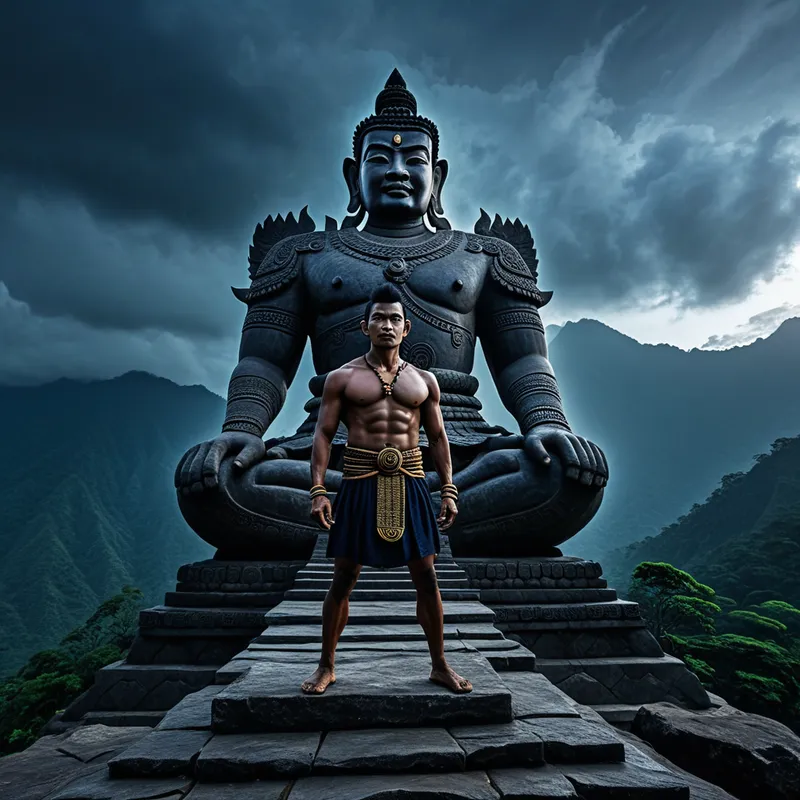
Hear now the tale that the mountains themselves remember, whispered by the winds over Lake Bandung and etched into the stone of Mount Tangkuban Perahu. In the time when gods walked closer to the earth, there lived a princess of unearthly beauty and power, Dayang Sumbi. Exiled to a life of solitude in the deep forest, her only companion was her faithful dog, Tumang, a creature of heaven sent to guard her.
From this union of goddess and divine beast, a son was born: Sangkuriang. She raised him in the green cathedral of the woods, never revealing the truth of his father. The boy grew strong and brave, a hunter with a restless spirit. One day, commanded by his mother to hunt for a deer’s heart, he ranged far and found nothing. Desperate to please her, a terrible thought took root. He drew his arrow and slew his own companion, Tumang, offering the loyal heart to Dayang Sumbi as a prize.
When she saw the heart, she knew. A cry of primordial grief tore from her lips. In her wrath and sorrow, she struck her son’s head with the very ladle she held, casting him out with a curse and a wound that would steal his memory of her. Banished, Sangkuriang wandered the world, his past a blank slate, until the years matured him into a formidable and powerful man.
Destiny, that relentless weaver, brought him back to the forest of his youth. There he saw a woman of breathtaking beauty, weaving at her loom. It was Dayang Sumbi, preserved in her divine youth. He did not know her. She did not know him, for the years had transformed the boy into a man. A fierce love, immediate and all-consuming, ignited between them. He vowed to make her his bride.
But as she tended to him, her fingers found the old scar on his head, the mark of her own ladle. Horror dawned. The beautiful stranger was her own son. Trapped by a taboo as old as time, she could not speak the truth without destroying him. So she set an impossible task: build a vast boat and fill a great lake by dawn, and she would be his. If he failed, the wedding was off.
Sangkuriang, his will fueled by a love that was also a profound ignorance, called upon the spirits of the earth and forest. An army of djinn answered. Through the night, they labored. Trees became planks, mountains were moved, and a gigantic vessel began to form in the valley. As the eastern sky began to pale, Dayang Sumbi saw he would succeed. In desperation, she unfurled her celestial weaving—a cloth of infinite length. She flung it to the east, where it blazed with the false light of dawn. The cocks crowed, believing morning had come.
Sangkuriang looked up. He saw the light and believed he had failed. A rage of cosmic proportions seized him. In his fury, he kicked the nearly completed boat. It flew through the air, landing upside down, its hull petrifying into stone. The waters he had gathered spilled and settled. And so, from a love that could never be, the world gained a new shape: the upside-down boat of Mount Tangkuban Perahu and the vast basin of Lake Bandung. Sangkuriang, in some tellings, vanished into the west, becoming the kernel of the setting sun.

Cultural Origins & Context
This myth is a cornerstone of Sundanese oral tradition from West Java. It is an etiological myth, providing a sacred narrative for the dramatic volcanic landscape around Bandung. Passed down through generations by storytellers and wayang performers, its function was multifaceted. It explained local geography, enforced social taboos—particularly the sacred prohibition against incest—and served as a cautionary tale about haste, wrath, and the consequences of deceit, even when born of necessity.
The story exists in many variants, a hallmark of a living oral tradition, but its core pillars—the unrecognized son, the impossible task, the creation from thwarted desire—remain constant. It sits at the intersection of nature worship (the personification of landscape), ancestor veneration, and deep psychological storytelling, reflecting a worldview where human passions directly sculpt the physical and spiritual world.
Symbolic Architecture
At its heart, Sangkuriang is not a simple love story but a profound drama of the Shadow and mistaken identity. The central taboo reveals the psychological danger of the unintegrated self. Sangkuriang does not know his own origin; he is a hero with a missing foundation. His desire for Dayang Sumbi symbolizes the psyche’s unconscious yearning to return to its source, to merge with the primal, nurturing Mother—a yearning that, if acted upon literally, is catastrophic.
The mountain is not just a boat turned to stone; it is the solidified eruption of a passion that could not recognize itself.
The woven cloth is a key symbol. It represents fate, time, and the fabric of reality itself, which Dayang Sumbi, as a goddess-figure, manipulates. Her weaving of the false dawn is the ultimate act of maya (illusion), a divine intervention to prevent a cosmic disorder. The impossible task is a classic mythological motif representing the trials of the hero, but here it is a test designed for failure, a riddle meant to protect the natural and psychic order.

The Dreamer's Resonance
When this myth stirs in the modern dreamscape, it often signals a profound confrontation with origins and identity. To dream of building something colossal against an impossible deadline may reflect a somatic feeling of striving from a place of deep, unrecognized lack—building a life or relationship on a foundation one does not fully understand.
Dreams of a powerful, alluring yet forbidden figure may point to an entanglement with a primal parental complex, where love is mixed with a fear of engulfment or a rage of betrayal. The feeling of a "false dawn"—of effort being sabotaged just at the point of success—can mirror the psyche’s self-sabotage when one approaches a milestone that would force a conscious recognition of a buried truth. The body may feel the heavy, petrified weight of the unfinished boat, a somatic metaphor for ambitions frozen by unconscious taboos.
Alchemical Translation
The alchemical journey in Sangkuriang is one of failed individuation, and thus a perfect negative blueprint. The process begins in the nigredo, the blackening: Sangkuriang’s original sin of killing Tumang (his father-principle) and his subsequent banishment (the loss of Self). He wanders in a state of separatio, cut off from his source.
His return and passionate love for Dayang Sumbi represent the coniunctio, the sacred marriage. But this is a false, unconscious coniunctio—a desire for fusion rather than conscious integration. The goddess-mother, representing the Self, cannot allow this psychic incest. Her impossible task is the ultimate mortificatio, the killing of the immature desire.
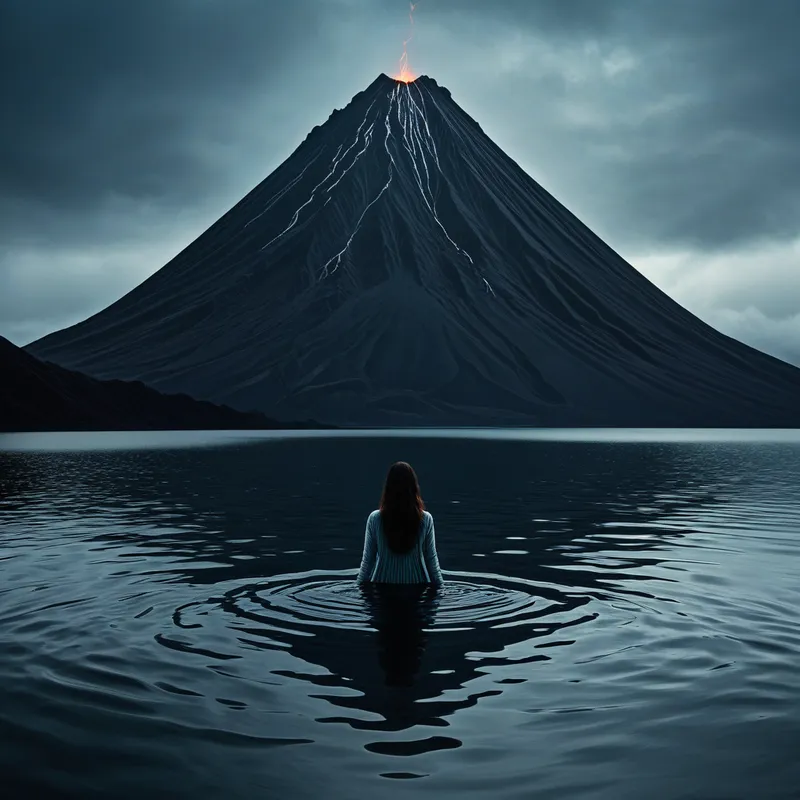
The eruption that creates the mountain is the necessary violence that occurs when an unconscious content forces its way into the world, forever altering the landscape of the soul.
For the modern individual, the myth instructs through its catastrophe. The psychic transmutation requires knowing one’s own "Tumang"—honoring the instinctual, foundational parts of oneself one may have rejected. It demands recognizing the "Dayang Sumbi" within not as an object of possession, but as the guiding, creative Self that sets boundaries for our own growth. The goal is not to kick the unfinished boat in rage, but to understand that the vessel of the personality cannot be built overnight, nor can it be built in ignorance of its own blueprint. The lake that remains is the reflective consciousness we are left with after the storm of unconscious passion subsides—a space to see clearly what was always there.
Associated Symbols
Explore related symbols from the CaleaDream lexicon:
- Mother — The divine, nurturing, and ultimately prohibitive force of origin; represents the unconscious source from which the conscious ego must healthily differentiate.
- Mountain — The solidified, eternal form of thwarted passion and colossal effort; symbolizes an enduring psychological complex or a monumental achievement born from crisis.
- Water — The gathered tears and spilled creation of Dayang Sumbi, forming Lake Bandung; represents the unconscious, emotion, and the reflective medium necessary for insight.
- Forest — The primal, secluded setting of the myth; symbolizes the unconscious mind, the place of exile, growth, and where hidden truths reside.
- Boat — The vessel of aspiration and escape that becomes a stone mountain; represents the personality or life structure built for a journey that cannot be taken.
- Dawn — The deceptive light woven by Dayang Sumbi; symbolizes false hope, illusion, and the critical moment of realization that separates success from catastrophic failure.
- Weaving — The act of creating fate, reality, and illusion; symbolizes the interconnectedness of life, destiny, and the creative power of the psyche to shape perception.
- Rage — Sangkuriang's transformative fury upon his perceived failure; represents the explosive energy of the psyche when a deeply held desire or identity is fundamentally blocked.
- Shadow — The unknown father (Tumang), the unrecognized mother, and Sangkuriang's own forgotten past; embodies the totality of the unconscious aspects the hero fails to integrate.
- Taboo — The inviolable prohibition against the mother-son union; represents the fundamental psychic and social laws that maintain order and enable conscious development.
- Creation — The genesis of tangible landscape from intangible emotion and conflict; symbolizes how profound inner struggles permanently shape the reality of the self and the world.