Oracle Bones Myth Meaning & Symbolism
A myth of seeking divine counsel through bone and fire, where ancestral whispers and cosmic will are revealed in sacred cracks.
The Tale of Oracle Bones
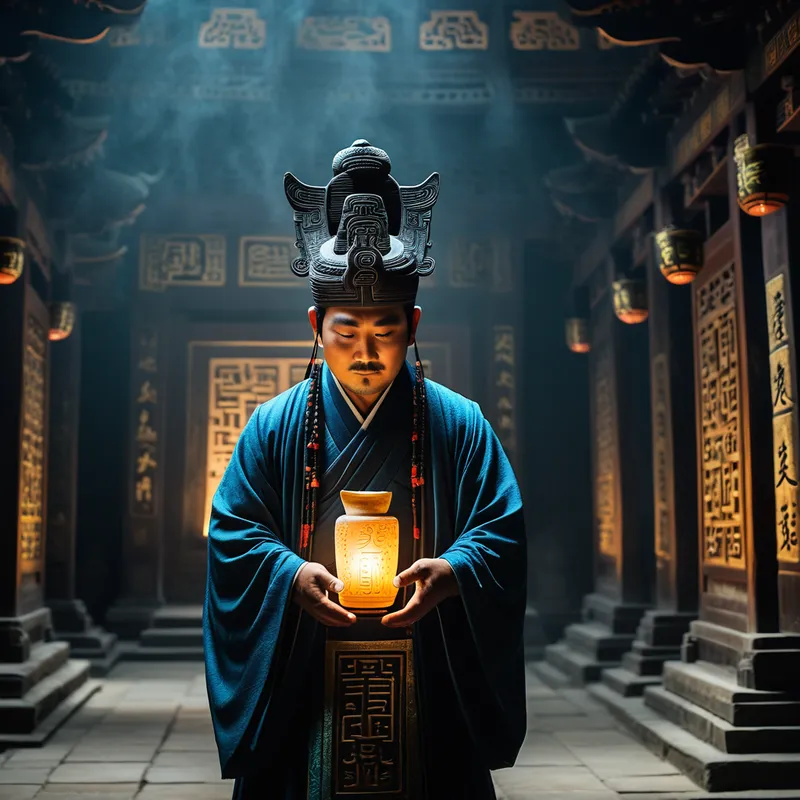
The air in the temple was thick, a palpable soup of smoke from smoldering mugwort and the collective breath of held anticipation. The king, a figure of earthly power draped in robes the color of midnight, stood as a statue of contained dread. Beyond the city walls, the enemy host gathered like a storm cloud. Within the palace, a prince burned with a fever no physician could cool. The questions hung in the air, unspoken but deafening: Will the attack come? Will the heir live? What have we done to anger the ancestors?
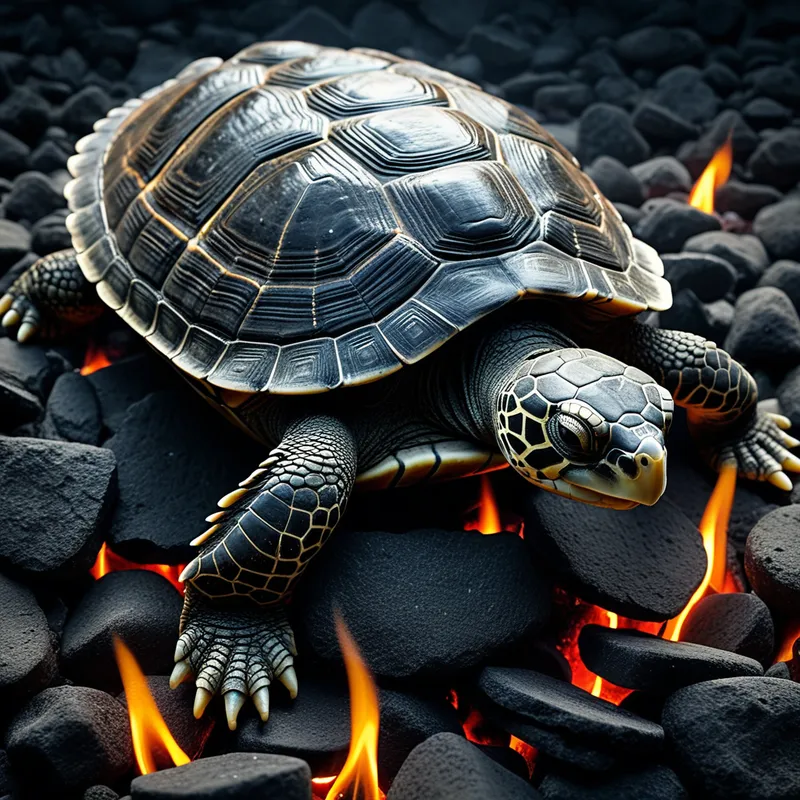
All eyes were on the bu zhen, the diviner. He was not a king, but in this moment, he was the conduit to a higher sovereignty. Before him lay the sacred artifact: the plastron of a great river turtle, a creature that bridged the elemental worlds of water and land, its surface cleaned, polished, and inscribed with meticulous rows of ancient script—the questions for the unseen. Another, the shoulder bone of an ox, symbol of steadfast earthly strength, lay ready.
His hands did not tremble as he took the bronze zhi, the pointed rod glowing cherry-red from the heart of the brazier. The only sound was the hiss of heat meeting bone. He applied the point to a prepared hollow on the turtle shell. A sharp pop, a scent of burning keratin, and then… silence.
This was the threshold. The world of men had asked its question with fire. Now, they waited for the world of spirits to answer.
And then, it came. Not a sound, but a sight. A fine, hairline crack sprinted across the bone from the point of heat. Then another, branching from the first like a lightning bolt frozen in capture. The cracks were not random; they held a grammar of the cosmos. They spoke of pressures and tensions hidden within the very fabric of destiny. The diviner’s eyes, trained over decades, read the fissures as a scholar reads text. He saw the character for “auspicious” in the clean, straight line. He saw the warning of “misfortune” in a tangled, forked branch. The ancestors, the Shang Di, and the myriad natural spirits had spoken through the medium of fracture.
A scribe, kneeling close, swiftly carved the cracks’ verdict into the bone itself, a permanent record of this dialogue between the temporal and the eternal: “Crack-making on gui-si day, divined: ‘The Fang will not attack us.’ The king read the cracks and said: ‘Auspicious. They will not attack.’” The king’s shoulders, which had held the weight of the realm, lowered a fraction. A path through the darkness had been illuminated, not by the sun, but by the sacred lines on a bone.
Cultural Origins & Context
This was not mere superstition, but the central nervous system of the Shang dynasty state. From around 1600 to 1046 BCE, the practice of pyromancy was the supreme technology of governance and cosmology. The myths and rituals surrounding the oracle bones were the domain of the royal court and its specialist priests. The bones themselves—primarily ox scapulae and turtle plastrons—were ritually prepared, becoming sacred vessels.
The process was a formalized dialogue. The questions, often posed in binary form (“Will it rain?” “Should we attack?”), were carved into the bone. The application of heat was the invocation. The resulting cracks were the divine response, interpreted by the king or his chief diviner. Finally, the prognostication and often the subsequent outcome were recorded directly onto the artifact. These bones are our earliest substantial body of Chinese writing, and they reveal a world-view where the human and spiritual realms were in constant, bureaucratic negotiation. The myth here is not of a single hero, but of a civilization’s enduring belief that the pattern of fate could be read, if one knew how to ask and how to see.
Symbolic Architecture
At its core, the myth of the oracle bone is a profound metaphor for the search for meaning in the midst of chaos and the unknown. The solid, white bone represents the known world, the conscious mind, the hard facts of a situation. It is the realm of the king—structured, inscribed with logic and question.
The crack is the intrusion of the transcendent into the immanent. It is the moment when the seamless surface of reality fractures to reveal a deeper, more complex pattern.
The fire is the catalyst of transformation, the heat of crisis, the burning anxiety or profound inquiry that forces a change in state. The crack that results is the symbol of revelation itself. It is not creation from nothing, but the disclosure of a truth already latent within the material. The bone always contained the potential for that specific pattern of fracture; the fire merely actualized it. Psychologically, this represents the idea that the answers we seek in times of turmoil are not imposed from an external deity, but emerge from the depths of our own psychic structure—our personal and collective ancestry, our innate wisdom—when subjected to the necessary heat of conscious engagement.
The bu zhen is the archetypal mediator, the function of the psyche that can hold the tension between the question (conscious ego) and the answer (unconscious Self) and translate the cryptic language of symbols into actionable insight.

The Dreamer's Resonance
When this myth stirs in the modern dreamer, it often manifests in dreams of seeking crucial answers from enigmatic sources. One might dream of examining a cracked wall or pavement and realizing the fissures form a meaningful message. Another might dream of holding a personal object—a heirloom, a stone, a piece of old wood—that heats up in their hands and splits open to reveal a glowing interior or a hidden inscription.
Somatically, this can feel like a pressure building in the chest or skull, a “burning question” that demands resolution. Psychologically, the dreamer is in the phase of the divination ritual. They have carved their question into their life through circumstance or conscious effort (the “inscription”). They are now in the painful, anxious, heated state of waiting—the application of the fire. The dream signals that the unconscious process is active; the “bone” of their current situation or identity is under transformative stress. The appearance of the crack in the dream is the first symbolic indication from the unconscious that an answer is forming, that the rigid structure of a problem is beginning to yield a new pattern of understanding.
Alchemical Translation
The alchemical journey modeled by the oracle bone is the process of individuation through sacred dialogue with the inner other. The “king” (the conscious ego) is faced with a seemingly insurmountable external threat or internal affliction. His first, instinctual move is not to charge out blindly, but to turn inward, to consult the deeper oracle.
The first stage is Preparation (The Inscription): The ego must formulate the question clearly. This is the hard work of self-reflection, of carving one’s confusion, desire, or fear into a defined form. “What is blocking my progress?” “From where does this recurring pain originate?”
The second is Ignition (The Application of Heat): This is the often painful stage of holding the question in focused awareness, allowing it to “burn.” It is the heat of sustained attention, of therapy, of meditation, of life crisis. It is the necessary suffering that forces a change in the psychic substance.
The goal is not to avoid the crack, but to learn the sacred art of its interpretation. The broken place becomes the place of reading.
The third is Revelation (The Crack): This is the spontaneous, unexpected insight—the dream image, the sudden memory, the shift in perspective that seems to come from beyond the ego. It is the pattern emerging from the fracture. The ego’s task here is not to invent, but to observe and interpret with humility.
The final stage is Integration (The Record): The new understanding must be carved back into the substance of the self. The insight becomes part of one’s personal myth, a recorded truth that guides future action. The bone, once a smooth, unreadable surface, is now a textured scripture of one’s own journey. The individual becomes, like the bu zhen, a translator between the mundane and the numinous, understanding that the self is both the question, the fire, and the bone that holds the answer in its very structure.
Associated Symbols
Explore related symbols from the CaleaDream lexicon: