
Callisto Myth Meaning & Symbolism
A nymph of Artemis, beloved by Zeus, is transformed into a bear by a jealous Hera, then placed among the stars as Ursa Major.
The Tale of Callisto
Hear now the story whispered by the pines of Arcadia, carried on the cold breath of the north wind. It begins not with a queen or a goddess, but with a woman of the wild. Her name was Callisto, and she belonged to the company of Artemis. Her home was the deep green cathedral of the forest, her roof the open sky, her companions the swift deer and the watchful owls. She wore the simple tunic of the huntress, and her hands were sure on the bow, her feet silent on the moss. She had sworn a sacred oath to remain untouched, to belong to no man, but only to the untamed world.
But the King of Olympus casts a long shadow. Zeus saw her, this paragon of fierce purity, and desire, that old, relentless fire, ignited in him. Knowing she would flee from a god in his glory, he took the form most likely to disarm her watchfulness. He came to her as Artemis herself—the same graceful stride, the same silver radiance, the same voice that commanded the loyalty of the wild. Trusting utterly, Callisto welcomed her mistress. And in that moment of sacred betrayal, the god revealed himself. The forest, her sanctuary, became her prison; her strength was as nothing against divine power.
Time passed, and during a ritual bath in a clear, cold stream, the truth could no longer be hidden. As the nymphs shed their garments, Callisto’s body told the secret. Artemis, the uncompromising guardian of virginity, saw the evidence of motherhood. Fury, cold and absolute, seized the goddess. There was no trial, no hearing for the violation that had been committed against her follower. The punishment fell upon the victim. With a word of ancient power, Artemis transformed her. The graceful huntress contorted. Soft skin prickled into coarse, dark fur. Her slender hands curled into massive paws. Her human cry became a deep, bewildered roar. Callisto was cast out, a shaggy, lonely bear wandering the very woods she once ruled, her mind a trapped, grieving human consciousness within a beast’s form.
Years lumbered by. She bore a son, Arcas, who was taken from her and raised among men. He grew into a skilled hunter. And the cruelest twist of fate was yet to come. One day, in the deep wood, the hunter and the hunted stood face to face. Arcas, seeing only a dangerous beast, drew his spear. The great bear, recognizing her own child, reared up—not to attack, but in a desperate, silent plea. The spear was poised to strike.
It was then that Zeus, perhaps stirred by a late pang of guilt, or perhaps merely enacting his will, finally intervened. He swept down in a whirlwind, staying the fatal blow. In one swift, cosmic motion, he grasped both mother and son and hurled them into the vault of the night sky. There, Callisto was fixed forever as Ursa Major, the Great Bear, circling the celestial pole. Her son Arcas became Arctophylax, the Bear-Watcher, forever near yet forever separate. And the queen of heaven, Hera, whose jealousy had fueled the tragedy, secured one final vengeance: she persuaded the elder sea-gods to decree that the bear must never bathe in the restorative waters of the ocean, condemning her to an eternal, parched circuit in the stars.

Cultural Origins & Context
The myth of Callisto is primarily preserved in the work of the poet Ovid, in his Metamorphoses, and in earlier fragments from the Catasterismi, a work on star myths. It is a tale deeply embedded in the Greek worldview, serving multiple functions. On one level, it is an aition—a story explaining the origin of a natural phenomenon, in this case, the circumpolar constellations of Ursa Major and Ursa Minor (sometimes associated with Arcas) and their never-setting nature.
The myth also reflects profound societal tensions. It exists at the fraught intersection of wilderness and civilization, purity and violation, female autonomy and patriarchal power. Callisto’s story was told in a culture where the vows of a priestess or a devotee were sacred, and their breaking carried cosmic consequences. Yet, it also starkly illustrates the vulnerability of mortal women to the caprice of the gods. The narrative was a tool for exploring the consequences of transgression, the cruel caprice of fate, and the ultimate, if melancholic, order imposed by the cosmos, which transforms personal tragedy into eternal, navigational patterns.
Symbolic Architecture
At its core, the myth of Callisto is a profound map of the violated self and its forced metamorphosis. Callisto represents the aspect of the psyche that is in sacred communion with instinct, wildness, and autonomous being—the anima in its natural state. Her oath to Artemis is a psychic pact with this self-contained, whole identity.
The first betrayal is not the transformation into a beast, but the violation of the inner sanctum by a force wearing the face of one's highest trust.
Zeus, as the archetypal patriarch and the personification of overwhelming, often unconscious, psychic force (the Self or the collective dominant), shatters this wholeness. His disguise as Artemis is the most chilling symbol: it is the corruption of one’s own guiding principles, the perversion of inner authority that leads to the psyche’s own undoing. The resulting pregnancy signifies the birth of something new from this trauma—a potential future self (Arcas) that is, for a time, completely alienated from its source.
Artemis’s wrath symbolizes the ruthless, puritanical aspect of consciousness that cannot tolerate complexity or the stain of experience. It would rather annihilate the violated than reconcile with its new state. The bear transformation is thus a descent into the instinctual shadow—not a regression, but a catastrophic encapsulation. Callisto becomes the wildness she served, but now as an outcast, a conscious mind trapped in an unconscious form. The near-murder by Arcas represents the ultimate psychic danger: the new consciousness, born of the trauma, turning to destroy its own repressed, instinctual origin, completing the cycle of self-annihilation.

The Dreamer's Resonance
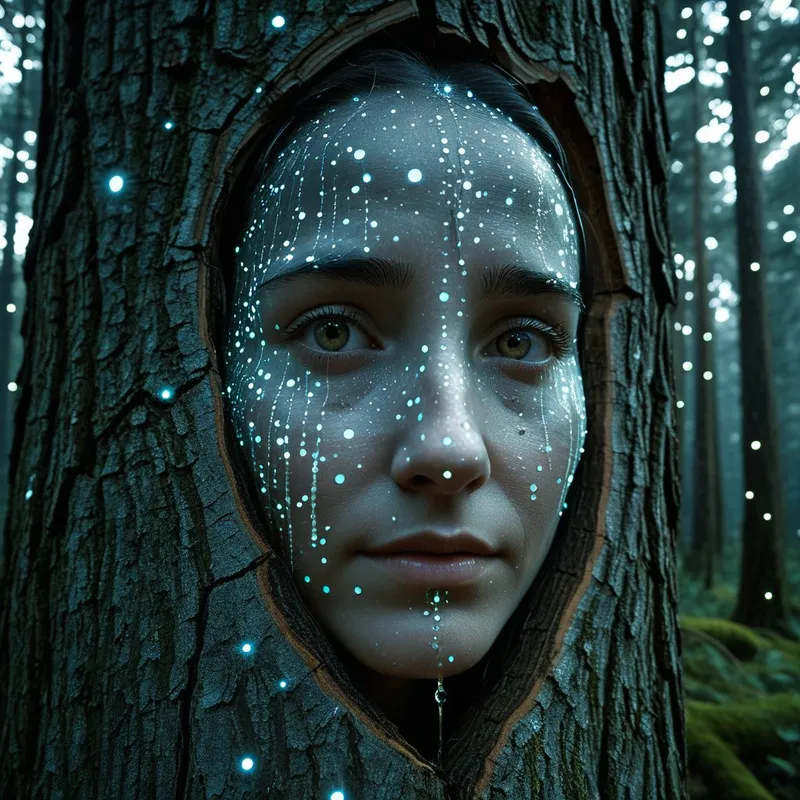
When this myth stirs in the modern dreamer, it often signals a profound process of alienation from one’s own nature following a violation or deep betrayal. The dream imagery may be stark: finding oneself in a familiar place (a home, a body) that has become alien and hostile. One may dream of being unable to speak, only to growl or roar, symbolizing the failure of cognitive, human language to express a primal wound. Dreams of being pursued by a hunter, or of being a silent observer in an animal’s body while family members walk past unseeing, are classic resonances.
Somatically, this can feel like a heavy, lumbering presence in the body—a weight of grief or rage that has no civilized outlet. It is the feeling of being “furred over,” emotionally numb yet raw underneath, trapped in a cycle of behavior or identity that feels brutish and unlike oneself. The psyche is working through the trauma by embodying it completely, wearing the shape of the damage until it can be seen, recognized, and ultimately, perhaps, redeemed by a force greater than the punitive ego (Artemis) or the traumatizing complex (Zeus).
Alchemical Translation
The alchemical journey modeled by Callisto is not one of heroic conquest, but of catastrophic nigredo—the blackening, the descent into the uttermost dark—followed by a cosmic, if involuntary, sublimation. The process begins with the violation of the prima materia, the pure, natural state. The forced union (Zeus and Callisto) is the coniunctio gone horribly wrong, a blending that creates not gold but leaden despair.
The long wandering as a bear is the essential stage of mortificatio and putrefactio. The old identity dies and rots within the new, horrifying form. This is not active shadow work, but shadow enclosure. The ego is imprisoned within the very thing it fears and rejects. The pivotal moment with Arcas is the brink of annihilatio, where the emerging, differentiated consciousness seeks to destroy its shadow-mother, which would result in permanent psychic fragmentation.
Salvation, in this alchemy, comes not from within the trapped self, but from a transcendent re-contextualization. The catastrophic fixatio (being turned to beast) is resolved by a celestial sublimatio.
Zeus’s final act—catasterism, placing them among the stars—is the archetypal sublimatio. The base, traumatized, earthly experience is lifted into the realm of the eternal and symbolic. Callisto does not become human again; she becomes a constellation. Her pain is not erased but given meaning, made into a guiding light. She is fixed in a pattern, her chaotic, painful journey given an eternal, revolving order. For the modern individual, this translates to the process of finding the mythic pattern in one’s own trauma. It is the work of seeing the personal catastrophe not just as a wound, but as the origin story of a unique, navigational wisdom—a fixed point in the inner cosmos around which the rest of the psyche can orient itself, forever circling, forever remembering, yet now part of an ordered, starry whole.
Associated Symbols
Explore related symbols from the CaleaDream lexicon: