
Eurydice Myth Meaning & Symbolism
A poet descends to the underworld to retrieve his lost love, but a single glance back to ensure she follows dooms her to remain in the realm of shadows.
The Tale of Eurydice
Listen, and hear the song that broke the heart of the world.
In the golden age of heroes, when rivers sang and trees whispered secrets, there lived Orpheus. His music was not mere sound; it was the very breath of the cosmos given voice. Stones wept to hear it, and savage beasts lay down in peace. His love was Eurydice, a being of the forest whose laughter was the rustle of leaves and whose step was lighter than dappled sunlight on the forest floor. Their union was a harmony, a perfect chord struck between the human and the wild.
But the Fates, who spin, measure, and cut the thread of life, are jealous of perfection. On their wedding day, as Eurydice danced with her sister nymphs in a meadow, a venomous serpent, hidden in the long grass, struck her bare heel. The music of her life ended in a single, sharp silence. Her light faded, and her shade was drawn down, down the long, dark path to the House of Hades.
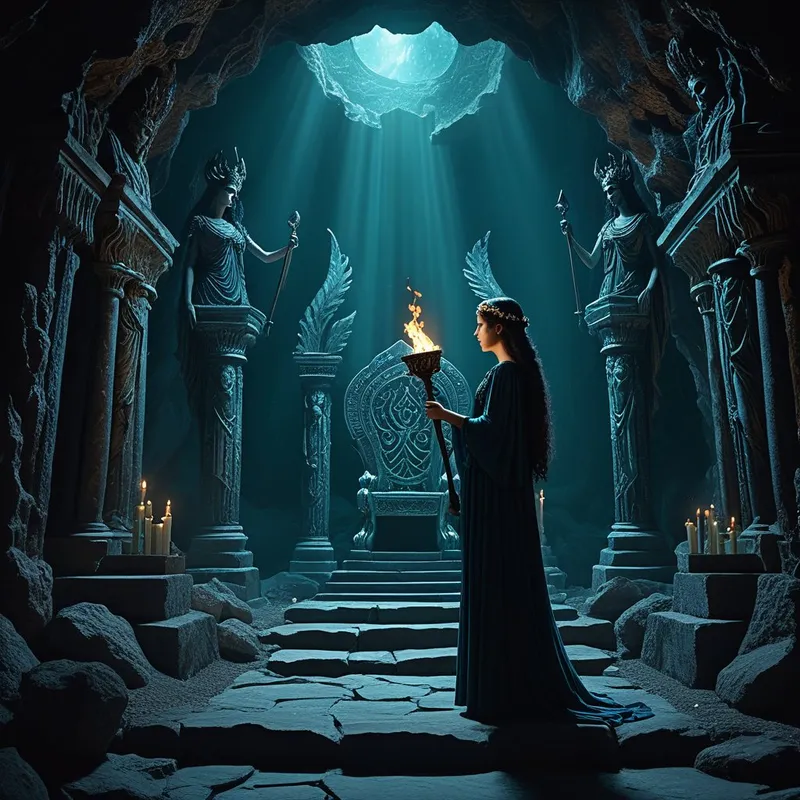
Orpheus’s world shattered into dissonance. His songs became dirges. Driven by a love that refused the finality of death, he took up his lyre and did the unthinkable: he walked the path of the dead. He descended through the cave of Tainaron, past the weeping ghost of the ferryman Charon, and stood before the ebony thrones of Hades and his queen, Persephone. There, in that sunless hall, he played. He sang of his love, of the cruel theft of beauty, of a world made barren by her absence. His music was so pure, so full of raw, mortal ache, that the very stones of Tartarus softened. The tormented Erinyes wept tears of black iron. For the first and only time, the heart of the deathless king was moved.
Hades granted the impossible boon. Eurydice could follow Orpheus back to the world of the living, on one condition: he must not look back at her until they had both fully emerged into the light of the upper world. She would walk behind him, a silent shade, guided only by the sound of his footsteps and his faith.
The ascent was an agony of hope. Orpheus led, hearing only the echo of his own steps in the terrifying silence. Was she there? Had the lords of the dead tricked him? The doubt grew with every step, a serpent coiling in his mind. As the first, faint glow of daylight began to stain the tunnel’s mouth, his fear overcame his faith. He had to know. He turned.
And there she was. His Eurydice, her eyes meeting his with a love as deep as the abyss from which she came. But in that moment of connection, the condition was broken. A soft cry escaped her lips—not of anger, but of infinite sorrow. “Farewell,” she whispered, and was drawn back into the depths, not as a reluctant shade, but as a soul forever lost by the love that sought to save her. His outstretched hand grasped only empty, cold air. The gates of Hades closed a second time, this time forever.
Cultural Origins & Context
The myth of Orpheus and Eurydice is most famously preserved in the Roman poet Ovid’s Metamorphoses and the Greek poet Virgil’s Georgics. However, its roots are far older, woven into the fabric of Orphic mystery cults that flourished in the ancient Greek world from the 6th century BCE onward. These cults, centered on the figure of Orpheus, promised initiates a blessed afterlife through ritual, asceticism, and sacred poetry. The descent to the underworld was not just a story but a core metaphor for the soul’s journey.
The myth functioned on multiple societal levels. As a public story, it was a profound meditation on the human condition: the power of art (Orpheus’s music), the fragility of happiness, and the immutable laws of fate and the divine. It explained why death is final, teaching the painful lesson that some losses cannot be undone, even by the greatest love or talent. Privately, within the mystery cults, it was a map for the soul’s own katabasis (descent) and potential anabasis (ascent), offering hope for transcendence beyond the finality that the public myth so tragically affirmed.
Symbolic Architecture
The myth is a perfect, heartbreaking blueprint of the psyche’s encounter with loss, doubt, and the nature of consciousness itself.
Eurydice represents the anima, the soul-image, or any aspect of our deepest, most vital life that is suddenly taken from us—not just a loved one, but inspiration, innocence, or a state of wholeness. Her death by serpent in a meadow ties her to the eternal cycle of nature (life, sudden death) and to a kind of primordial, unconscious knowing (the serpent).
The Underworld is the unconscious. It is not a place of punishment, but of reality—the realm where what is lost resides in its true, shadowy form. Orpheus’s journey is the heroic, conscious ego’s attempt to reclaim a lost part of the self from the depths.
The condition—do not look back—is the central, agonizing law of psychic retrieval. It is the demand for faith in a process that cannot be scrutinized by the doubting, analytical eye of consciousness.
The glance back is not a mere mistake; it is the inevitable failure of the conscious will when faced with the unconscious process. It is the need for proof, for confirmation, for the ego to assert control and see the transformation it has initiated. This glance objectifies the soul, turning the living process of integration (her following him) into a static image to be possessed. In that moment, the connection is severed. The soul cannot be integrated through force of will or desperate longing alone; it requires a surrender to the process, a walking in faith through the darkness.

The Dreamer's Resonance
When this myth stirs in the modern dreamer, it often manifests as a profound somatic experience of almost. You dream of a lost loved one who turns a corner just before you can see their face. You are in a dark place, following a voice or a light, but a deep, instinctual anxiety compels you to look over your shoulder, and upon doing so, the path vanishes. You find a precious, long-lost object, only to watch it dissolve in your hand upon waking.
Psychologically, this is the psyche working through a process of retrieval that is not yet complete. The dreamer is in the "ascent," attempting to bring a repressed memory, a stifled talent, or a grieving heart back into the light of daily life. The "look back" in the dream is the ego’s panic, its inability to trust that healing is occurring without constant, anxious monitoring. The dream repeats the pattern to show the dreamer where their consciousness is interfering with their own soul’s return. The feeling upon waking is not just sadness, but the specific ache of self-sabotage—the recognition that we, ourselves, broke the condition for our own wholeness.

Alchemical Translation
The alchemical journey is one of solve et coagula: dissolve and coagulate. The myth of Eurydice is the supreme allegory for this process in the realm of love and loss.
First, the solve: the blissful union (the conjunctio) is dissolved by the serpent’s bite. The conscious personality is shattered, forced into the nigredo, the black despair of the underworld. Orpheus’s music here is the first stirring of the alchemical art—the attempt to find harmony even in the darkest matter.
The journey to reclaim Eurydice is the arduous work of separation and purification. Hades’s condition is the precise rule of the opus: the work must be done in darkness, without the interference of ordinary consciousness. The ascent is the albedo, the whitening, the slow emergence of hope and spirit.
The fatal glance is the moment the alchemist opens the vessel too soon, ruining the long incubation. The psychic material, not yet fully transformed, cannot withstand the light of scrutiny and falls back into chaos.
For the modern individual, the alchemical translation is clear. We all experience catastrophic losses—of relationships, dreams, or parts of ourselves. The instinct is to desperately try to drag the past, unchanged, back into the present (Orpheus’s quest). The work of individuation, however, is to make the descent, to grieve fully in the darkness of the unconscious (sitting with Hades and Persephone). Then, we must begin the ascent, not by clutching the old form, but by having faith that what is essential—the prima materia of our experience—is following us, being transformed by the journey itself. We must resist the backward glance of obsession, regret, and the need for guaranteed outcomes. The triumph is not in the retrieval of the lost object, but in the transformation of the one who made the journey. Orpheus returns alone, but his music, born of that searing loss, becomes transcendent. The soul he sought to save outside of himself becomes the enduring song within.
Associated Symbols
Explore related symbols from the CaleaDream lexicon: