The Chameleon and the Lizard Myth Meaning & Symbolism
A myth where a chameleon's deliberate pace and a lizard's frantic haste deliver conflicting messages from the gods, deciding humanity's fate with death.
The Tale of The Chameleon and the Lizard
In the time before time, when the sky was closer to the earth and the breath of the first beings still warmed the soil, the Great Spirit looked upon the newly formed humans. They were beautiful in their form, but fragile in their substance—made of clay and water, animated by a borrowed spark. A great question hung in the air, thick as the humidity before a storm: should these creatures live forever, or should they know an end?
The Great Spirit called a council beneath the oldest baobab, its branches holding up the heavens. The decision was made. Humanity would be offered the gift of eternal life. But a gift must be delivered, and a message must be carried. The Spirit chose two messengers, each a master of their domain.
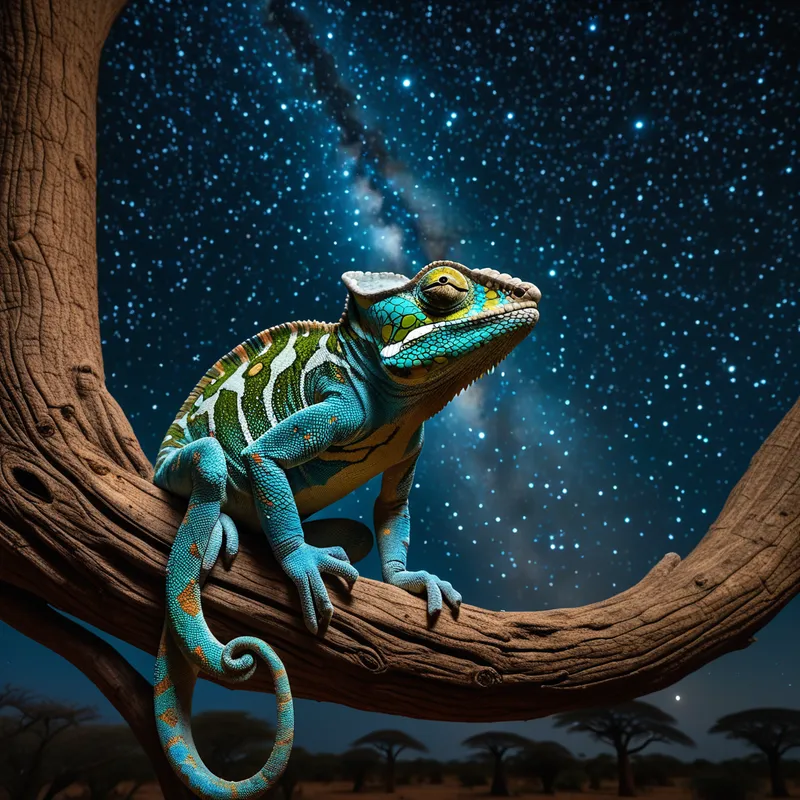
To the Chameleon, patient and deliberate, was given the message of life. “Go to the humans,” the Spirit instructed, its voice like wind through dry grass. “Tell them they shall not die. They shall shed their years like old skin and be renewed with the rains.” The Chameleon, wise and steady, took the sacred word into its mouth. It began its journey with infinite care, placing one meticulous foot after another, its eyes swiveling to behold the wonder of the world. It moved with the pace of a growing mountain.
But doubt, that sly whisperer, had been listening. It slithered to the Lizard, who was busy tasting the air with its quick, flicking tongue. “See how the Chameleon dawdles!” doubt hissed. “The humans will grow old and despair waiting. They need an answer now. Go, swift one. Tell them the opposite, that they shall die. It is the only certainty. Be the bearer of decisive news.”
The Lizard, agitated by the urgency, did not wait for a formal decree. It darted forward, a streak of scaled energy over the hot earth. It raced past the slow-moving Chameleon, kicking up puffs of red dust. Its heart beat a frantic rhythm against its ribs as it sped towards the human villages.
The Chameleon saw the Lizard pass but did not alter its pace. It knew the weight of the word it carried. It moved through the forest, its skin blending with leaf and bark, becoming a part of the journey itself.
The Lizard arrived first, panting, at the edge of the human settlement. It scurried up a post and shouted its message with all its might. “Hear me! The word from the Great Spirit is this: You shall die! Death is your destiny!” The humans heard. A great wail went up. They felt the cold shadow of an ending fall upon their hearts for the very first time.
Much later, when the sun had journeyed across the sky and begun its descent, the Chameleon finally arrived. It climbed onto the same post, now cool in the twilight. It opened its mouth and spoke the true message, its voice a slow, deliberate rasp. “The Great Spirit sends this word: You shall not die.”
But it was too late. The first message, delivered with such haste and conviction, had already taken root in the human soul. The law had been set. The word of the Lizard, once spoken, could not be un-heard. The Chameleon’s truth became a haunting echo of a possibility forever lost, a shimmering mirage of immortality just beyond the horizon of time. And so, mortality settled upon humanity, not as a curse from the gods, but as the indelible consequence of a message delivered in haste, accepted in fear.

Cultural Origins & Context
This profound narrative finds its roots among several peoples across the African continent, including the Zulu, Basotho, and other Bantu-speaking groups. It is a classic example of an etiological myth, specifically addressing the fundamental human condition of mortality. Unlike many creation myths that involve direct punishment or divine flaw, this story presents a more nuanced, almost procedural tragedy.
It was traditionally told by elders and storytellers, often during initiations or gatherings under the night sky. Its function was multifaceted: to explain the universal reality of death, to impart values of patience, deliberation, and discernment, and to explore the complex relationship between divine intention and mortal action. The story served as a philosophical tool, teaching that fate is not always a sealed decree from above, but can be shaped—for better or worse—by the intermediaries and the readiness of those who receive the message.
Symbolic Architecture
The myth constructs a powerful symbolic framework around time, communication, and the nature of truth.
The first word to reach the heart becomes the law of the world, regardless of its origin.
The Chameleon represents divine time, synchronicity, and integrated wisdom. Its color-changing ability symbolizes adaptability and perception—it sees the whole picture and becomes part of it. Its slowness is not incompetence, but the pace of authenticity and the careful bearing of a sacred truth. It is the messenger of the Self, the totality of the psyche, which operates on a timeline beyond egoic impatience.
The Lizard embodies the anxious, reactive ego. It is haste, anxiety, and the human propensity for catastrophic thinking. It acts on the first compelling impulse (the whisper of doubt) and mistakes speed for efficacy. The Lizard is the part of us that would rather have a terrible certainty than live with a pregnant, unfolding mystery. It delivers the message of the Shadow—our fear of annihilation—and presents it as ultimate reality.
The conflict is not between life and death, but between two modes of being: the deliberate, embodied pace of the Chameleon versus the frantic, disembodied rush of the Lizard. Humanity’s acceptance of the Lizard’s word signifies our collective psychological identification with the ego’s fears rather than the soul’s timeless potential.

The Dreamer's Resonance
When this myth pattern stirs in the modern unconscious, it often manifests in dreams of missed messages, slow-motion running, or receiving contradictory news. To dream of a chameleon might indicate a need for patience, adaptability, or that a deep, authentic truth is slowly making its way to your awareness. It can feel like a frustrating delay in a time of crisis.
Dreaming of a lizard, especially one darting frantically, often correlates with anxiety, a sense of racing against time, or acting on panic rather than wisdom. You may be “beating yourself to the punch” with self-sabotaging narratives. The core somatic experience is one of tension—between the gut’s intuitive, slow knowing and the mind’s frantic need for a conclusion. This dream myth activates when we are at a existential crossroads, where a hasty decision (in relationships, career, or self-concept) could cement a limiting “fate” for ourselves, foreclosing on a more expansive possibility that requires patience to emerge.
Alchemical Translation
The psychic alchemy modeled here is the transmutation of Lizard-time into Chameleon-time—the integration of the ego’s haste into the soul’s patience. This is a core process of individuation.
The work is not to outrun death, but to slow down enough to hear the message of life that is still on its way.
The first stage is Nigredo: the blackening. This is the moment the Lizard’s message is accepted—the confrontation with our mortality, limitations, and the ego’s fearful projections. We must fully feel the grief of believing the hasty, fearful story we’ve told ourselves about who we are and what is possible.
The Albedo, or whitening, is the arrival of the Chameleon. It is the dawning awareness that another message exists. This is not about denying death, but about realizing that the quality of our living—its depth, authenticity, and connection—is determined by which messenger we choose to heed in our daily lives. Do we operate from panic or from presence?
The final stage, Rubedo, the reddening, is the integration. It is not achieving immortality, but achieving a state where the truth of the Chameleon—the soul’s timeless, adaptable essence—informs our mortal journey. We live with the knowledge of an end, but we are paced by the wisdom of the eternal. We carry our own sacred message. We become the vessel that can hold both truths: the Lizard’s fact of physical cessation, and the Chameleon’s truth of psychic continuity. In this synthesis, we don’t escape fate; we transform our relationship to it, moving through our allotted time not with frantic dread, but with deliberate, color-shifting authenticity.
Associated Symbols
Explore related symbols from the CaleaDream lexicon:
- Chameleon — The deliberate messenger of life, representing divine time, adaptability, integrated wisdom, and the slow, authentic delivery of the soul's truth.
- Lizard — The hasty messenger of death, embodying the anxious ego, catastrophic thinking, and the human tendency to accept fearful certainty over patient mystery.
- Message — The divine decree about human fate, symbolizing the core truths or potentialities about our existence that we must either receive with patience or distort with haste.
- Time — The central conflict of the myth, represented by the opposing paces of the two creatures, questioning whether our reality is ruled by frantic linear time or deep, cyclical soul-time.
- Death — The condition established by the accepted message, representing not just physical end, but the psychological acceptance of limitation, finality, and fear-based narratives.
- Spirit — The originating source of the message, representing the unconscious Self or the cosmic order from which our fundamental nature and potential emanate.
- Shadow — The whispering source of doubt that spurs the Lizard into action, representing the repressed fears and negative impulses that can hijack our mission if not integrated.
- Journey — The path from the divine source to humanity, symbolizing the process of bringing unconscious potential into conscious reality, a voyage easily misdirected by haste.
- Fate — The outcome decided by which message is heard first, representing how our psychological readiness and biases shape the "destiny" we experience, more than any absolute decree.
- Patience — The virtue embodied by the Chameleon, representing the necessary container for deep transformation and the ability to hold uncertainty without collapsing into fear.
- Haste — The vice embodied by the Lizard, representing the ego's defense against the anxiety of the unknown, often creating the very tragedy it seeks to avoid.