The Greek Moirai Myth Meaning & Symbolism
The three primordial sisters who spin, measure, and cut the thread of every mortal and divine life, embodying the inexorable law of destiny.
The Tale of The Greek Moirai
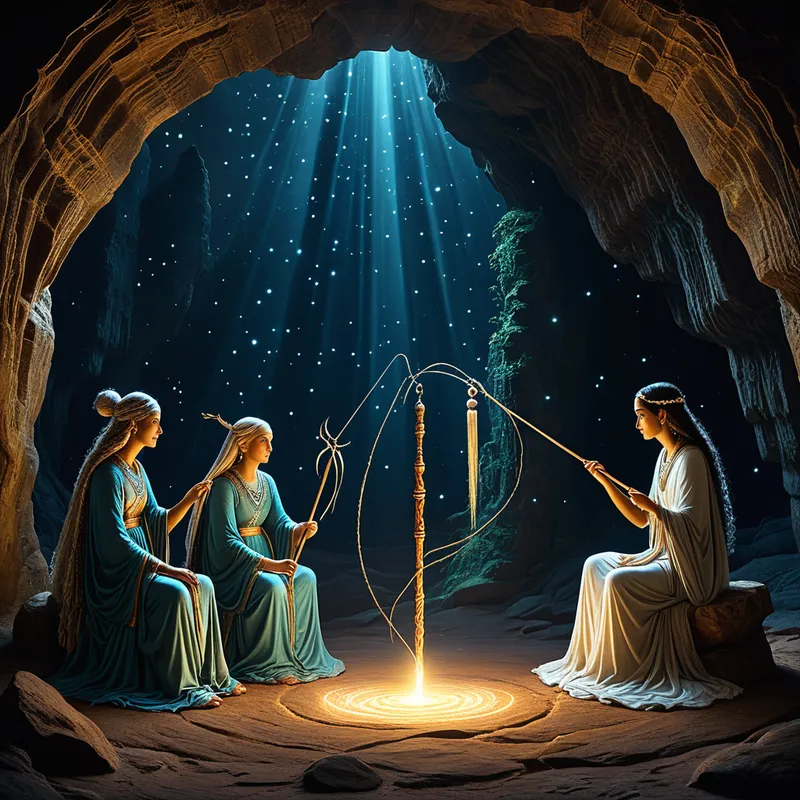
Listen. Beneath the roots of the great Yggdrasil, in a cavern where time itself drips like water from stone, they sit. The air is not air, but the breath of stars held still. Here, in the deepest marrow of existence, the three sisters work. They are the Moirai, and their hands move with the patience of mountains.
First is Klotho. Her fingers, thin and strong as spider-silk, draw the raw stuff of being from a void of potential. With a spindle of polished moonstone, she twists it—a single, shimmering filament. You can hear it hum, a note so high it is the sound of a soul’s first cry and its last sigh woven into one. She smiles, not with joy, but with the concentration of pure creation.
The thread passes to Lachesis. Her face is unreadable, a pool of still water. She takes the glowing strand and lays it against a rod carved from a single beam of celestial light. Her touch is measurement itself. With no haste and no delay, she determines its span—the length of a laugh, the stretch of a struggle, the duration of a dynasty. She allocates the portion of luck and sorrow, of love and loss, that will be woven into its very fiber. Her decree is silent, absolute.
Then, to Atropos. She is the smallest, the oldest, her eyes like chips of flint in a face of wrinkled parchment. In her hand, she holds the shears. They are not large, but their blades are made of a darkness that drinks light. She waits. She watches the thread, now vibrant with the full story of a life, pulse along the measured length. And when the final moment arrives—be it in a hero’s last stand on a windy plain or a grandmother’s final breath by a quiet hearth—her hand flicks. A sound like the snapping of the universe’s spine. The thread falls, its light extinguished instantly, absorbed into the silent loom of the earth.
Even Zeus himself, the cloud-gatherer, the thunderer, bows his head before their work. It is said he may hold the scales of victory, but the Moirai hold the scale of existence. Their law is older than Olympus, deeper than Gaia, more fundamental than Chaos. They do not hate. They do not love. They simply are. The spin, the measure, the cut. The beginning, the middle, the end. This is the tale that has no end, for it is the tale of every end that ever was or will be.

Cultural Origins & Context
The Moirai are not Olympian inventions. Their roots plunge into the pre-Hellenic, Mycenaean world, perhaps even earlier, emerging from that primal human need to personify the most terrifying and absolute of realities: limit. In the oral traditions preserved by poets like Hesiod in his Theogony and Homer in the epics, they are presented as daughters of Nyx (Night), born from darkness itself. This lineage marks them as fundamental forces, akin to Death, Sleep, and Strife, operating with an autonomy that even the newer, more anthropomorphic gods must respect.
Their societal function was profound. In a world perceived as often chaotic and capricious, the Moirai represented an implacable, non-negotiable order. They were the ultimate answer to "why?" Why did the strong fall? Why did the infant die? Why did fortune shift? The answer was moira—one's allotted portion, one's fate. This was not a discouragement but a framework. It placed every life, from king to beggar, within a cosmic structure. Rituals, oracles, and sacrifices were not attempts to break fate, but to understand and align with one's allotted portion. The Moirai provided the terrifying, yet strangely comforting, borders of the human condition.
Symbolic Architecture
The Moirai are the triune embodiment of Time’s action upon a life, but psychologically, they represent the internal architecture of destiny and necessity.
Klotho symbolizes the raw potentiality of the Self at birth—the genetic code, the ancestral inheritance, the innate talents and predispositions. She is the unconscious source from which the thread of individual consciousness is drawn forth. She represents the principle of becoming.
Lachesis embodies the lived experience that gives that thread its unique texture and pattern. She is the choices made, the chances taken, the relationships formed, the sufferings endured, and the joys celebrated. This is not a predetermined script, but the active measurement and shaping of one’s portion through engagement with the world. She is the principle of being.
Atropos is the ultimate limit: death, finality, the necessary end that gives shape and meaning to the whole. Psychologically, she represents all the inevitable endings within a life—the death of childhood, the conclusion of phases, the letting go of identities. She is the ruthless, yet essential, principle of completion that makes transformation possible.
The thread is not a prison, but a medium. The artistry lies in how one wears the pattern woven by its length.
Together, they form a complete psychic process: emergence from the unconscious (Klotho), development through conscious experience (Lachesis), and dissolution or integration back into a new wholeness (Atropos). They are the ultimate rulers not through tyranny, but through the inviolable law of process itself.
The Dreamer's Resonance
To dream of the Fates is to encounter the psyche’s own council of necessity. A dream of Klotho—of spinning wheels, tangled yarn, or the sudden emergence of a new, fragile connection—often surfaces when one is at the beginning of a major life chapter, feeling the pull of a new potential or identity struggling to be born. It can feel somatic, like a quickening.
A dream of Lachesis manifests as dreams of measurement: being judged, weighing options, seeing the length of a road or a corridor stretch before you. This is the psyche assessing the current trajectory, asking, "Is this the measure of my life? Am I using my allotted time?" It speaks to mid-life evaluations, career crossroads, or the sober assessment of a relationship’s depth.
A dream of Atropos is the most visceral. It appears as imagery of cutting, severing, scissors, sudden endings, or silent, ancient feminine figures who bring a calm finality. This is not necessarily about physical death, but the necessary death of an outworn attitude, a toxic attachment, or a finished project. The somatic sensation is often a deep release followed by emptiness—the fertile void after the cut.

Alchemical Translation
The individuation process, the alchemical journey toward psychic wholeness, is modeled perfectly in the Moirai’s triad. The modern individual must become, in turn, all three sisters to their own life.
First, one must become Klotho: attending to the raw, often ignored material of the soul. This is the work of withdrawing projections, listening to dreams, and acknowledging the innate, often fateful patterns (complexes) that spin from our personal and collective unconscious. It is the courage to begin spinning a new thread from old wounds.
Then, one must take up the rod of Lachesis: consciously measuring one’s life. This is the ego’s active engagement with its portion. It involves making choices that align with the deeper Self, taking responsibility for one’s actions, and weaving the experiences—both golden and dark—into a coherent narrative. It is the creation of personal meaning within the bounds of one’s existence.
Finally, and most crucially, one must wield the shears of Atropos. This is the alchemical mortificatio—the killing of the outmoded. It is the voluntary sacrifice of infantile fantasies, rigid personas, and addictive attachments that prevent growth. It is the conscious acceptance of limits, of endings, of the death of who we were to make room for who we must become.
To individuate is to willingly submit to your own necessity, to become the sovereign who decrees the end of your own tyranny.
In this alchemy, the Moirai transform from external tyrants into internal governors. The fate they represent is no longer a sentence to be endured, but a self-created destiny to be lived. The thread becomes the tapestry, and the one who wears it discovers they were also the weaver at the loom all along.
Associated Symbols
Explore related symbols from the CaleaDream lexicon: