The Calydonian Boar Hunt Myth Meaning & Symbolism
A king's forgotten sacrifice unleashes a monstrous boar, uniting heroes in a hunt that becomes a crucible of honor, betrayal, and primal rage.
The Tale of The Calydonian Boar Hunt
Hear now of the wrath of Artemis, whose altars run cold. In the rich land of Calydon, King Oeneus gathered the first fruits of the harvest. To the gods of the sky and the earth, he poured libations of wine and oil. But to the Mistress of the Wild, the Lady of the Beasts, he offered nothing. The smoke of her sacrifice did not rise. In the deep, untamed groves where moonlight filters through oak leaves, a silence fell—a silence that was not peace, but a held breath.
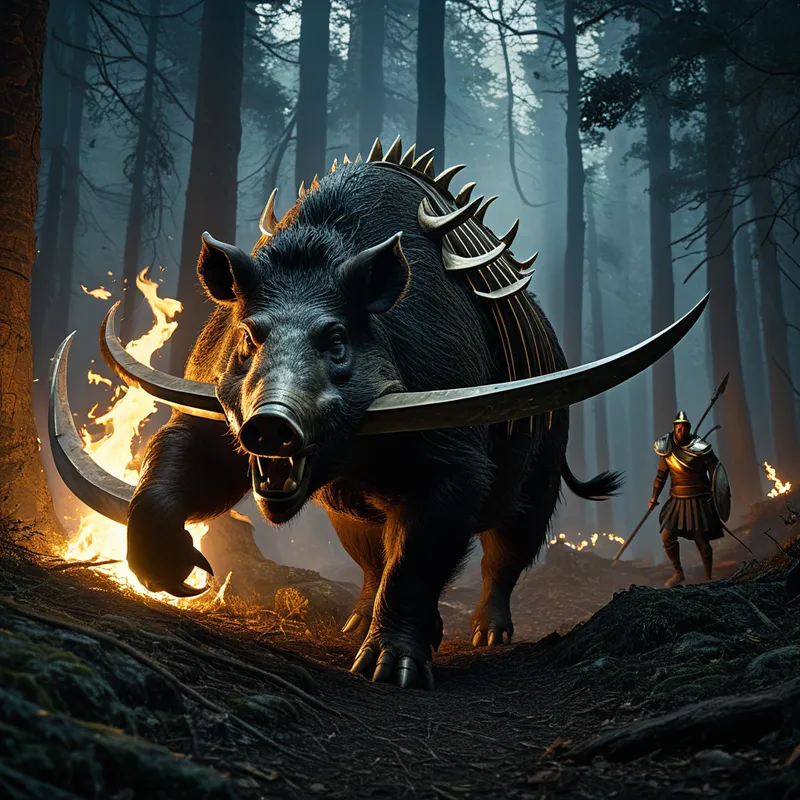
From that silence, she sent her answer. Not a plague of mind or body, but a plague of the land itself. The earth of Calydon heaved and split. From a chasm fouled with the breath of the underworld, it came. A boar, but no creature of field or forest. This was a mountain of living fury, a god-forged engine of destruction. Its shoulders were higher than a chariot, its hide like cured leather over iron plates, proof against any spear. Its tusks were curved, white scimitars, sharp as a scythe’s blade. Its eyes burned with a cold, intelligent malice. Where it trod, orchards were trampled into mud. Where it rooted, granaries were shattered. It gored cattle and men alike, leaving the fertile kingdom a wasteland of fear.
The king’s son, Meleager, knew the call. He sent word across the Hellas, gathering the greatest heroes of the age. They came in their pride: the twin sons of Jason, the swift-footed Ancaeus, the wise Nestor, and many more, a constellation of might and renown. And among them, by Meleager’s own defiant invitation, came one who was not like the others: Atalanta. Her presence was a discordant note, a woman in the realm of the hunt, her eyes calm where the men’s burned with competitive fire.
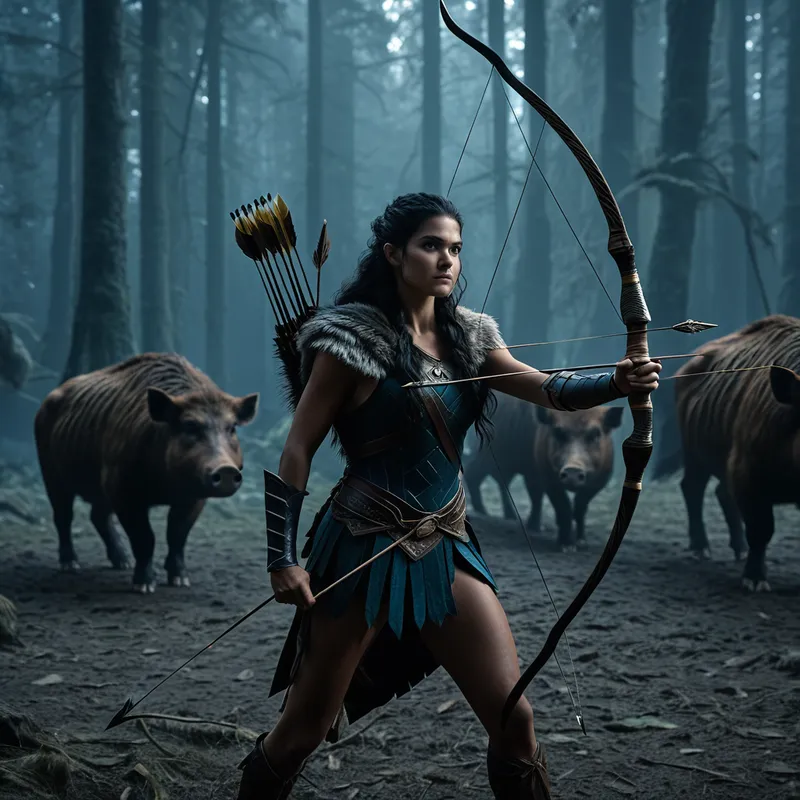
Into the ravaged woods they went, a noisy, clattering host. The boar was waiting. It burst from a thicket with the sound of a landslide, scattering heroes like leaves. Spears glanced off its hide. Men shouted, stumbled, were tossed into the air. In the frenzy, it was Atalanta who stood firm. With the cool precision of one who knows the wild not as an enemy but as a home, she drew her bow. The arrow sang, a thin, biting sound, and buried itself in the beast’s flank—the first wound. A roar, not of pain, but of outrage, shook the trees.
Spurred by her success, shamed by it, the heroes rallied. But it was Meleager, his heart alight with a strange mix of fury and admiration for the huntress, who drove the killing blow. He charged, dodging a sweeping tusk, and plunged his spear deep into the beast’s side, finding the heart. The monster crashed down, its death throes flattening the undergrowth. The hunt was over.
But the true tragedy was only beginning. In accordance with honor, Meleager awarded the boar’s hide—the prize of prizes—to Atalanta, whose shot had begun its end. His mother’s brothers, Thestius's sons, erupted in fury. How could a woman take the glory from men? Words became blows. In the red mist of defense, of pride, of a rage as primal as the boar’s, Meleager turned his bloodied spear on his own uncles and struck them down. And in that moment, in a palace far from the gore of the forest, his mother Althaea heard the news. She walked to the hearth, to the log she had saved from the fire on the day of his birth. She looked at the flame, she looked at the log, and in her heart, the love for a son warred with the duty to avenged brothers. Duty won. She threw the log into the fire. As it caught, spluttered, and burned, so too did the life of her son, the hero of Calydon, extinguish into ash and memory.
Cultural Origins & Context
This potent myth comes to us primarily from the epic cycle, most notably in fragments of the Cypria and later, more fully, in the Roman poet Ovid’s Metamorphoses. It was a story told not in quiet temples but in the halls of warriors and at public festivals, a tale that belonged to the age of heroes that preceded the historical Trojan War. Its function was multifaceted. On one level, it was an aetiological myth, explaining the fierce, destructive nature of wild boars and the dangers of the untamed frontier. On a deeper societal level, it served as a narrative crucible for examining the codes of honor, hospitality (xenia), and the fragile, often violent, bonds of kinship and gender roles.
The gathering of heroes from across Greece prefigures the mustering of ships for Troy, making it a foundational story of pan-Hellenic identity. Yet, its catastrophic end—triggered by a woman’s action and a mother’s choice—underscored a profound Greek anxiety: that the very forces of chaos the hero is meant to subdue (the boar) can be unleashed from within the family and the self, through forgotten ritual, misplaced honor, and uncontrollable rage.
Symbolic Architecture
The Calydonian Boar is no mere animal. It is the incarnate Shadow of a neglected principle. Artemis, the goddess of the wild, the untamed, the fiercely independent and chaste, represents a psychic force that demands recognition. Oeneus’s omission is the ego’s arrogance, believing it can cultivate the fields of consciousness (agriculture, order, society) without honoring the wild, instinctual, and autonomous realms of the psyche.
The monster sent by a god is always a divine message made flesh, a truth the conscious mind has refused to hear.
The boar, therefore, is repressed instinct erupting into ordered life. Its destruction of crops and men symbolizes how unintegrated wildness ravages our cultivated selves—our relationships, our projects, our peace. The hunt is the necessary, heroic confrontation with this chaos. Yet, the myth wisely shows that the shadow cannot be defeated by brute force alone. Atalanta, the devotee of Artemis, is the key. She represents the capacity to relate to the wildness, to understand it, to strike with precision rather than blind rage. Her success signifies that integrating the shadow requires a quality of consciousness that is receptive, intuitive, and aligned with the very nature of the beast.
Meleager’s fatal rage against his uncles reveals the final, tragic trap: the hero, in conquering the external monster, can become possessed by its spirit. The chaos outside becomes the chaos within. His death by his mother’s hand, tied to a primal log (a symbol of his own life-force or thymos), completes the cycle. The neglected feminine (Artemis) unleashes chaos; the possessive, kinship-bound feminine (Althaea) ends the hero. The psyche, in its attempt to rebalance, can consume itself.
The Dreamer's Resonance
When this myth stirs in the modern dreamer, it often manifests as a confrontation with a terrifying, unstoppable force within a personal landscape. You may dream of a rampaging animal in your childhood home, a monstrous presence destroying your workplace, or a chaotic, invasive force in a once-peaceful garden. The somatic feeling is one of profound dread, urgency, and often, a frustrating inability to fight back effectively.
This is the psyche signaling that a long-ignored instinct, a repressed rage, a denied wildness or autonomy (your inner Artemis) has reached a critical mass. The "boar" is the symptom. The dream hunt is the ego’s mobilization of all its resources—your skills, your logic, your support networks (the heroes)—to contain the crisis. If you dream of being an observer, or a failed hunter, it may indicate a feeling of being overwhelmed by unconscious contents. If you dream of landing a blow, or of a figure like Atalanta appearing, it suggests the emergence of a new, more nuanced attitude capable of engaging with the chaos not as an enemy to be slaughtered, but as a force to be understood and directed.
Alchemical Translation
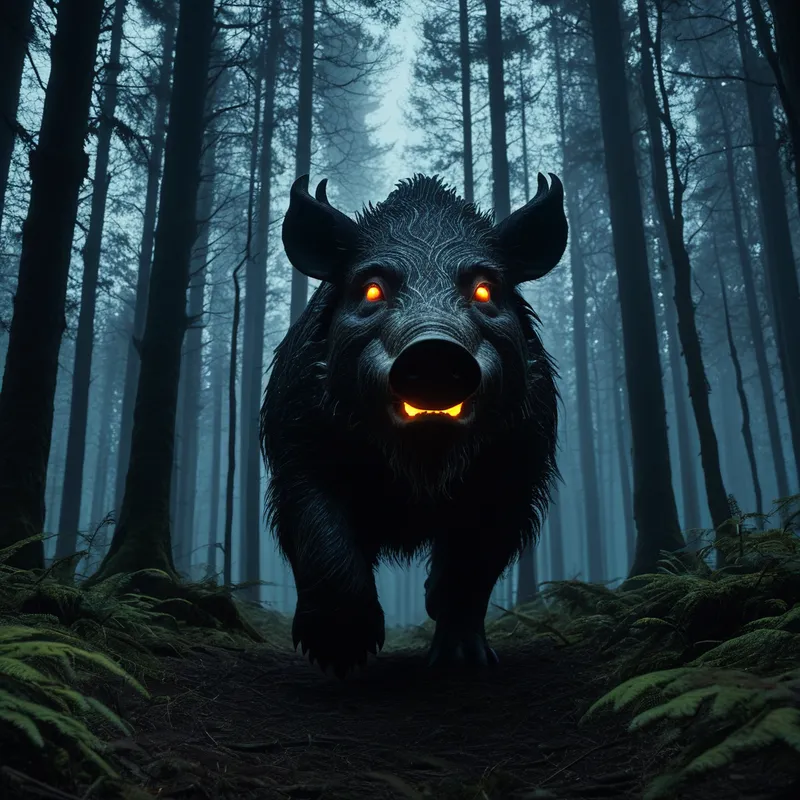
The alchemical journey modeled here is not one of simple victory, but of treacherous integration. The prima materia, the base stuff of the psyche, is the state of neglect—the forgotten sacrifice. The boar’s eruption is the necessary nigredo, the blackening, the descent into chaos and confrontation that shatters the old, arrogant order of the ego.
The prize of the hunt is not the hide, but the consciousness earned in the pursuit. The true tragedy is to win the battle and lose that hard-won awareness.
The gathering of heroes represents the summoning of all available conscious faculties. Atalanta is the crucial coniunctio, the symbolic marriage of the masculine, goal-oriented striving with a feminine, receptive wisdom that knows the nature of the shadow. Her successful strike is the first light in the darkness, the albedo.
Meleager’s subsequent failure is the warning. The integration of the shadow is not its destruction, but its transformation. To kill the uncles who insult the new wisdom (Atalanta’s honor) is to be consumed by the shadow’s rage, to identify with it. This is the failed transmutation, where the ego, inflated by its victory, becomes the new monster. His fate teaches the ultimate lesson: individuation requires not just the courage to face the beast, but the humility to receive the prize without being poisoned by it. The log on the fire is the final sacrifice—the burning away of the heroic ego itself, so that a more complete, albeit tragically earned, consciousness might be remembered in the soul’s lore. The hunt’s end is not peace, but a profound, costly knowledge of the wild within.
Associated Symbols
Explore related symbols from the CaleaDream lexicon: