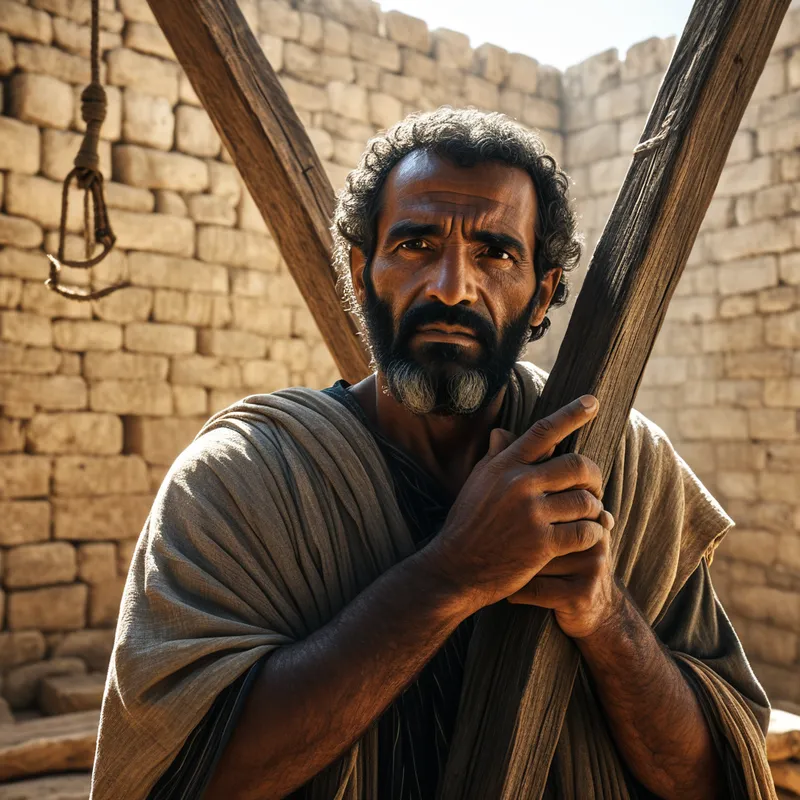
Simon of Cyrene Myth Meaning & Symbolism
A foreign pilgrim is compelled to carry the cross of a condemned man, transforming a moment of coercion into an eternal archetype of shared suffering.
The Tale of Simon of Cyrene
The sun over Jerusalem was a hammer of brass, beating the breath from the narrow streets. The air, thick with dust and the metallic scent of fear, vibrated with the ugly music of a mob. On the stone-paved path known as the Via Dolorosa, a figure stumbled. He was a man broken by the state, a Messiah to some and a criminal to Rome, his shoulders raw from the lash, his brow crowned with cruel thorns. The weight he bore was not just the rough-hewn timber of a crossbeam; it was the weight of a world’s expectation and rejection. It was too much. His knees buckled, the wood crashing into the dust.
The Roman soldiers, their faces hard masks of duty and disdain, scanned the jeering crowd. Their prisoner could go no further, and the spectacle must reach its appointed end. Their eyes fell upon a stranger, a man whose features and dress marked him as from elsewhere. This was Simon, a man of Cyrene, who had come to the city for the Passover. He was not part of this drama. He was a pilgrim, an observer, a man with his own life waiting beyond these walls.
There was no request. Only the impersonal force of imperial authority. They seized him. "You. Carry this." It was a command, a conscription into a narrative he had not chosen. Simon’s own plans, his prayers, his anonymity—all were obliterated in that instant. His hands, perhaps still dusty from the road, closed around the blood-slicked wood. The weight transferred from one collapsing back to another. He lifted it. He did not carry it for the condemned man, but with him. Step by agonizing step, Simon of Cyrene walked the final ascent to Golgotha, his fate now inextricably, physically linked to a stranger’s execution. In that coerced act, a bystander became a central participant. A pilgrim bearing his own burdens found himself bearing the central burden of his age.
Cultural Origins & Context
The story of Simon is recorded with stark brevity in three of the Gospels (Matthew 27:32, Mark 15:21, Luke 23:26). Mark’s account offers the tantalizing detail that he was “the father of Alexander and Rufus,” suggesting his sons were known to the early Christian community in Rome. This tiny note transforms Simon from a mere narrative device into a historical person with a legacy.
The myth functions on multiple levels within the early Christian cultural memory. Historically, it reflects the brutal reality of Roman angaria—the right to force a civilian into temporary service. Theologically, it introduces a crucial human element into the divine drama. The crucifixion is not a solitary act between God and Rome; it requires, even forcibly, human participation. Societally, Simon represents the Gentile (non-Jewish) world being drawn into the story of Israel’s Messiah, a symbolic first fruit of the faith’s eventual spread. He is the ultimate outsider who, by fate’s rough hand, is brought to the very heart of the mystery.
Symbolic Architecture
Simon embodies the archetype of the Conscripted Caregiver. He does not volunteer for sainthood; sainthood is thrust upon him. His myth dismantles the fantasy of chosen, glorious sacrifice and replaces it with the reality of participated suffering.
The most sacred burdens are often not the ones we choose, but the ones that choose us.
Psychologically, Simon represents the ego confronted by the Self’s destiny. We journey through life with our personal aims (Simon the pilgrim) only to be intercepted by a transpersonal demand—a depression, a family crisis, a call to responsibility that shatters our plans. The “cross” is the symbol of this crushing, transformative burden that feels alien yet must be borne. His act symbolizes the reluctant but necessary acceptance of a fate larger than one’s individual will. He carries the patibulum (crossbeam), not the whole stake, indicating he shares the burden but does not assume the totality of the other’s fate—a crucial boundary in compassionate care.
The Dreamer's Resonance
When this myth stirs in the modern unconscious, it often manifests in dreams of being given an impossible task by an anonymous authority, or finding oneself inexplicably responsible for a stranger’s profound pain. You dream you are late for a crucial meeting, but the crowd parts to hand you a dying animal. You are boarding a train when a official presses a heavy, locked box into your arms with no explanation.
These are somatic dreams of the psyche’s conscription. The body feels the weight upon waking. The psychological process is one of abrupt, often resented, enrollment into a phase of carrying. The dreamer is being initiated into the Caregiver archetype not through desire, but through necessity. It signals a confrontation with the Shadow aspect of service—the resentment, the unfairness, the loss of autonomy. The dream asks: What burden, which feels alien and imposed, are you being forced to carry in your waking life? And what might it mean to stop resisting and simply lift your end?
Alchemical Translation
The alchemy of Simon’s myth models the psychic transmutation of compulsion into communion. The base metal of his situation is pure coercion—an act of imperial power devoid of meaning. The alchemical fire is the journey up the hill, the intimate, step-by-step sharing of another’s suffering. The gold produced is not fame or salvation, but a fundamental change in identity: from “Simon of Cyrene, pilgrim” to “Simon, who carried the cross.”
The path to individuation is paved with stones we did not lay, leading to a summit we did not choose.
For the modern individual, this is the process of finding profound meaning in the unasked-for trials: the unexpected care of a sick parent, the burden of a community’s need, the personal crisis that becomes a crucible. We are not asked if we want these things. Like Simon, we are seized by the collar of fate. The alchemical work begins when we stop asking “Why me?” and begin to ask “What is this weight teaching me about connection, about strength, about the nature of the sacred hidden in the profane?” By bearing the imposed burden consciously, we perform the ultimate act of psychic transmutation. We are no longer victims of circumstance; we become the necessary participants in a mystery far greater than ourselves. Our forced service becomes our most authentic vocation.
Associated Symbols
Explore related symbols from the CaleaDream lexicon: