Perseus's Harpe Myth Meaning & Symbolism
The myth of the hero Perseus, armed with a divine sickle-sword, who must confront the petrifying Gorgon Medusa to reclaim his stolen future.
The Tale of Perseus's Harpe
Hear now the story not of a man born to glory, but of a boy cast into the deep. His name was Perseus, and his cradle was a wooden chest, his lullaby the crash of the wine-dark sea. A king’s fear had sealed him there, a prophecy that the grandson would be the king’s doom. But the sea, that ancient, salty womb, did not claim him. It delivered him, a squalling secret, to the shores of Seriphos.
There he grew, a shadow in another man’s house, his true lineage a ghost haunting his mother’s eyes. His fate was a debt, a weight. The tyrant Polydectes demanded a bride-price no mortal could gather: the head of the Gorgon Medusa. It was a sentence of stone and silence.
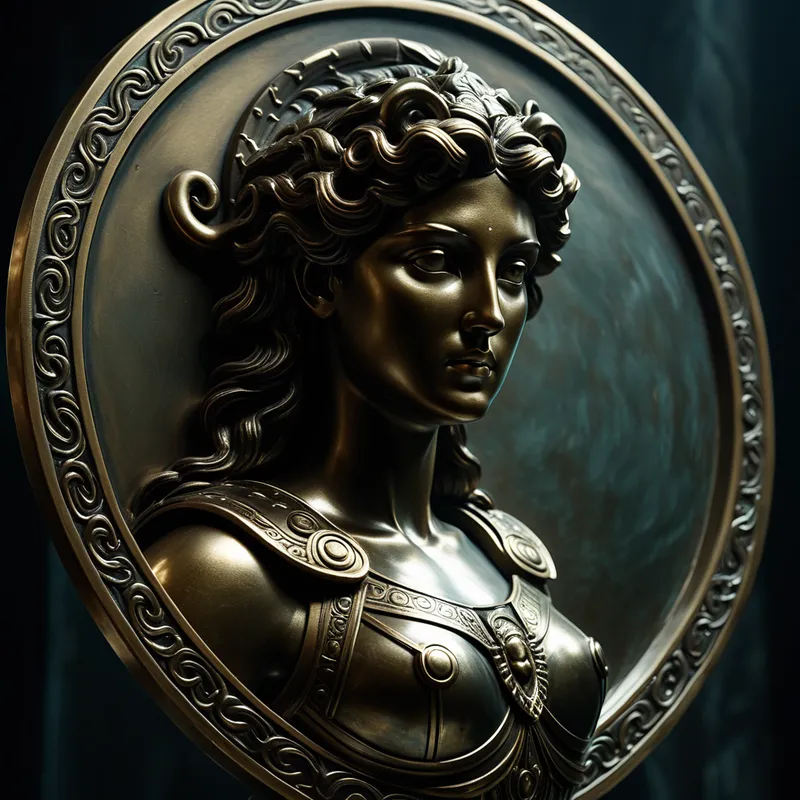
But in the deep places where mortals despair, the gods stir. From the grey mists of his destiny, helpers emerged. Athena, whose gaze is as sharp as an owl’s in the gloom, appeared. In her hands was not a spear, but a shield of polished bronze, a mirror to face the unfaceable. Hermes, the traveler between worlds, gifted winged sandals to dance upon the wind and a helm of darkness borrowed from Hades himself.
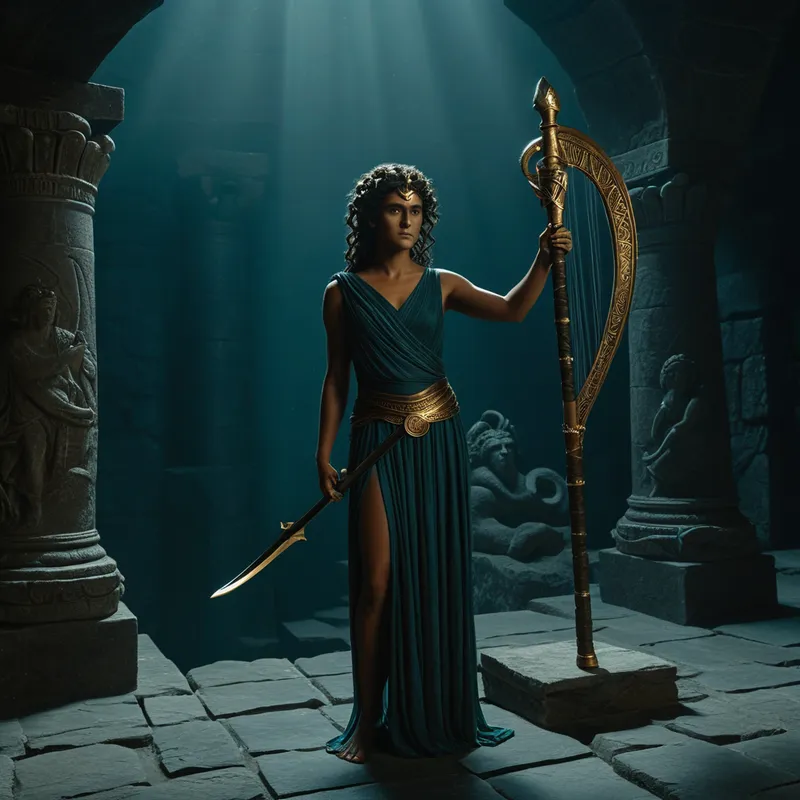
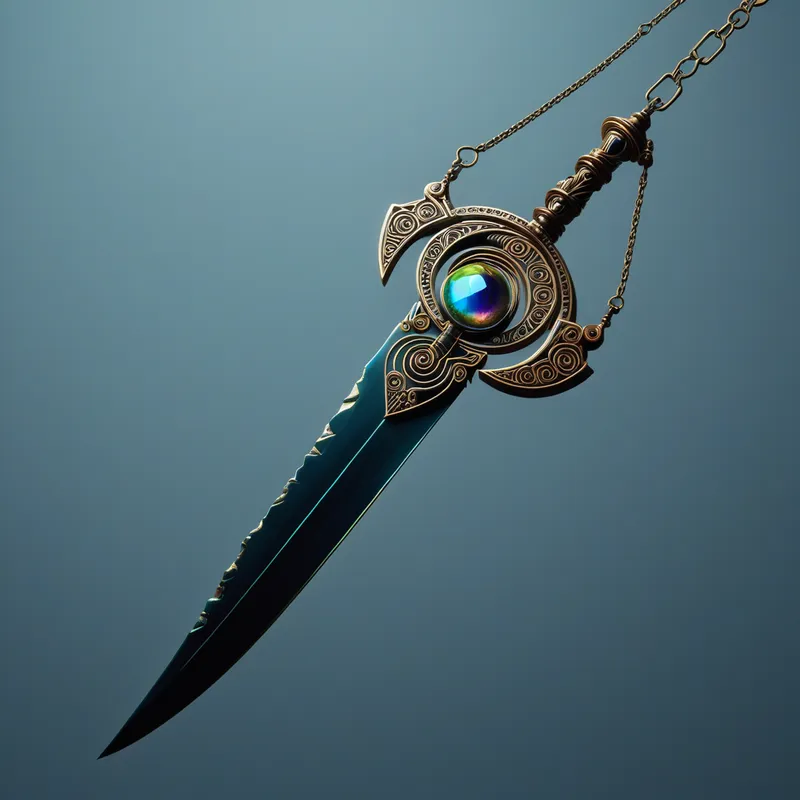
And then, the final gift. From the forges of the gods, a weapon was brought—the Harpe. It was neither sword nor sickle, but both: a blade of adamantine, curved like a new moon, set in a handle of gold. This was the tool of the impossible task.
Guided by the gods, Perseus flew to the end of the world, to the land of the Graeae, whose whispered directions led him to the Gorgons’ lair. It was a place frozen in a scream, littered with the statues of men and beasts, their faces etched with final terror. Among the stones, the Gorgons slept. And there was Medusa, the only mortal one, her hair a nest of vipers, her very visage a curse.
Perseus did not look. He could not. He moved like a breath, the helm of darkness upon his head, his eyes fixed on the reflection in Athena’s bright shield. In that bronze mirror, he saw the monster. He saw his own fate reflected back at him. With the Harpe held high, a crescent of divine intention, he struck not with brute force, but with guided precision. The curved blade found its mark. A silent sweep, and the dreadful head was severed from the serpent-ridden neck.
From the bleeding wound sprang Pegasus, a creature of poetry and thunder. Perseus seized the head, its eyes still deadly, and placed it in a sack of magic. The Harpe had done its work. It had cut the thread of a monstrous life and, in doing so, severed the chains on his own.
Cultural Origins & Context
The myth of Perseus is one of the oldest strata of Greek heroic narrative, predating even the tales of Achilles and Odysseus. It was a story told not in the courts of kings, but in the communal spaces—around hearths, in workshops, and during festivals. Its primary tellers were the rhapsodes, bards who wove existing local tales into the great Panhellenic cycles, and it found its most enduring form in later works like Hesiod’s Theogony and Ovid’s Metamorphoses.
Societally, the myth functioned on multiple levels. For the polis, it was a foundational story of a hero cleansing the land of a primordial terror, establishing order over chaos. For the individual, it was a parable of the young man’s journey (kouros), moving from a state of dependent obscurity (the chest, the foreign shore) to autonomous, heroic identity through a seemingly impossible trial. The divine gifts, particularly the Harpe from Hermes, underscore a core Greek belief: true heroism is not sheer strength, but the ability to be a vessel for divine favor and cunning (metis). The hero is an instrument of the gods’ will, and his tools are extensions of their power.
Symbolic Architecture
The myth is a dense matrix of symbols, but at its heart lies the act of severance performed by the Harpe. This is not mere killing; it is a sacred, surgical cut.
The Harpe is the instrument of necessary severance. It does not destroy wholesale; it makes a precise incision between what must die and what must live.
Medusa herself is the ultimate symbol of the petrified past, the traumatic memory, or the paralyzing complex. Once beautiful, she was transformed by a divine curse into a thing of such horror that to look upon her is to be frozen forever in that moment of shock. She represents the aspect of experience we cannot integrate, the sight that turns the soul to stone. She is the unprocessed trauma that stops time.
Perseus’s strategy is the blueprint for confronting such psychic material. He does not face it directly. He uses reflection—Athena’s shield. This is the gift of consciousness, of seeing indirectly. We cannot stare our deepest wounds in the face without risk of paralysis. We must approach them through the mediating tools of therapy, art, narrative, or ritual—the reflective surfaces that allow us to observe without being obliterated.
The winged sandals of Hermes lift him above the petrified landscape, granting the psychological distance needed for the operation. The helm of darkness represents the focused, inward-turned attention required for such deep work, rendering one invisible to the distracting outer world. And the Harpe is the decisive act of differentiation itself. It is the clear, conscious choice to cut away an identity, a dependency, or a story that, however monstrously formed, has been a part of one’s being.
The Dreamer's Resonance
When this myth stirs in the modern dreamer, it announces a profound crossroads. To dream of confronting a Medusa-figure—a terrifying, snake-haired presence, a petrifying parent, a monstrous aspect of the self—is to feel the psyche preparing for a necessary confrontation with something that has long held power through fear.
The somatic experience is often one of literal paralysis within the dream, a feeling of being turned to stone, heavy and immobile. This mirrors the psychological state of being stuck, unable to move forward in life due to an old wound, a rigid belief, or a frozen emotion. The appearance of a curved blade, a sickle, or a mirrored surface in the dream signals that the resources for this confrontation are emerging. The dream-ego is being equipped.
The act of severing in the dream is rarely violent in a bloody sense; it is more often a clean, swift separation. Upon waking, the dreamer may feel a strange mixture of exhaustion and lightness, as if a weight has been lifted. This is the psychic residue of the Harpe’s work. The dream is the soul’s rehearsal for the conscious, waking act of setting a boundary, ending a toxic cycle, or finally speaking a long-silenced truth.
Alchemical Translation
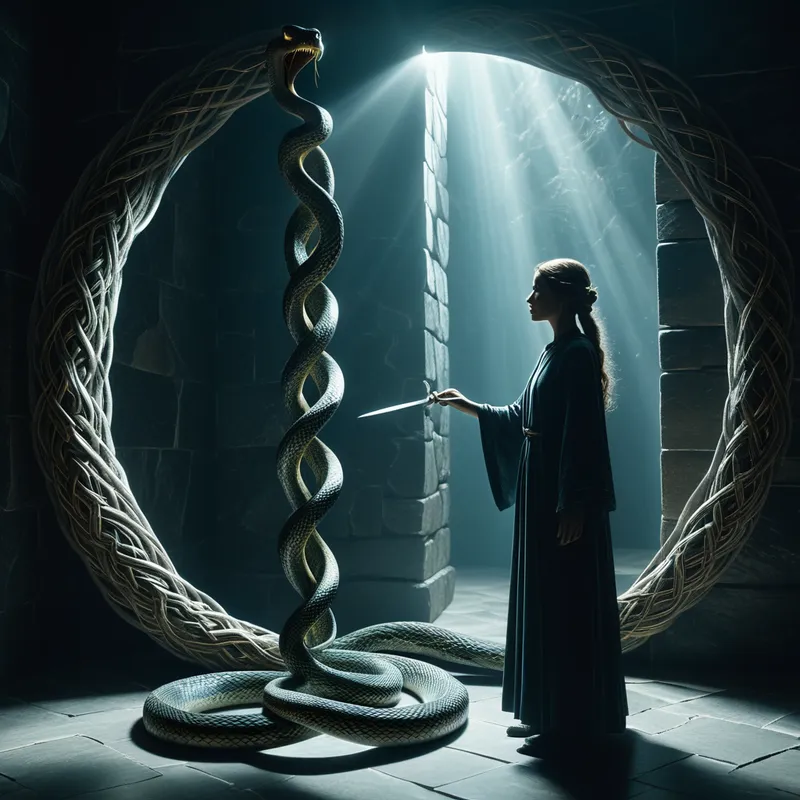
In the alchemical vessel of individuation, the myth of Perseus maps the process of separatio—the crucial stage where the adept must distinguish and isolate the pure from the impure, the essential self from the contaminating complexes.
The initial state is the nigredo, the blackening: Perseus adrift in the chest, his identity negated, his life dictated by another’s fear. The call to fetch Medusa’s head is the furnace heat applied to this prima materia. The divine gifts represent the arrival of transpersonal resources—insight (Athena), transcendent mobility (Hermes), and the focused will (the Harpe)—that the conscious ego must learn to wield.
The journey to the Gorgons’ lair is the descent into the unconscious, into the personal and collective shadow. The petrified statues are the frozen selves we have left behind in our own psychic landscape, casualties of previous failed confrontations.
Using the shield’s reflection is the act of conscious observation without identification. It is holding the complex in mindful awareness, seeing it for what it is without being swallowed by it. The strike of the Harpe is the moment of integration through discrimination. One does not become Medusa; one severs her power to petrify. From the wound of this severance springs Pegasus—the liberated creative spirit, the soaring imagination that was born from, and is now free of, the monstrous past.
For the modern individual, the alchemical translation is clear: our monsters are real, but they are not to be faced with naked eyes. We must craft our shields of reflection—through introspection, dialogue, and creative expression. We must accept our winged gifts of perspective. And when the time is right, we must find our Harpe—the clear, sharp, and merciful tool of conscious choice—and make the cut that separates our living future from our petrified past. The head in the sack is not a trophy, but a reclaimed power, now under the dominion of a self no longer made of stone.
Associated Symbols
Explore related symbols from the CaleaDream lexicon: