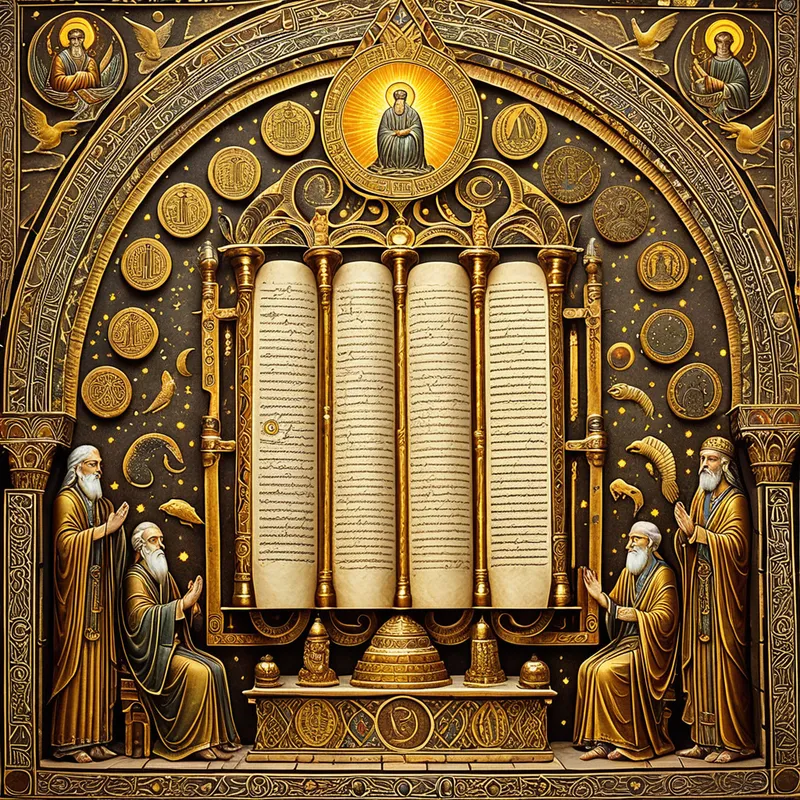
The Dream of Judgment: The Soul's Internal Court
The Somatic Echo
It begins not as a thought, but as a weight. A cold, dense stone settles in the gut, a metallic taste at the back of the tongue. The shoulders pull inward, the spine subtly curves as if bracing for a blow. There is a hollowness in the chest, a chamber waiting for a verdict. This is the body’s pre-language, the somatic architecture of the internal tribunal. Before the mind conjures the judge, the gavel, or the crime, the nervous system has already convened the court. It is the echo of a verdict already passed in some silent, subterranean chamber of the self. The dream of judgment is the psychic immune system flagging a profound misalignment—not with the world’s laws, but with your own.
The Dreamer's Log (Case Vignette)
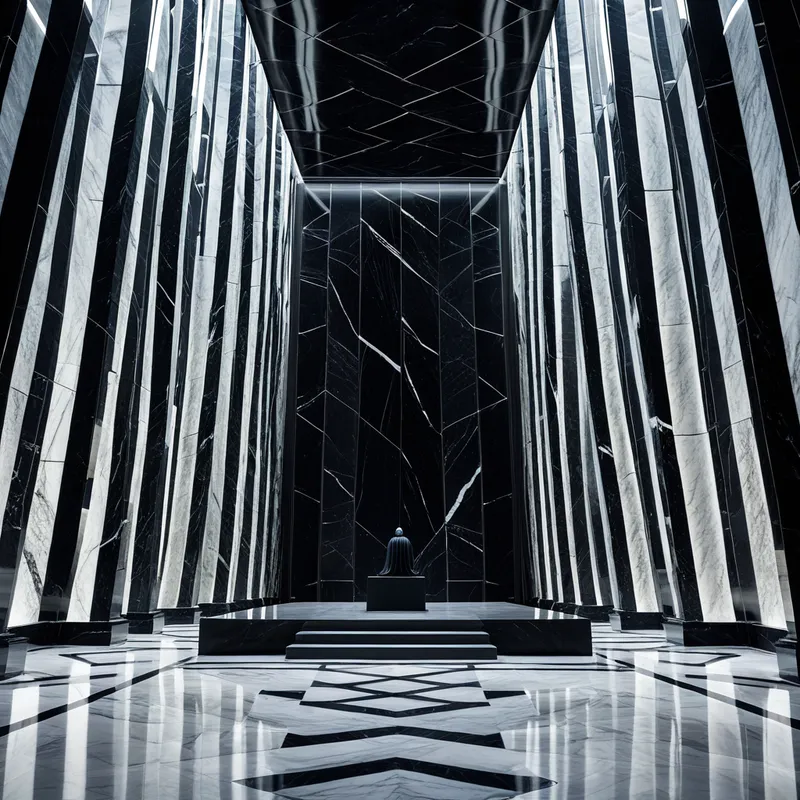
I am standing in a vast, abandoned data center. The servers hum with a low, mournful frequency. In the center of the room sits an ornate, wooden judge’s bench, frosted over. A single sheet of paper glows upon it. I know, with absolute certainty, that it contains my life’s final evaluation. I cannot move to read it. The cold is not in the air, but in the verdict itself.
Alchemical Interpretation: The frozen bench in the temple of data signifies a stalled self-audit, where the logical mind has attempted to render a verdict on the soul’s worth, only to find its own tools inert and chilling.

The False Lead
This theme is not about predicting external condemnation or forecasting misfortune. It is not a prophecy of being “found out” by others. That is paranoia, the orphan’s fear. The dream of judgment is far more intimate and demanding. It is the self turning upon the self, a process of ruthless internal accounting that has reached a critical, often unconscious, juncture. To mistake it for simple anxiety about others’ opinions is to bypass its sacred function: it is the psyche’s method of forcing a confrontation with the gap between who you are and who you have sworn, in your deepest covenants, to become.
Psychological Architecture
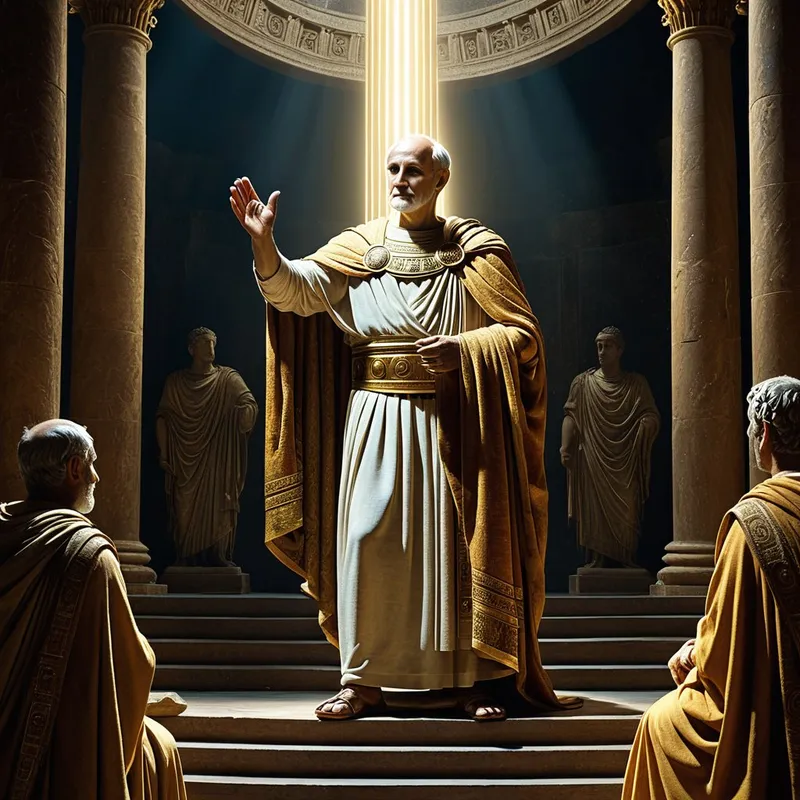
The architecture of the judgment dream is the architecture of the superego—not as a Freudian caricature, but as an internal governing body. Think of it as a parliament of past voices: the internalized parent, the cultural code, the moral injunctions of forgotten teachers, the promises you made to your younger self. In times of significant choice, failure, or transition, this parliament convenes. The shadow work here is to enter that chamber not as a cowering defendant, but as the newly appointed speaker. It requires listening to each voice—the harsh critic, the disappointed idealist, the fearful conformist—not to obey their verdicts, but to understand their original, often protective, intent. The individuation process is the moment you realize you are the only legitimate authority in that room. Sovereignty is not overthrowing the court; it is integrating its functions into a conscious, self-authored code of ethics.
Mythic Resonance
We see this eternal process in the myth of Osiris. Murdered and dismembered by Set (the shadow self, chaos), Osiris’s fragments are gathered by Isis. But the final ritual—reconstitution and judgment—occurs in the Hall of Ma’at. Here, his heart is weighed against the feather of truth. This is not a judgment by a capricious god, but an impersonal, cosmic audit of integrity. The heart must match the feather. The dream is our personal Hall of Ma’at, where the accumulated substance of our actions and intentions is measured against the feather-light truth of our essential nature. The terror is in the weighing. The salvation is in the alignment.
Symbolic Nodes
- Courtrooms, Judges, Benches: The structure of internal authority.
- Scales, Weights, Measuring Tools: The process of evaluation and comparison.
- Legal Documents, Indictments, Lists: The catalog of perceived transgressions or failures.
- Being Watched or Observed Unseen: The feeling of being perpetually under review.
- A Verdict Being Read Silently: The internalized conclusion you already know.
- Frozen or Inert Gavels: A stalled or paralyzed decision-making faculty.
Archetypal Resonance
The energy here is pure, often brutal, discernment. It is the drive to separate wheat from chaff, truth from falsehood, integrity from compromise. This is the core energy of The Sage Archetype, here manifesting in its most challenging aspect: The Shadow Sage.
The Shadow Sage is the archetype of judgment severed from wisdom. It is the internal magistrate who confuses the rigid letter of an inherited law with the living spirit of truth. Its somatic echo is that cold, constricting weight—the body armored against the perceived flaw. Its alchemical potential, however, is immense. The heat of this dream is the friction between your messy, human experience and this shadowy ideal. The pressure forces you to interrogate the source of the law. Is it yours? The transmutation occurs when you take the gavel from the Shadow Sage’s hand and use its innate power of discernment not to condemn, but to see clearly. You move from being judged by a dogma to judging your own life with compassionate clarity.
The Alchemical Process
The alchemy of judgment is the solve et coagula of the self-concept. First, solve: the intense heat is the shame and fear that arises as the old, unquestioned statutes of your worth are dissolved. This is the painful deconstruction of the "shoulds." The pressure is the sustained, uncomfortable gaze upon your own contradictions. Then, coagula: from that dissolved matter, you consciously re-coagulate a new standard. This is not a lighter standard, but a truer one. You do not discard the scale; you recalibrate it with the weight of your own lived experience, compassion, and authentic values. The leaden fear of condemnation is transmuted into the gold of self-authority. You become both the measured and the measurer, in harmony.

The Integration Protocol
Question 1: If the judge in your dream were to speak, not its verdict, but its fear, what one sentence would it whisper?
Question 2: What ancient, unexamined law—inherited from family, culture, or a past version of you—are you currently being tried for breaking?
Question 3: If you were to defend your most human "flaw" not as a crime, but as a necessary feature of your soul's curriculum, what would your closing argument be?
Action 1 (The Grounding Audit): For one day, carry a small notebook. Each time you feel a pang of self-judgment (e.g., "I should be more X"), briefly note the "crime" and the imagined "sentence." Do not analyze. Simply evidence. This externalizes the internal court docket.
Action 2 (The Creative Pardon): Take the most recurring "crime" from your audit. Create a simple, symbolic "pardon" for it. This could be a short piece of music that embodies absolution, a abstract painting using colors of release, or a written decree from your sovereign self, sealed with wax. The form is less important than the ritual act of self-clearing.
Action 3 (The Sovereignty Ritual): At night, stand before a mirror. State aloud three declarative sentences that begin with "I hold the authority to..." (e.g., "...define my own worth," "...measure my own progress," "...integrate my mistakes"). The words are for your nervous system. Feel the shift from defendant to bench.
Final Validation
The dream of judgment is a difficult grace. It means your psyche is no longer willing to live on autopilot, governed by ghostly statutes. The cold terror of the verdict is real, and it is the sign of a conscience that matters. Do not flee that courtroom. Walk into its silence. The bench is empty because it has been waiting for you. To sit in it is not to pronounce a final sentence upon your past, but to assume, with clear-eyed compassion, the ultimate responsibility for your becoming. The gavel is yours. The law can now be written in the language of your soul.