
Geburah Divine Severity
In Kabbalistic tradition, Geburah embodies divine severity, judgment, and limitation—the necessary counterbalance to mercy that structures spiritual reality.
The Tale of Geburah Divine Severity
In the beginning, before the beginning that we can name, there was the boundless light of the Ein Sof. From this endless, undifferentiated radiance, a single point of willed withdrawal occurred—a contraction to make space for the world. Into that vacated space, a vessel formed, the first of ten, pouring forth the emanation of divine light. This was Keter, pure potential. From Keter flowed Chokhmah, the flash of insight, and then Binah, the great mother who receives and gives form. From the union of Chokhmah and Binah, two children were born: Chesed and Geburah.
Geburah did not emerge gently. It was a birth of fire and iron, a necessary crystallization from the fluid mercy of its sibling. Where Chesed saw infinite possibility, Geburah saw the need for definition. Where Chesed poured forth unconditionally, Geburah asked, "To what end?" It was the first question in the universe, and it carried the weight of a sword.
The divine light, streaming from above, was too potent for the nascent vessels of the lower Sephirot. In the great myth of the Shevirat HaKelim, the vessels of strict judgment—Geburah foremost among them—could not contain the influx. They shattered. Holy sparks, fragments of the divine light, were flung into the abyss, scattered and trapped within the shells of broken vessels, giving birth to the realm of fragmentation and illusion. This was not a failure, but a divine necessity—the severity of Geburah enacted a cosmic limitation, creating the conditions for a world of choice, struggle, and ultimately, redemption.
Thus, Geburah stands eternally on the Pillar of Severity in the Tree of Life, a sovereign power opposite the flowing grace of Chesed on the Pillar of Mercy. It is the force that metes out the measure of all things, that establishes the shoreline against the ocean of grace, that gives spine to the cosmos. It is the divine "No" that makes every "Yes" meaningful, the judgment that renders mercy not mere sentiment, but a sacred gift.
Cultural Origins & Context
Geburah (גבורה), meaning "Strength," "Might," or "Severity," is a foundational concept within the Jewish mystical tradition of Kabbalah, which developed its classical form in medieval Spain and Provence, most notably in texts like the Zohar. Its theological roots, however, dig deep into the bedrock of the Hebrew Bible. Geburah is the divine attribute behind the narratives of judgment, the hardening of Pharaoh's heart, the establishment of law at Sinai, and the wars of conquest. It is the arm of God, the quality of Din (Judgment) in its purest form.
In the intricate architecture of Kabbalistic thought, Geburah is not evil, nor is it merely punitive. It is an essential component of the divine psyche, without which creation would be an amorphous, unsustainable burst. The system is profoundly dialectical: for there to be relationship, there must be distinction; for there to be form, there must be boundary. Geburah provides the structural integrity for the emanated universe. It is associated with the left side, the side of perceived restriction, and with the divine name Elohim Gibor (God of Power). In the microcosm of the human soul, it corresponds to the left arm and the capacity for discipline, courage, and necessary restraint.
Symbolic Architecture
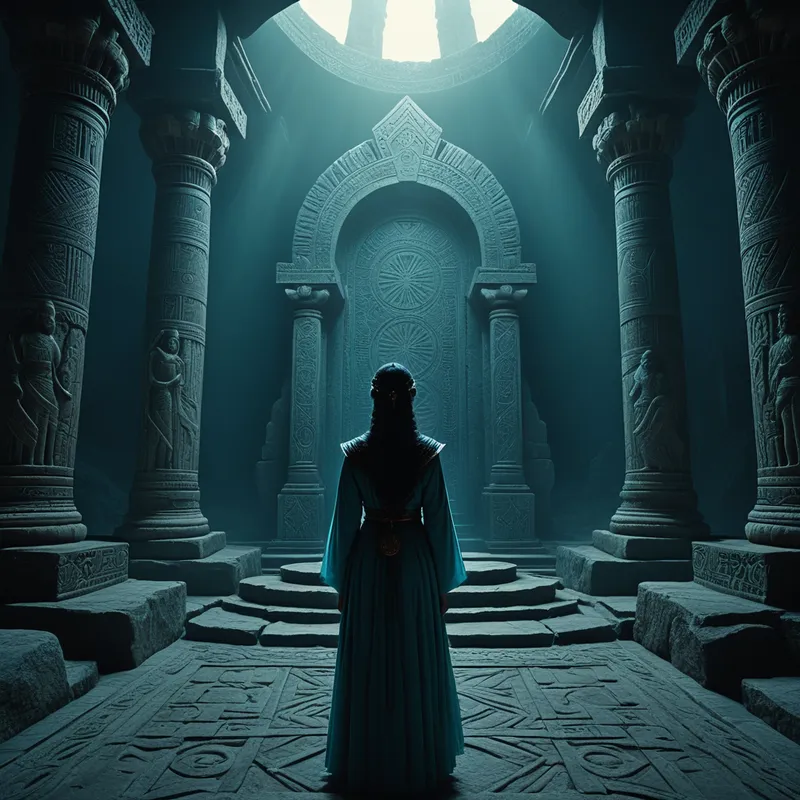
The architecture of Geburah is one of austere, terrifying beauty. It is a palace of red sandstone, its corridors straight and unyielding, its gates guarded by the principle of consequence. Its number is five, the number of structure and the pentagram, but also of rupture. Its color is a deep, fiery red, the red of arterial blood and refining flame.
Geburah is the cosmic sculptor. Chesed provides the infinite block of marble—the unformed potential of all that could be. Geburah is the chisel that strikes, the hammer that chips away everything that is not the destined form. The process is violent to the excess stone, but it is the only way the statue within can be revealed.
This sphere is ruled by the planet Mars, the classical symbol of war, aggression, and focused energy. Its archangel is Kamael, "He who sees God," often depicted as a warrior, the celestial general who embodies the strength to enact divine will. The angelic order associated with Geburah is the Seraphim, the "burning ones," beings of pure, consuming fire that both purify and destroy. Here, judgment is not a cold calculation, but a passionate, fiery engagement with truth.
The Dreamer's Resonance
To encounter Geburah in the inner landscape is to meet the principle of necessary pain. Psychologically, it represents the superego in its formative, structuring role—not the critical voice that tortures, but the internal lawgiver that establishes boundaries between self and other, right and wrong. It is the force that says "enough" to our own boundless appetites and the encroachments of others. It is the courage to cut away what is toxic, even if it is a part of ourselves we have long cherished—a habit, a narrative, a relationship.
The shadow of Geburah is cruelty, tyranny, and mercilessness—judgment severed from the heart of Chesed. This manifests as harsh self-criticism, rigid dogma, or the projection of our own unresolved severity onto the world as anger and condemnation. The spiritual task is not to destroy Geburah, but to balance it. We must learn to wield the sword of discrimination with compassion, to set boundaries with love, and to accept the necessary limitations of our mortal form not as punishment, but as the very architecture of our soul's journey.

Alchemical Translation
In the alchemy of the soul, Geburah is the stage of separatio and calcinatio—separation and burning. It is the fiery furnace where the dross of the personality is burned away, where impurities are separated from the essential gold. This is a painful, transformative fire. It is the crisis that forces differentiation, the illness that demands a change of life, the loss that clarifies what truly matters.
The alchemical fire of Geburah does not seek to annihilate, but to reveal essence through ordeal. As base metal must be subjected to fierce heat to shed its impurities, so too must the soul pass through the fires of limitation and judgment to discover its unshakeable core. This is the severity that serves liberation.
This process aligns with the Kabbalistic concept of Tikkun Olam, the repair of the world. Our personal acts of judgment—of discernment, of saying no, of taking a principled stand—are microcosmic acts of gathering the scattered sparks trapped in the shells of brokenness. By integrating our own Geburah with consciousness, we help restore balance to the divine structure itself.
Associated Symbols
Explore related symbols from the CaleaDream lexicon:
- Fire — The purifying and destructive element of Geburah, representing both the severity of judgment and the transformative power of divine will.
- Sword — The instrument of divine discrimination, cutting through illusion to separate truth from falsehood and enact necessary boundaries.
- Mars — The planetary ruler embodying focused energy, assertive action, and the principled force required to defend and define.
- Red — The color of arterial blood and refining flame, symbolizing the passionate, dynamic, and sometimes violent nature of severe justice.
- Lion — The archetypal symbol of fierce courage and sovereign power, representing the noble yet terrifying aspect of divine strength.
- Warrior — The embodiment of disciplined force, courage in conflict, and the willingness to engage in struggle for a higher principle.
- Thunder — The terrifying voice of divine judgment, breaking the silence with a force that commands attention and signifies irrevocable change.
- Mountain — The immutable, imposing form that represents the absolute, unyielding law and the formidable challenge of spiritual ascent.
- Bone — The internal structure that provides form and support, symbolizing the essential, non-negotiable framework upon which life is built.
- Balance — The eternal counterweight to mercy, representing the cosmic and psychological equilibrium that severity seeks to establish and maintain.
- Divine — The ultimate source and context of Geburah’s power, anchoring its severity not in petty malice but in the sacred architecture of creation.