
The Worm Myth Meaning & Symbolism
A myth of divine judgment where the worm is an unending witness to decay, confronting mortality and the ultimate fate of rebellion against the sacred.
The Tale of The Worm
Hear now, you who dwell in houses of clay, whose foundations are dust. Listen to the tale that is not told in the light, but whispered in the final, cooling ash.
There was a king, a man of pride, who built his throne to scrape the heavens. His city was a jewel set in the desert’s crown, his gardens hung like miracles from the cliffs. He drank from a cup of conquest and believed its vintage was eternal. “Is not this great Babylon, that I have built?” His voice echoed against the marble, a sound that believed itself a god’s.
But the heavens are not mocked. A voice came, not in thunder, but in the silence that follows it. A decree was written by a finger not of flesh, upon a plaster wall lit by the trembling light of sacred lamps. Mene, Mene, Tekel, Upharsin. The words hung in the air, cold and final as a tomb seal. That very night, the garment of kingship was torn from him. The feast ended in blood. The mighty was brought low, to eat grass with the beasts, his mind unhinged, until he acknowledged that the Most High rules.
Yet this was but the prelude. For the prophets spoke of a fate beyond the fall of a single king. They sang of a day of YHWH’s vengeance, a day of wrath. They sang of a place where the fire is not quenched. And in that song was a creature, a witness more enduring than flame.
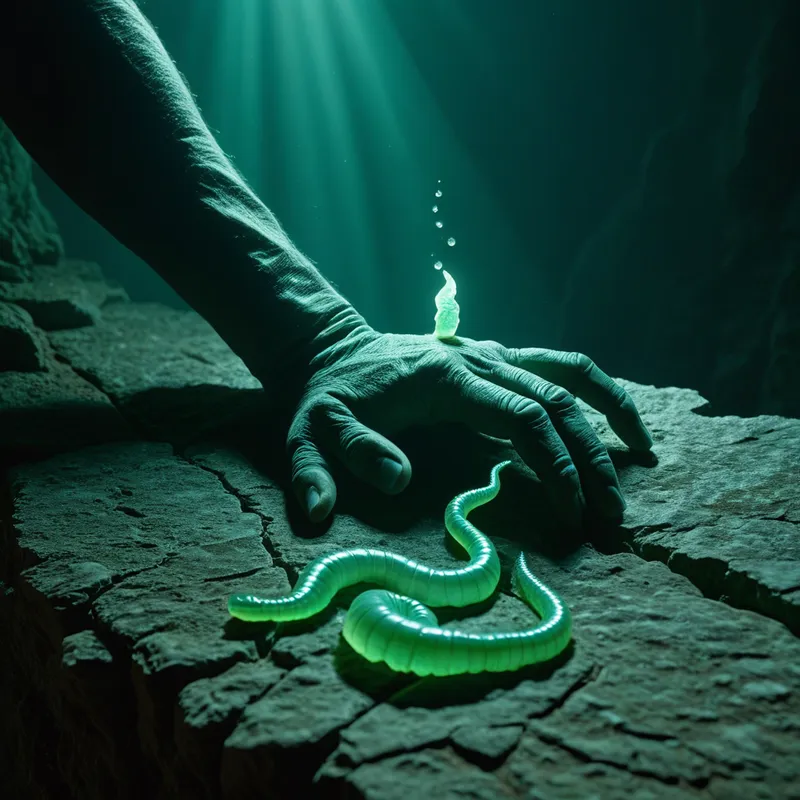
They called it rimmâ. Not the serpent of the garden, wise and cunning, but the worm of the grave, humble and absolute. In the prophet’s vision, the proud ones who set themselves against the mountain of the Holy One are cast down. Their corpses lie under an alien sky. And the fire descends. But the prophet’s gaze pierces the conflagration and sees what remains when the roaring ceases. He sees the smoldering heap. And upon it, the worm. It does not flee the heat. It is born from it. It feasts, and its feast does not end. Its life is the unmaking. Its tireless, silent gnawing is the final testament to all that exalted itself against the dust from which it came. The fire may eventually sleep, but the worm, it is said, does not die. It is the eternal witness to the truth that all flesh is grass.
Cultural Origins & Context
This imagery emerges not from a single story, but is woven through the prophetic and wisdom literature of the Hebrew Bible, most starkly in the closing verses of the book of Isaiah. It is a motif of the Day of the Lord. This was not folklore for the hearth but theology from the precipice, spoken by figures like Isaiah and referenced by Jesus of Nazareth in the New Testament. Its primary societal function was not to comfort, but to confront. It was a radical deconstruction of human arrogance, aimed at kings, empires, and any power structure that claimed ultimacy. In a culture deeply aware of covenant and consequence, the undying worm served as the ultimate symbol of irreversible judgment—a poetic and terrifying counterpoint to the promise of everlasting life for the righteous. It was a mythic reality check, searing the collective psyche with the understanding that certain rebellions against the sacred order lead not to mere defeat, but to a state of perpetual dissolution.
Symbolic Architecture
The worm is the great leveler. It is the biological and spiritual fact that awaits all temporal glory that has divorced itself from its source. Symbolically, it operates on multiple levels.
It is the consciousness of decay that haunts all denial of death. The worm is the truth we cannot digest, and so it digests us.
First, it is the embodiment of shame and insignificance. In the Psalms, the psalmist cries, “I am a worm and not a man,” expressing total abjection. The worm is the self stripped of all pretense and social armor, reduced to its most vulnerable, despised state.
Second, and more profoundly in the prophetic context, it represents the inescapable consequence of idolatry. Idolatry is not merely worshipping a statue; it is the absolutizing of the finite—be it the self, a nation, wealth, or power. The undying worm symbolizes the inherent entropy within such a project. The finite thing, made into a god, must eventually reveal its mortality. The worm is the process of that revelation made animate and eternal. It is the psychic corrosion that continues long after the initial catastrophe.
Psychologically, the worm is the Shadow of creation itself. If life is the organizing principle, the worm is the disorganizing principle, the return to the base matter from which new forms can arise, but in this mythic frame, do not. It is a symbol of sterile, endless repetition of the same destructive process.

The Dreamer's Resonance
When the myth of the worm surfaces in modern dreams, it rarely appears as a biblical pastiche. It manifests as a feeling of inescapable, gnawing decay. The dreamer may be in their childhood home, but the walls are soft and crumbling. They may look in a mirror and see their features subtly rotting, or feel something moving just beneath their skin. They may discover a room in their house they had forgotten, filled with damp, ruined possessions being consumed by larvae.
Somatically, this dream points to a profound psychological process: the confrontation with a morbid complex. This is a cluster of thoughts, memories, and emotions that are not just painful, but feel deathly—a secret shame, a long-held resentment, a foundational betrayal, or a core sense of worthlessness that has been buried alive. The worm is the activity of this complex. It is the part of the psyche that feeds on itself, that believes in its own irredeemable corruption. The dream is the psyche’s attempt to bring this auto-cannibalizing process into view, to say, “See? This is what has been happening in the dark. This is what your pride (or your trauma) has been feeding.”
The dreamer is going through the first, terrifying stage of metabolizing a truth they have spent a lifetime avoiding. The worm does not symbolize the truth itself, but the resistance to it—the endless, circular consumption that prevents transformation.

Alchemical Translation
The alchemical journey begins with the Nigredo, the blackening. This is the stage of utter despair, putrefaction, and confrontation with the prima materia—the foul, base matter of the soul. The myth of the undying worm is a pure, stark portrait of the Nigredo. It shows what happens if the process stalls here, if the putrefaction becomes not a phase but a permanent state.
The alchemist’s task is not to kill the worm, but to hear its message: that the current form must utterly die, so that the spirit trapped within the decay can be freed.
For the modern individual seeking individuation, this myth models the essential, non-negotiable stage of surrender. The king must be dethroned. The ego-structure built on false foundations (grandiosity, denial, old wounds posing as strength) must be exposed to its own mortality. The “worm” is the feeling that arises when this structure starts to decompose. The terror is that the decomposition is all there is.
The alchemical translation lies in realizing that the worm’s endless feast is an illusion born of resistance. The transformative step is to consciously enter the decay, to allow the old identity to be consumed, not with the hope of stopping the worm, but with the faith that something in the core is indestructible and will remain. This is the leap from a sterile, self-consuming hell (Samsara) to a purposeful dissolution (Solve). One must become the corpse and the worm, and also the ground that holds them both, to eventually become the phoenix that rises from that same ground. The myth, in its terrifying finality, is the ultimate warning against getting stuck in the stage of self-recrimination and shame. It points to the necessity of moving through it, by fully facing the truth it reveals: all that is not rooted in the eternal Self must, and will, pass away.
Associated Symbols
Explore related symbols from the CaleaDream lexicon: