
The Parable of the Talents Myth Meaning & Symbolism
A master entrusts his wealth to three servants before a long journey, returning to judge them not by their safety, but by their courage to risk and multiply.
The Tale of The Parable of the Talents
Listen. The dust of the road was still settling around his sandals when he called them. The master of the great house, a man whose eyes held the weight of distant markets and kingdoms, was departing. Not for a day, not for a season, but for a long time. The air in the courtyard was thick with the scent of olive wood and impending absence.
Before him stood three. Not slaves in chains, but servants bound by trust. His wealth was in his hands—not coins of copper, but talents, each a fortune unto itself. The metal sang a soft, heavy song as he counted them out.
To the first, whose brow was already furrowed in calculation, he gave five talents. The weight settled into the servant’s palms, a promise and a burden. To the second, a man of steady hands and quiet resolve, he gave two. To the third, whose eyes darted like a frightened bird’s, he gave one. No lengthy instruction was needed. The command was the weight itself: “Trade with these until I come.”
And then he was gone. The gates closed. The world of the house was now defined by those silent, heavy parcels.
The first servant did not hesitate. He felt the potential in the silver like a seed in the soil. He went immediately—to the caravans, to the docks, to the murmur of deals in shadowed porticos. There was risk, yes. The fear of loss was a cold companion. But he wrestled with it, partnered with it, and his five talents became ten. The metal bred more metal.
The second servant walked a quieter path. His two talents were not squandered in grand gambles but invested in careful, sure things. A loan to a reliable potter, a share in a modest vineyard. His growth was slower, a steady vine rather than a sudden bloom, but his two talents became four.
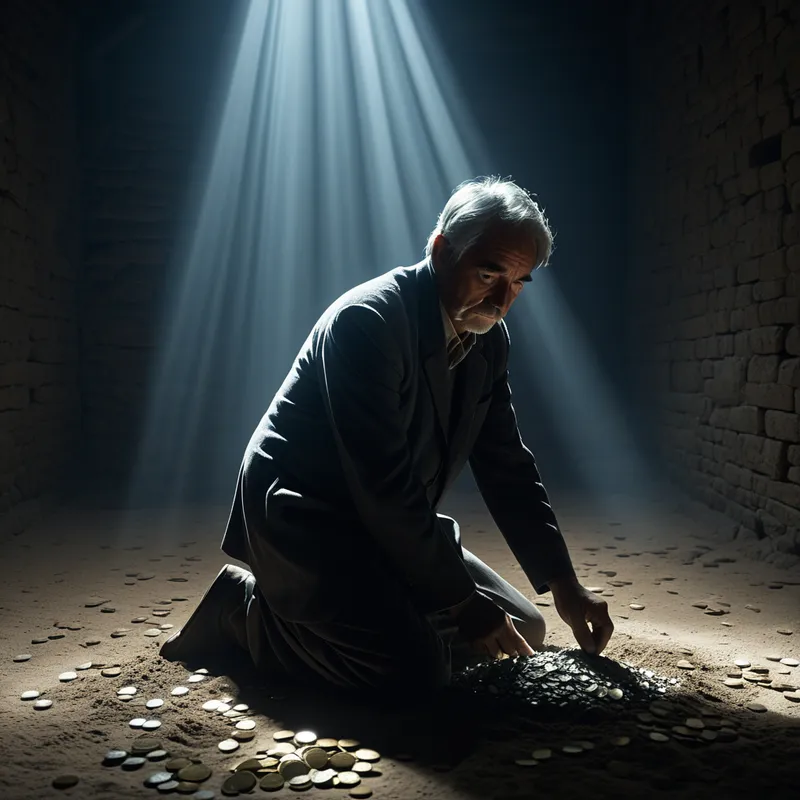
The third servant looked at his single talent. He saw not potential, but peril. He saw the master’s stern face, the terrible accounting to come. To risk was to possibly lose, and to lose was unthinkable. So he took a spade, went to a forgotten corner of the estate, and dug. The earth was cool and receptive. He placed the talent in that dark womb, covered it over, and patted the soil smooth. Safe. Hidden. Sterile.
Seasons turned. The master returned, his journey done. He called for an accounting.
The first servant came forward, not with a single bag, but with two. “Master,” he said, “you delivered to me five talents; look, I have gained five more.” The master’s stern face broke into a radiant smile. “Well done, good and faithful servant! You have been faithful over a little; I will set you over much. Enter into the joy of your master.”
The second came with his four talents, and the same blessing was bestowed. Faithfulness was rewarded with greater responsibility, with entry into joy.
Then came the third. He approached with the soil of the field still clinging to his knees. He unearthed the single, unchanged talent and presented it. His voice was a mixture of accusation and self-justification. “Master, I knew you to be a hard man, reaping where you did not sow, and gathering where you scattered no seed. So I was afraid, and I went and hid your talent in the ground. Here, you have what is yours.”
The air in the courtyard grew cold. The master’s joy vanished. “You wicked and slothful servant! You knew that I reap where I have not sown? Then you ought to have invested my money with the bankers, and at my coming I should have received what was my own with interest.” He turned to the others. “Take the talent from him and give it to the one who has the ten. For to everyone who has will more be given, and he will have an abundance. But from the one who has not, even what he has will be taken away.”
And the servant with the one talent was cast out, into the outer darkness, where there is weeping and gnashing of teeth. The story ends not with a lesson, but with a chilling echo of loss echoing in the void where potential once lay buried.
Cultural Origins & Context
This story is one of the Parables of Jesus, recorded in the Gospel of Matthew (25:14-30). It belongs to a set of eschatological teachings—stories about the end of the age and the final judgment. It was told to a 1st-century Judean audience living under Roman occupation, an audience intimately familiar with the dynamics of absentee landowners and the economics of entrusted capital. A “talent” was not a personal skill, but a massive sum of money, perhaps equivalent to twenty years’ wages for a laborer. The parable functioned as a radical, destabilizing metaphor. It used the familiar, anxiety-ridden world of financial stewardship to illustrate the terrifying and awesome responsibility of spiritual stewardship. It was a call to active, risk-embracing faithfulness in anticipation of the return of Christ (the master), challenging passive, fear-based religiosity. It was transmitted orally within early Christian communities as a formative narrative shaping their ethics of mission and expectation.
Symbolic Architecture
The parable is a perfect, haunting map of the psyche’s relationship with its innate potential. The master represents not a capricious tyrant, but the objective, impersonal reality of the Self—the totality of the psyche that demands development. The journey is the necessary withdrawal of this guiding center, creating the space where the ego (the servants) must act autonomously.
The talents are the raw, God-given capital of the soul: our innate capacities, our time, our intelligence, our psychic energy. They are not distributed equally, but they are distributed according to ability. The system is not unfair; it is efficient and knowing.
The greatest sin against the Self is not failure, but the refusal to engage. To bury the talent is to choose the certainty of psychic death over the risk of psychological life.
The two faithful servants symbolize the ego that aligns with the Self’s intent. They engage with the world (“traded”), accepting risk and uncertainty. Their reward—“I will set you over much” and “enter into the joy of your master”—is the experience of individuation: greater complexity, responsibility, and participation in the fullness of being.
The third servant is the archetypal portrait of the neurotic ego, paralyzed by a negative father complex. He projects his own laziness and fear onto the master, painting him as a “hard man.” His strategy is one of perfect, sterile defense. He preserves the literal object but murders its purpose. His fate—having even what he has taken away—is the psychological law of “use it or lose it.” Capacities that are not exercised atrophy; energies that are not invested turn toxic and lead to the “outer darkness” of depression, meaninglessness, and alienation from the inner source of life.

The Dreamer's Resonance
When this myth stirs in the modern unconscious, it rarely appears as a biblical scene. Instead, the dreamer may find themselves in an endless, fluorescent-lit office being handed a complex, urgent project (the five talents) they feel unprepared for. They may dream of receiving a sealed, precious box from a departing parent or mentor with the instruction to “open it when you’re ready,” only to spend the dream trying and failing to find a safe hiding place (the one talent). The somatic feeling is key: the exhilarating, anxious buzz in the chest of the first servant, or the leaden, congested dread in the gut of the third.
This dream pattern signals a crossroads in the dreamer’s relationship with their own potential. The psyche is presenting an accounting. It asks: Where have you invested your life-energy? What innate gift have you, out of fear of failure or judgment, buried alive? The “weeping and gnashing of teeth” manifests as chronic frustration, envy of others’ successes, or a pervasive sense of being cheated by life—all hallmarks of the energy of the buried talent turned inward against the self.

Alchemical Translation
The alchemical opus mirrored in this parable is the transformation of prima materia (the raw talent) into the philosophical gold (the multiplied return). The master’s journey is the necessary separatio and mortificatio—the withdrawal of conscious certainty that forces the base material of the soul to ferment.
The faithful servants undertake the solutio—dissolving rigid fears in the waters of engagement with the world—and the coagulatio, giving new, substantial form to their efforts. Their work is the coniunctio oppositorum of risk and security, potential and action.
The buried talent is the ultimate failed alchemy. It attempts the nigredo—the blackening, the descent—without the intention of transformation. It mistakes the tomb for the womb.
For the modern individual, the “outer darkness” is not a place of punishment, but the inevitable psychological state of the one who refuses the journey of integration. The call is to exhume our buried gifts. This is not a call to frantic productivity, but to conscious, courageous investment. It means risking the approved, safe identity to trade in the uncertain markets of authentic vocation, creative expression, or deep relationship. The “joy of the master” we are invited to enter is the joy of the Self realized—the profound satisfaction that comes when we stop hiding our light and finally, terrifyingly, put it to work in the world. The parable’s final, severe law reminds us: the psyche is an economy. Energy in motion creates more energy. Energy in stasis condemns itself to entropy. We are here not to preserve our souls, but to hazard them magnificently.
Associated Symbols
Explore related symbols from the CaleaDream lexicon: