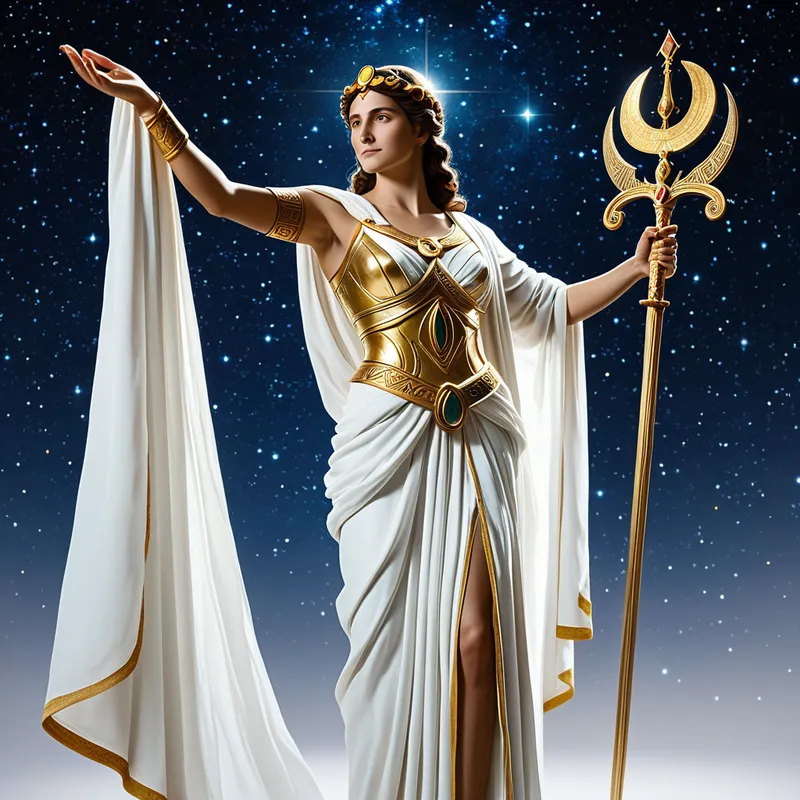
The Scales of Justice Myth Meaning & Symbolism
The blindfolded goddess Themis holds the scales, weighing souls and actions, embodying the eternal principle of cosmic balance and impartial judgment.
The Tale of The Scales of Justice
Before the clamor of the agora, before the first stone of the first courthouse was laid, there was a silence in the cosmos—a silence that was not empty, but full of potential law. From this primordial quiet stepped Themis. She was not born of the later, brighter Olympian passions, but of the ancient, deep-boned order of the universe itself. Her eyes, which saw the true weight of all things, were often veiled, for mortal sight is too easily swayed by beauty, by tears, by gleaming gold.
Her temple was not of marble, but of circumstance. It was the crossroads where paths of action converged. It was the hushed moment before a verdict. It was the inner chamber of the heart when conscience speaks. And in her hands, she bore her sacred instruments: the unadorned sword, cutting cleanly through deception, and the Scales.
These were no merchant’s tool. Forged in the first fire of cosmic necessity, their balance was perfect, their pans empty yet waiting. They did not measure wheat or coin. They measured consequence. They measured truth against falsehood, order against chaos, the soul’s essence against the feather of Maat.
When a soul, shimmering and anxious, was brought before her after life’s long journey, the great hall would fall into a silence deeper than death. No pleas were heard here, no last-minute arguments. Charon’s fare was paid in the coin of a life lived. The Infernal Judges would present the record—a scroll of deeds both bright and dark, woven from every choice, every whispered kindness, every act of hidden violence.
Then, Themis would extend her arm. With a motion as inevitable as the tide, she would place the feather of truth in one shining pan. Into the other, she would pour the sum of the soul’s heart. If the heart was heavy with guilt, with malice, with the leaden weight of broken oaths, the scale would tip with a groan that echoed in the bones of the world, and the soul would be led to its fitting rest in the fields of Tartarus. But if the heart was light, made buoyant by integrity, by courage, by compassion that outweighed self-interest, the scale would find its balance. The pans would hang, steady and serene, and the soul would be guided toward the Elysian Fields.
This was the drama played out not just in the underworld, but in every moment of consequence. Themis and her scales were present when Zeus pondered the fate of cities, when a judge raised his hand to vote, when a person stood alone in the dark, weighing a terrible choice. The scales were always there, suspended in the unseen architecture of reality, waiting to find their equilibrium.

Cultural Origins & Context
The figure of Themis and her scales is not a singular myth from one epic poem, but a foundational concept woven into the very fabric of ancient Greek thought. Her origins are pre-Olympian; she is a Titan, daughter of Uranus and Gaia. This lineage is crucial—she represents an order older and more fundamental than the personal whims of the Olympian gods. She is themis: divine law, right custom, the proper way of things.
Her stories were passed down not as a single bard’s tale, but through hymns, philosophical discourse, and the practical functioning of society. Hesiod speaks of her as Zeus’s second wife, emphasizing that his rule is legitimized by union with Law itself. In the civic space, her presence was invoked in law courts. Jurors swore oaths to her. The concept of “ tipping the scales of justice ” was a living metaphor, a reminder that human judgment aspired to mirror a cosmic standard.
The societal function was dual. Externally, it provided a divine sanction for human law and a terrifying incentive for ethical behavior, with the post-mortem weighing acting as the ultimate audit. Internally, it cultivated an ethical mindset. It taught that actions have inherent weight, that every deed is deposited on a cosmic balance sheet, and that true justice is blind, impartial, and inexorable.
Symbolic Architecture
The symbol of the scales is an archetypal blueprint for the psyche’s innate drive toward equilibrium. It is the embodiment of the principle of measure.
Justice is not vengeance, nor is it mercy. It is the relentless, impersonal mathematics of the cosmos restoring its own equilibrium.
The Scales themselves symbolize the dynamic tension of opposites. Light and dark, good and evil, truth and falsehood, order and chaos—these are not merely moral categories but energetic realities that must be acknowledged and weighed. The perfect balance is not a bland midpoint, but a precise state where all forces are accounted for, creating a stable whole.
The Blindfold (a later addition from Roman Justitia, but now inseparable from the symbol) represents the necessity of impartiality. It signifies that true judgment must look past the superficial—wealth, status, beauty, emotion—to perceive the essential weight of the matter. Psychologically, this is the difficult act of setting aside our personal biases, projections, and histories to see a situation or a part of ourselves clearly.
The Sword represents the decisive, cutting power of discernment and the enforcement of the verdict. Once the scales have tipped, action must follow. It is the power to sever illusion from reality, to make the difficult choice, to enact the consequence that restores balance. It is the will that follows wisdom.
Together, this triad forms a complete psychic process: impartial observation (blindfold), careful evaluation (scales), and decisive action (sword).

The Dreamer's Resonance
When the Scales of Justice appear in a modern dream, the dreamer is almost invariably in a state of internal moral or ethical reckoning. The courtroom setting may be absent, but the feeling of being weighed is palpable.
Somatically, one might dream of feeling physically unbalanced, of being pressed down by a heavy weight on the chest (a “heavy heart”), or of trying to hold two wildly different objects level in one’s hands. Psychologically, this is the Self auditing the ego. The dream is staging a trial where conflicting parts of the personality—the responsible citizen versus the rebellious shadow, the compassionate caregiver versus the self-serving survivor—are being placed on the pans.
A dream of perfectly balanced scales can indicate a hard-won state of inner peace, a decision rightly made, or a sense of integrity. A dream where the scales are wildly tipping, or where one pan is empty while the other crashes down, signals profound inner conflict, guilt, or a feeling that one’s life is out of alignment with one’s core values. The dream is the psyche’s own Themis, working to restore balance by forcing these contradictions into conscious view.
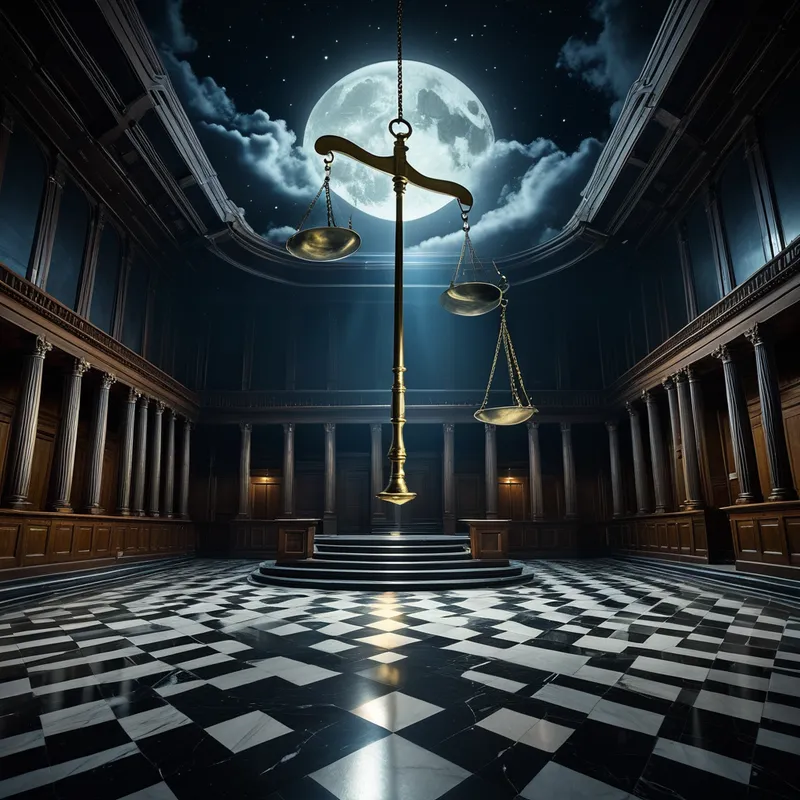
Alchemical Translation
The myth models the alchemical process of separatio and coniunctio—the separation of elements and their reunification at a higher level. Individuation, the process of becoming whole, is not about becoming a saint, but about consciously weighing and integrating all the elements of one’s being.
The alchemical gold is not found in purity, but in the precise balance of all constituents. The lead of our shadow must be weighed, not discarded.
The first step is Gathering the Ores. This is the difficult, honest work of introspection—bringing our deeds, motives, shames, and virtues into the light of consciousness. We must place them on the pan, acknowledging their true weight without denial or inflation.
The second is The Weighing. This is the stage of discernment and evaluation. With the “blindfold” of impartial self-observation, we assess: Does this action align with my deepest self? Does this resentment weigh more than my peace? Does my ambition tip the scale against my humanity? This is not about harsh self-judgment, but about clear-eyed assessment.
The final, crucial step is The Adjustment. Based on the weighing, we must actively engage in psychic transmutation. If the scale is tipped toward negativity, we must consciously add weight to the other side—through atonement, through new actions, through integrating the lesson. We use the “sword” to cut away what is false and to decisively choose a new path. The goal is not a static balance, but the dynamic, ongoing practice of self-correction, moving ever closer to the equilibrium where the soul is light enough to meet its own truth. In this way, the external, cosmic judgment of Themis becomes internalized as the lifelong practice of ethical and psychological self-governance.
Associated Symbols
Explore related symbols from the CaleaDream lexicon: