The Pharisee and the Tax Collector Myth Meaning & Symbolism
A parable where two men pray in the temple; one boasts of his virtue, the other begs for mercy. Only the humble is justified.
The Tale of The Pharisee and the Tax Collector
Let the stones of the temple bear witness. Let the incense smoke, curling towards the vaulted heavens, carry this truth.
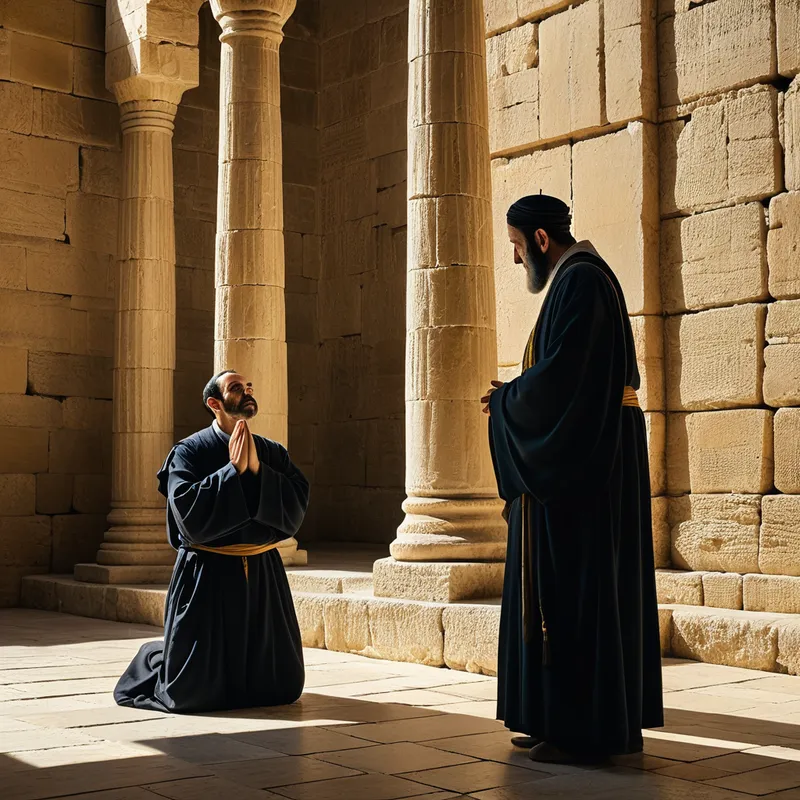
In the heart of Jerusalem, where the sun hammered the white limestone into a blinding glare, stood the Temple. Its courts were a sea of humanity—a murmur of prayers, the shuffle of sandals, the scent of sacrifice and dust. Into this sacred tumult came two men, as different as the eagle and the worm.
The first was a Pharisee. His robes were of the finest linen, the tassels precisely knotted, a walking testament to devotion. He moved through the crowd with the gravity of a mountain, people parting before him. He took his place, not in some hidden corner, but standing, visible to all. He lifted his face, not in supplication, but in declaration. His prayer was not a whisper but a monument built word by word: “God, I thank you that I am not like other men—robbers, evildoers, adulterers—or even like this tax collector over there. I fast twice a week and give a tenth of all I get.”
His words hung in the air, solid and self-assured. He cataloged his virtues like jewels, each one polished by his own effort. He did not ask; he announced. He did not seek; he presented. And in his eyes was the serene conviction of a man who has built his own staircase to heaven.
And then, there was the other.
A tax collector. He stood far off, as if the holiness of the place might burn him. He dared not lift his eyes to heaven. The weight upon him was not of fine cloth, but of a thousand betrayals—coins taken from widows, lies told to neighbors, the constant, sour taste of collaboration with the empire that crushed his people. His body was a sculpture of remorse. His shoulders were hunched, as if carrying the very wall he leaned against. And then, a gesture that shook the foundations of his being: he beat his breast, a dull, rhythmic thud of bone on flesh, a somatic cry where words failed.
From the depths of him, choked and raw, came the only prayer he could muster: “God, have mercy on me, a sinner.”
He offered no list, no defense, no bargain. Only the naked, shattered fact of himself. He stood not in the light of his own virtue, but in the shadow of his need. And in that shadow, something happened. A silence deeper than the temple’s fell. It was not the silence of absence, but of a presence leaning in.
The tale ends with a thunderclap of divine reversal, spoken by the teacher who told it: “I tell you, this man, rather than the other, went home justified before God.”
The proud staircase crumbled into dust. The shattered man in the shadow was lifted up. The last were first, and the first, last. The temple stones heard it all.

Cultural Origins & Context
This story is a parable, attributed to Jesus of Nazareth, as recorded in the Gospel of Luke (18:9-14). It was not a formal myth of a pantheon but a subversive street-theology, told to “some who were confident of their own righteousness and looked down on everyone else.”
Its original audience lived under the tension of Roman occupation and complex religious social strata. The Pharisees were respected lay leaders, guardians of ritual purity and Mosaic law. The tax collectors were socio-religious pariahs, considered morally corrupt and ritually unclean. The parable’s shock value was visceral. It functioned as a cultural grenade, exploding the assumed maps of spiritual hierarchy. It was transmitted orally within early Christian communities as a core memory of Jesus’s teachings, a story preserving the radical, heart-oriented ethic that challenged institutionalized piety. Its societal function was to deconstruct religious pride and redefine the very ground of a relationship with the divine—shifting it from achievement to acknowledgment, from contract to plea.
Symbolic Architecture
The two figures are not merely historical characters but eternal poles of the human psyche. They represent two fundamental orientations of the soul.
The Pharisee symbolizes the Persona in its most fortified state—the constructed self, armored in virtue and comparison. His prayer is not dialogue but monologue; he is speaking to his own ideal image. He is trapped in the “spiritual materialism” of counting merits, a psychological economy where the ego is both merchant and god. His stance—“I thank you that I am not like that man”—is the foundational gesture of the shadow’s denial. He projects all that is sinful, weak, and unacceptable onto the tax collector, thus purifying himself by contrast. He is the hero of his own myth, but it is a myth devoid of grace, for it leaves no room for the unknown, the broken, the unmanaged.
The greatest barrier to the sacred is often the monument we build to our own virtue.
The Tax Collector embodies the conscious encounter with the Shadow. He is the projected content. He does not fight the label of “sinner”; he accepts it as his psychic reality. His beating of the breast is a profound somatic ritual—an attempt to physically break open the hardened shell of the ego to reach the vulnerable heart beneath. His prayer, “have mercy,” is the ultimate surrender of egoic control. It is an admission of bankruptcy, which paradoxically becomes the only currency accepted in the economy of grace. He represents the death of the old, self-justifying identity, a necessary death for any true transformation.
The Temple itself is the symbolic container—the temenos or sacred space where this inner drama is allowed to unfold. It is the psyche itself, where the battle between persona and shadow is staged.

The Dreamer's Resonance
When this mythic pattern stirs in the modern dreamer, it signals a critical crossroads in the relationship between the ego and the Self. One does not simply dream of a Pharisee and a tax collector; one dreams as both.
To dream of standing proudly, listing achievements while secretly feeling fraudulent, points to a hyper-inflated persona. The dream ego is identified with its resume, its social mask, its spiritual or intellectual credentials. There is a somatic feeling of rigidity, of being “puffed up,” yet brittle. The psyche is issuing a warning: the constructed self is nearing a point of isolation, cut off from the nourishing waters of the unconscious.
To dream of being the one hunched in the corner, overwhelmed by a sense of failure, shame, or unworthiness, is not a nightmare of regression but often a dream of profound progression. It signifies the ego’s capitulation. The defensive walls are down. The feeling is one of crushing weight, but also of strange, raw honesty. This is the somatic signature of the ego beginning to align with a deeper, more authentic state of being—a state that feels like ruin to the persona, but like truth to the soul. The beating of the breast in the dream may manifest as a sensation of pressure on the chest, shortness of breath, or deep, involuntary sighing—the body participating in the psychic release.

Alchemical Translation
The parable is a perfect map of the alchemical nigredo, the blackening, and the ensuing transformation. The Pharisee represents the ego’s attempt to skip this stage, to remain in the purity of albedo (whitening) without first facing the nigredo. He polishes his lead and calls it gold. But the work is false; no transmutation has occurred.
The tax collector willingly enters the nigredo. His humble confession, “a sinner,” is the solutio—the dissolving of the hardened, complexified ego in the waters of truth. His beating of the breast is the calcinatio—the burning away of pride by the fire of remorse. He reduces himself to his prima materia, his base, shameful matter. This is not an end, but the essential beginning.
Justification—being made right—occurs not through addition, but through subtraction; not by building a tower, but by falling to your knees.
In this state of radical humility, the ego is no longer the operator of the psyche but becomes a vessel. The divine “justification” is the alchemical rubedo, the reddening, where the base metal of the broken self is penetrated by the transcendent influence of the Self. The tax collector’s mercy is the Philosopher’s Stone—it transforms not by effort, but by reception.
For the modern individual, the path is not to become the tax collector in a moral sense, but to internalize his posture. It is to find, in moments of quiet honesty, that part of oneself which is all persona, all comparison, all spiritual boastfulness, and to consciously relinquish its stand. It is to courageously acknowledge the inner “tax collector”—the bundle of shame, failure, and need we exile to the shadows—and to bring it, trembling, into the temple of awareness. There, in that act of non-judgmental acknowledgment, the psychic gravity reverses. The lead of our brokenness becomes the very substance from which the gold of compassion—for ourselves and for all other “sinners” on the road—is born. The one who went home justified did not become perfect; he became whole. He had finally come home to himself, in the presence of the All.
Associated Symbols
Explore related symbols from the CaleaDream lexicon: