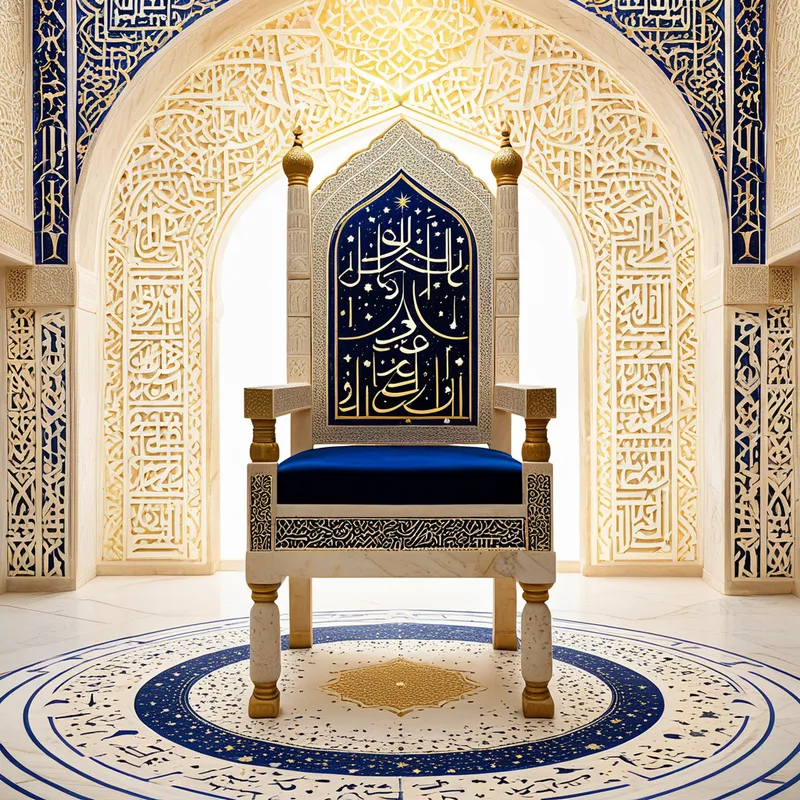
Takht Myth Meaning & Symbolism
A myth of a celestial throne embodying divine justice, where cosmic order is weighed against the human heart's truth.
The Tale of Takht
Before the first word was spoken, before time was measured in sunrises, there existed a silence so profound it was a presence. In that silence, woven from the fabric of pre-dawn twilight and the dust of distant stars, the Takht was fashioned. It was not built, but manifested—a seat of luminous white stone, veined with silver like frozen lightning, resting upon the back of the Gaw and the Mahi, the great fish that swims in the celestial sea of Vourukasha.
To this throne came the Radiant Sovereign, the Khvarenah-blessed one, whose face was neither young nor old, but held the patience of mountains. His gaze was not of fire, but of clear, still water that reflected all things as they truly were. Upon the Takht, he did not rule lands or command armies. He presided over the balance of the cosmos itself.
Each soul, upon shedding its mortal coil, would journey through the perilous Chinvat Bridge. But before that crossing, they were brought before the awesome stillness of the Takht. There were no accusations, no pleading advocates. Instead, from the very arms of the throne, two golden scales unfolded with a sound like a sigh. Into one pan, the angel Raqib would place every good deed, every moment of compassion, every truth spoken—each one a feather of light, weightless yet radiant. Into the other, the angel Atid would place every act of cruelty, every lie nurtured in the heart's darkness, every broken promise—each one a bead of black iron, cold and dense.
The Sovereign did not move. He only watched. The air hummed with the tension of the universe holding its breath. The scales would tremble, the feather-light goodness against the leaden weight of wrong. If the scales tipped toward the light, the soul’s own heart would sing a note of pure joy, and the path across the bridge would widen into a sunlit garden. If they sank toward the dark, the soul would feel the crushing weight of its own choices, and the bridge would become a razor's edge over an abyss of its own making.
This was the eternal ritual of the Takht: not a punishment decreed, but a truth revealed. A moment where the cosmos itself held up a mirror, and the soul witnessed, irrevocably, the sum of its own being.

Cultural Origins & Context
The concept of the Takht as a divine seat of judgment is a profound thread woven through the tapestry of Persian thought, evolving across millennia. Its deepest roots tap into pre-Zoroastrian Indo-Iranian cosmology, where the king (Khvarenah) was seen as the earthly anchor of cosmic order (Asha). His throne was not merely a piece of furniture but a microcosm of the universe, the point where heaven and earth met.
With the advent of Zoroastrianism, this symbolism was ethicized and eschatologized. The Chinvat Bridge and the final judgment became central, and the imagery of a weighing of deeds—a "moral accounting"—took hold. This Persian cosmological framework profoundly influenced later Islamic eschatology, particularly within the rich Persianate interpretive traditions (tafsir) and mystical (Sufi) literature. The Quranic descriptions of the Arsh (the Throne of God) and the Lawh al-Mahfuz (the Preserved Tablet) resonated with and were elaborated upon through this existing Persian symbolic lexicon.
The myth was passed down not as a single canonical story, but as a constellation of images in religious texts, royal panegyrics, and epic poetry like the Shahnameh. It functioned as a societal anchor, reinforcing the idea that all power—royal, divine, and personal—came with an ultimate accountability. The king on his earthly Takht was a steward, answerable to the Sovereign on the celestial one.
Symbolic Architecture
At its core, the Takht is not about a god judging from on high, but about the architecture of consciousness itself. It represents the inescapable inner tribunal where our actions and intentions are perpetually weighed.
The throne is the seat of the Self, the central organizing principle of the psyche that demands integrity between who we are and what we do.
The Gaw and the Mahi symbolize the foundational, often unconscious, instincts and depths that support our conscious sense of order and judgment. The scales are the function of conscience and moral reflection, the psychic apparatus that measures the alignment (or dissonance) between our persona and our shadow. The feather is the symbol of Maat (borrowed from Egyptian symbology but perfectly apt)—truth as something light, delicate, and essential. The black iron beads are the condensed, heavy psychic matter of repression, guilt, and unlived life.
The myth tells us that judgment is not an external event awaiting us in an afterlife, but a continuous internal process. The "Radiant Sovereign" is the observing consciousness, the part of us that can witness our own life without immediate identification or denial. The drama at the Takht is the soul's confrontation with its own totality.
The Dreamer's Resonance
When the imagery of the Takht surfaces in modern dreams, it signals a profound moment of psychic reckoning. The dreamer is not being judged by an external god, but by the Self. Common motifs include:
- Finding an empty, majestic throne in a familiar place: This suggests the ego is being confronted with the authority of a deeper, central aspect of the psyche it has ignored. The throne is "waiting" for the dreamer to claim their own responsibility.
- Being forced to place objects on a scale: The psyche is actively weighing life choices, relationships, or values. What is being placed on the scales—childhood toys, career tools, loved ones' faces—reveals the content of the inner conflict.
- The scales being impossibly balanced or wildly tipping: This reflects the somatic feeling of a moral or existential dilemma. A perfectly balanced scale can indicate paralysis or a fear of decision. A violently tipping scale manifests as anxiety, the visceral feeling of being "weighed down" by guilt or "light-headed" from a lack of substance.
The dream is an invitation to this inner court. The anxiety it produces is the friction of the ego resisting the soul's demand for a truthful accounting. It is a call to stop projecting blame and to begin the difficult work of self-assessment.
Alchemical Translation
The journey of the myth is a blueprint for the alchemical process of individuation—becoming whole. The initial state is one of unconscious living, where deeds and self are disconnected. The summons to the Takht is the nigredo, the dark night of the soul, where everything must be brought to light.
The alchemical fire is not punishment, but the searing heat of absolute self-honesty required to transmute leaden guilt into conscious responsibility.
The act of weighing is the separatio—distinguishing the feather of our essential truth from the iron dross of our complexes and adaptations. This is not about achieving perfection, but about conscious integration. The black iron of the shadow, when acknowledged and brought before the throne, loses its autonomous, weighty power. It is seen, named, and its energy can be reclaimed.
The figure on the throne, ultimately, is the goal of the work: the integrated Self, the inner ruler who presides with calm authority over the reconciled kingdom of the psyche. To "ascend the Takht" psychologically is not to become tyrannical, but to achieve a state of inner sovereignty. It is to sit in the center of one's own being, where choices are made from alignment, where one's personal law (Asha) is in harmony with one's actions. The myth teaches that this throne is our birthright, but we must pass over the bridge of self-examination, carrying only the truth we have had the courage to weigh, to claim it.
Associated Symbols
Explore related symbols from the CaleaDream lexicon: