The Plumb Line of Amos Myth Meaning & Symbolism
A shepherd sees a divine plumb line held against a crooked nation, a vision of ultimate judgment and the unyielding standard of true alignment.
The Tale of The Plumb Line of Amos
The wind on the high places does not whisper; it carries the voices of the flock and the scent of distant rain. Here, among the stunted oaks and the rocky outcrops of Tekoa, a man named Amos tended his sheep and dressed his sycamore figs. His world was one of tangible things: the weight of a lamb, the grit of soil, the surety of a straight wall built stone upon stone. He knew the plumb line—a simple cord with a weight—that revealed truth in the silence of its hang. A wall that looked straight to the eye could be shown, by that silent judge, to be leaning toward ruin.
But one day, the wind changed. It did not bring rain. It brought a vision that tore the fabric of the seen world.
“Amos, what do you see?”
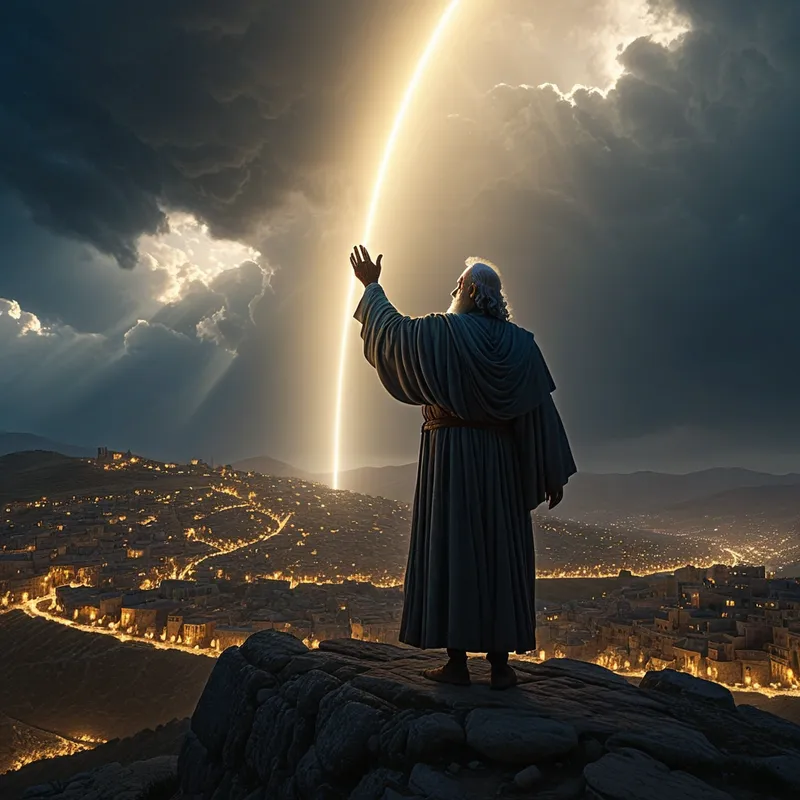
The voice was not in the wind, but of it, and through it. Before him, the Lord stood—not as a man, but as the presence of a mason, holding a tool. It was a plumb line, but one spun from the substance of judgment itself. It was set, not against a wall of stone, but against the people of Israel.
“Behold, I am setting a plumb line in the midst of my people Israel,” the voice declared, a pronouncement that rolled like thunder with the finality of a falling stone. “I will never again pass by them.”
And Amos saw. He saw not with his eyes, but with the terrible clarity of the spirit. The plumb line hung, immovable, absolute. Against its perfect vertical, the nation was measured. He saw the crookedness of their justice, sold for silver. He saw the leaning towers of their greed, the foundations of their compassion cracked and unsound. The high places of Bethel and the palaces of Samaria were not monuments, but symptoms of a profound structural flaw. The line did not waver. It revealed the inevitable: a structure so out of true cannot stand.
The vision sealed his tongue with fire and his feet with purpose. He left the flock and the fig trees. He journeyed north to the very heart of the crookedness, to the royal sanctuary at Bethel. There, before the priest Amaziah and the complacent worshippers, he spoke the unbearable truth shown by the line. “The high places of Isaac shall be made desolate,” he proclaimed, his shepherd’s voice cutting through the incense, “and the sanctuaries of Israel shall be laid waste.” He spoke of exile, of a land measured and found wanting. The plumb line had spoken; the builder had judged his own work. The wall would fall.

Cultural Origins & Context
This vision is recorded in the Book of Amos, a text that emerges from a specific and tense moment in the 8th century BCE. Amos was not a professional prophet or a priestly insider. He was a noged, a herdsman and arborist from the southern kingdom of Judah, who delivered his oracles in the prosperous but morally precarious northern kingdom of Israel under King Jeroboam II. This outsider status is crucial. He brought the perspective of the margins, of one whose life depended on tangible realities and straight dealings, into the polished, corrupt center of power.
The myth was preserved not as folklore, but as prophetic literature—a form of divinely-sanctioned social critique. It was likely passed down orally among disciples and communities who saw their world in the prophecy’s terrifying fulfillment with the Assyrian conquest and exile of the northern kingdom in 722 BCE. Its societal function was dual: it was a forensic indictment of systemic injustice, exploitation of the poor, and hollow religiosity, and simultaneously, a theodicy, an explanation for the coming national catastrophe. The disaster was not random; it was the structural consequence of spiritual and ethical misalignment, measured by an immutable standard.
Symbolic Architecture
At its core, the plumb line is an archetypal symbol of objective measure. It represents the principle of Dharma or Ma'at—the fundamental law against which reality is assessed. It is not a tool of creation, but of evaluation.
The plumb line does not argue, persuade, or punish. It simply reveals the hidden angle of collapse already present in the foundation.
Psychologically, the myth stages a brutal confrontation between the ego’s constructed reality and the Self’s demand for integrity. The nation of Israel symbolizes the personal psyche—a complex structure of habits, values, identities, and compromises (the “wall”). The prophet Amos represents the emergent voice of conscience or the transcendent function, the part of the psyche that can perceive the objective standard. The vision is the moment of shocking self-awareness, where one’s life, relationships, or society is seen not through the lens of justification or wishful thinking, but through the cold, clear lens of truth. The “crookedness” symbolizes repressed shadow elements—greed, hypocrisy, neglected duties—that have been built into the very structure of one’s life.

The Dreamer's Resonance
When this myth stirs in the modern unconscious, it often manifests in dreams of measurement, inspection, or structural failure. A dreamer may see an architect or surveyor examining their home, finding a cracked foundation. They may dream of a tower leaning perilously, or of trying to hang a picture that will never sit straight on the wall. The somatic sensation is often one of deep, vertebral tension—a feeling that one’s own spine is being tested for true alignment.
This dream pattern signals a profound psychological process: the psyche’s innate movement toward integrity is activating. The “plumb line” moment in a dream is the moment of irreducible truth, often preceding a conscious crisis or a necessary life correction. It is the soul’s quality assurance. The anxiety it produces is not about an external punishment, but the internal recognition that a way of being has become unsustainable, that the persona has drifted too far from the core Self. The dream is an invitation to self-audit before the unconscious forces a collapse.

Alchemical Translation
The alchemical journey modeled here is not one of combination, but of separation and reduction to the true essence. In alchemical terms, it is the separatio and the mortificatio—the breaking down of the composite into its constituent parts to reveal the hidden flaw.
The initial state is the prima materia of the unexamined life, a complex mixture of genuine values and corrupt compromises. The vision of the plumb line is the application of the vas (the vessel) of honest self-reflection. This process is inherently destructive to the old, false structure. The “falling wall” of Israel is the necessary nigredo, the blackening, the death of an out-of-true identity.
The triumph is not in avoiding the measure, but in having the courage to stand in its revealing light. The collapse of the false wall is the creation of the cleared site.
For the modern individual, the alchemical work is to internalize the plumb line. This means cultivating an inner Amos—a detached, observant witness that can hold up the standard of one’s deepest values against the daily construction of one’s life. It involves the ruthless, compassionate examination of where one’s actions are “crooked” against one’s own soul’s truth. The transmutation occurs when one begins to rebuild, stone by conscious stone, from the foundation up, using that inner standard as the guide. The goal is not a perfect, static wall, but a living structure in continual, honest dialogue with the plumb line—a life of authentic alignment where the inner and outer worlds finally coincide. The exiled Israelites, in the broader biblical narrative, eventually return to rebuild; so too does the psyche, after its necessary judgment, rebuild on truer ground.
Associated Symbols
Explore related symbols from the CaleaDream lexicon: