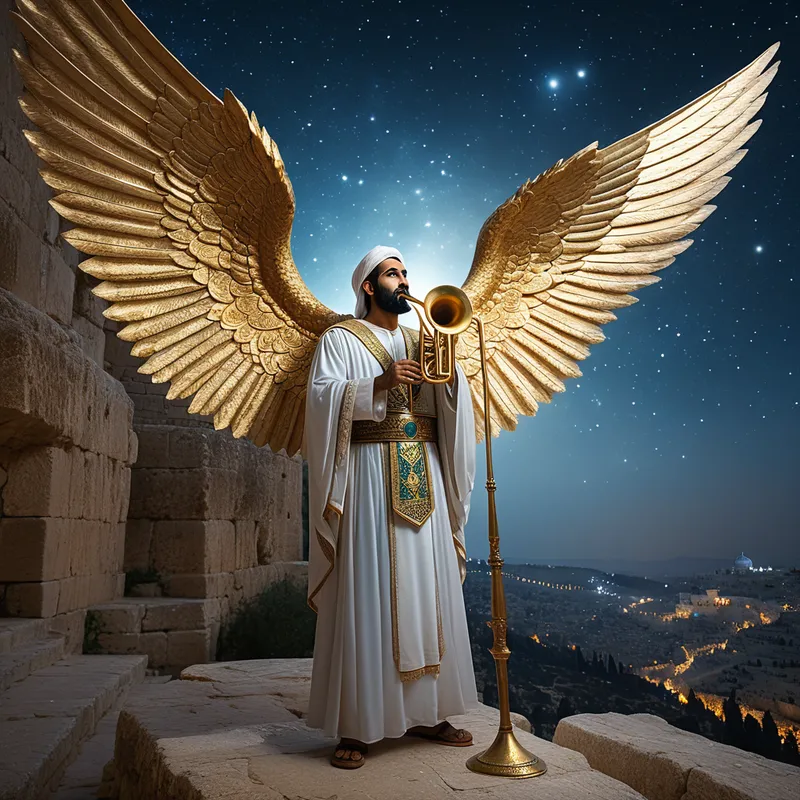
Israfil Myth Meaning & Symbolism
The angel Israfil awaits God's command to blow the trumpet, signaling the end of time and the resurrection of all souls from dust.
The Tale of Israfil
Listen. Before the first word was spoken, before light was separated from dark, there was a silence so profound it was a presence itself. And in that silence, a being was fashioned from light and divine fire, given a form of unbearable majesty and a single, sacred duty. His name is Israfil.
He stands, this angel, upon the Sakhrah, the foundation stone of the world. His feet are planted where earth meets heaven, and his gaze spans the entirety of creation, from the swirling of distant galaxies to the beating heart of the smallest creature in the deepest sea. In his hands, he cradles an instrument—a trumpet, a sur. It is not made of brass or silver, but of a substance that drinks in the light of divine command. Its mouthpiece rests perpetually at his lips.
Four times a day, every day since the dawn of time, Israfil looks toward the Arsh, the Throne, awaiting the signal. A shudder passes through his being, a preparatory breath drawn from the well of eternity, and he nearly sounds the call. But the command does not come. Not yet. He returns to his vigil, the breath held in abeyance, the silence deepening around him, heavy with the weight of what is to come.
He is the keeper of the interval, the guardian of the pause between the in-breath and the out-breath of God. All of history unfolds beneath his watchful, sorrowful eyes—the rise and fall of empires, the whispered prayers of the faithful, the cries of the oppressed, the joy of lovers, the silence of graves. He sees it all, and he waits. He hears the cosmic clock tick down toward an hour known only to the Al-`Alim.
Then, the moment arrives. A command, silent and absolute, emanates from the Throne. It is not a sound but the cessation of all possibility of further delay. Israfil’s chest expands with a breath drawn from the source of all life. He puts the trumpet to his lips and blows.
The first blast is not a melody but an unmaking. It is a sound that is the absence of all other sound, a wave of pure negation that travels faster than light. Stars are extinguished like candles. Mountains are lifted and scattered like dust. The seas boil away. The sky is rolled up like a scroll. Every living thing, every nafs (soul), is separated from its body. Time itself shatters. All that remains is a formless, silent void, and Israfil, alone with his instrument, amidst the cosmic dust.
He waits again. For forty years—or perhaps forty ages, for time has lost its meaning—he stands in the absolute desolation. Then, the second command comes.
He raises the trumpet again. This second blast is the inverse of the first. It is not negation, but a calling-forth. It is a sound that is a creative word, a divine "Be!" It pierces the stillness and travels into the abyss, into every atom of scattered dust, into the memory of every soul that ever was. And from the dust, forms begin to stir. Bones knit together. Flesh is reclothed. Eyes open, blinking in a new, fierce light. Every soul that ever lived, from the first prophet to the last child, stands upon the plain of al-Mahshar, resurrected, whole, and utterly awake.
His duty complete, Israfil will lay down his trumpet. The one who was the herald of the end becomes a witness to the final, everlasting beginning.
Cultural Origins & Context
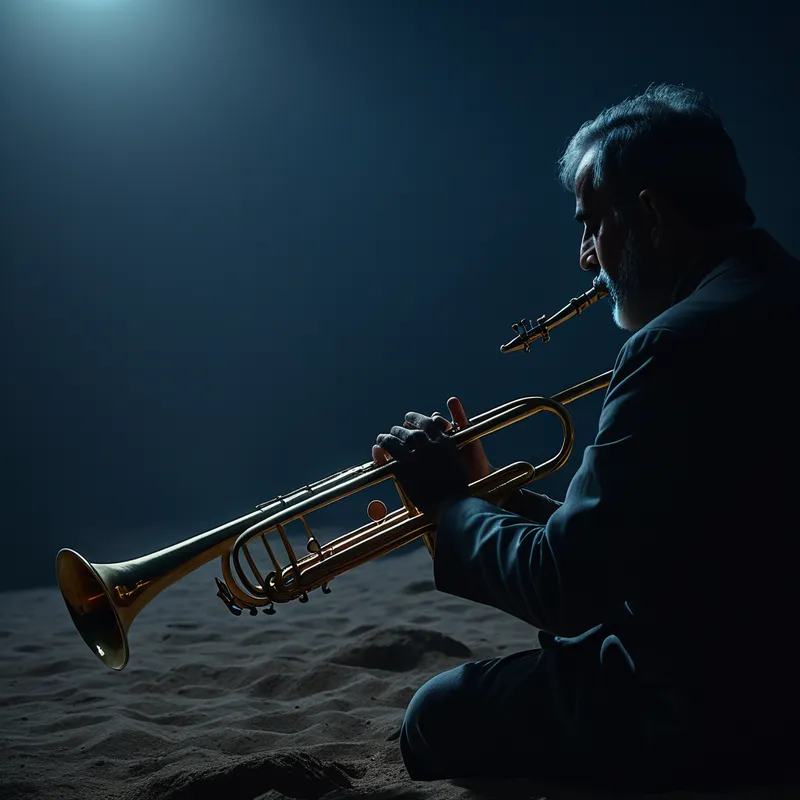
The figure of Israfil is woven into the rich tapestry of Islamic eschatology, primarily found within the Hadith literature and the works of classical scholars and mystics. While the Quran speaks powerfully of the Trumpet Blast (an-Naqur) and the Day of Resurrection (Yawm al-Qiyamah), it is in the explanatory tradition of the Hadith that the angel receives his name and vivid characterization.
These narratives were passed down orally by scholars and storytellers (qussas), serving a crucial societal function far beyond mere fright. The tale of Israfil was a profound cosmological anchor. It situated human life within a vast, meaningful narrative arc that stretched from creation to final accountability. It was a reminder of the transience of the material world (dunya) and the absolute reality of the hereafter (akhirah). In Sufi circles, the myth took on deeper psychological dimensions, with Israfil symbolizing the divine call to spiritual awakening that must be heeded within one's lifetime.
Symbolic Architecture
Israfil is not a character in a drama but an archetypal function made manifest. He is the embodiment of the liminal—the eternal dweller on the threshold. His trumpet is the symbol of the divine imperative that interrupts all human constructs of time, identity, and permanence.
The first blast is the psychology of dissolution. It represents the necessary death of the ego, the constructed self, and all its attachments. It is the terrifying but essential breakdown that must precede any genuine rebirth.
His perpetual readiness symbolizes the latent potential for radical transformation that exists at every moment. The four daily near-blasts reflect the cyclical nature of smaller endings and renewals in life—the death of a phase, a relationship, an old identity—each a microcosm of the greater finale. The long pause between the blasts is the symbolic "barzakh" or isthmus, the state between states, which in the human psyche is the period of integration, mourning, or gestation after a great collapse and before a new consciousness can form.
The Dreamer's Resonance
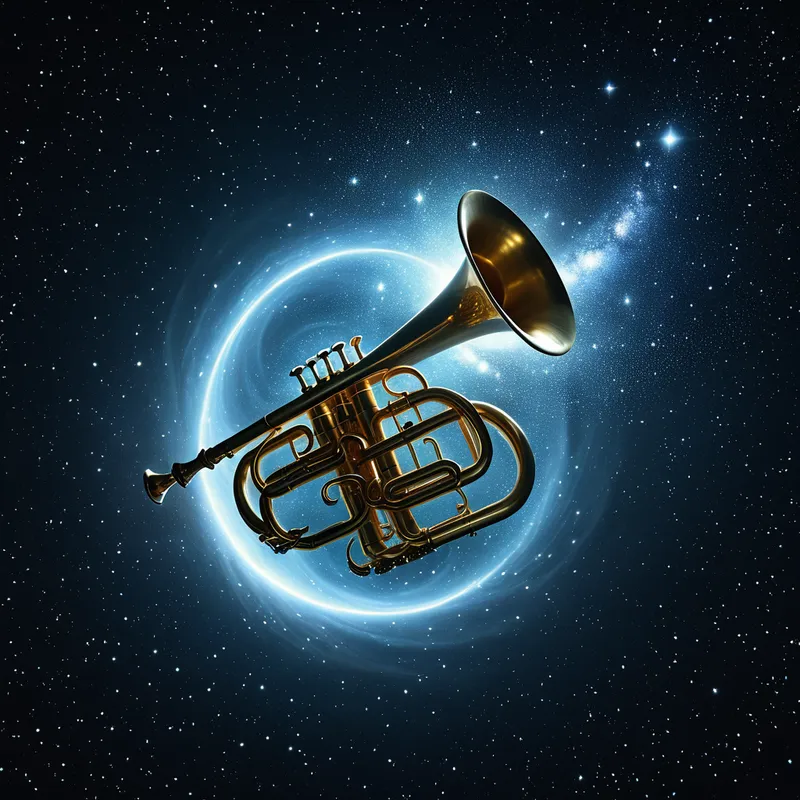
When the archetype of Israfil stirs in the modern dreamer, it often heralds a profound psychic upheaval. One might dream of hearing a deafening, beautiful, or terrifying sound that shatters the dream landscape. One might be the one holding the instrument, filled with both dread and a sense of sacred duty.
Somatically, this can correlate with a feeling of an impending "snap" or breakthrough—anxiety mixed with anticipation. Psychologically, the dreamer is likely at a point where an old life structure (a career, a self-concept, a foundational belief) has become untenable. The unconscious is signaling that a period of comfortable stagnation is over. The trumpet in the dream is the call from the deeper Self, demanding an end to the inauthentic and a courageous facing of truths that have been long suppressed. The dream is an internal Yawm ad-Din, a day of reckoning within the soul.

Alchemical Translation
The myth of Israfil provides a stark, majestic map for the alchemical process of individuation—the journey toward psychic wholeness.
The first stage, nigredo (blackening), is the first blast. It is the conscious, often painful, engagement with one's shadow, the breakdown of persona, and the descent into what feels like psychic chaos and annihilation. Everything one thought was solid melts. The ego's kingdom is destroyed.
The waiting period in the void is the albedo (whitening). It is the essential, fallow time of reflection, purification, and sorting through the ashes. It is a state of humility and openness, where the old is gone and the new has not yet formed.
The second blast is the culmination of the alchemical work: rubedo (reddening) and citrinitas (yellowing). It is the rebirth of the personality from a deeper center, the Self. The scattered, disparate elements of the psyche are called back together, not in their old, egoic arrangement, but reconstituted around a new, more authentic core. What is resurrected is not the old "I," but a truer, more integrated being, accountable to a reality larger than itself.
In this translation, Israfil is the archetypal force of the Self that orchestrates this entire profound, terrifying, and ultimately liberating process. To heed the inner trumpet is to consent to one's own most necessary transformations.
Associated Symbols
Explore related symbols from the CaleaDream lexicon: