Noah Myth Meaning & Symbolism
A righteous man is chosen to survive a divine flood, preserving life in an ark and receiving a covenant of renewal for a corrupted world.
The Tale of Noah
Listen. The world had grown heavy with a noise you could taste—a metallic tang of violence, a greasy smear of corruption in every thought and deed. The hearts of men and women had turned inward, curling like rotten leaves, until their every imagination was only evil continually. The fabric of creation groaned under the weight of this sickness.
But in the midst of the cacophony, there was a silence. It walked with a man named Noah. He was a man who found favor in the eyes of Yahweh. The silence in Noah was not emptiness, but a deep, listening integrity. And into that silence, a Voice spoke—a sound that was not sound, but a knowing etched into the bone.
The Voice brought a terrible grace. It spoke of an end, a great unraveling. The Tehom, the deep chaos held at bay since the first day, would be invited back. A flood to scour the earth clean. But the Voice also brought a pattern: measurements of gopher wood, a blueprint for a vessel of salvation. An Ark.
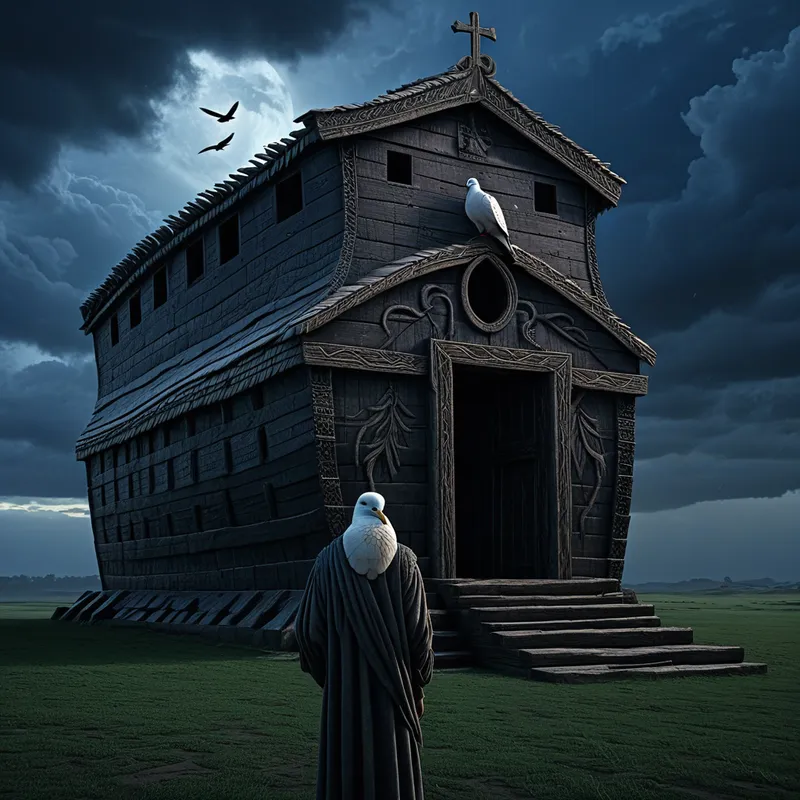
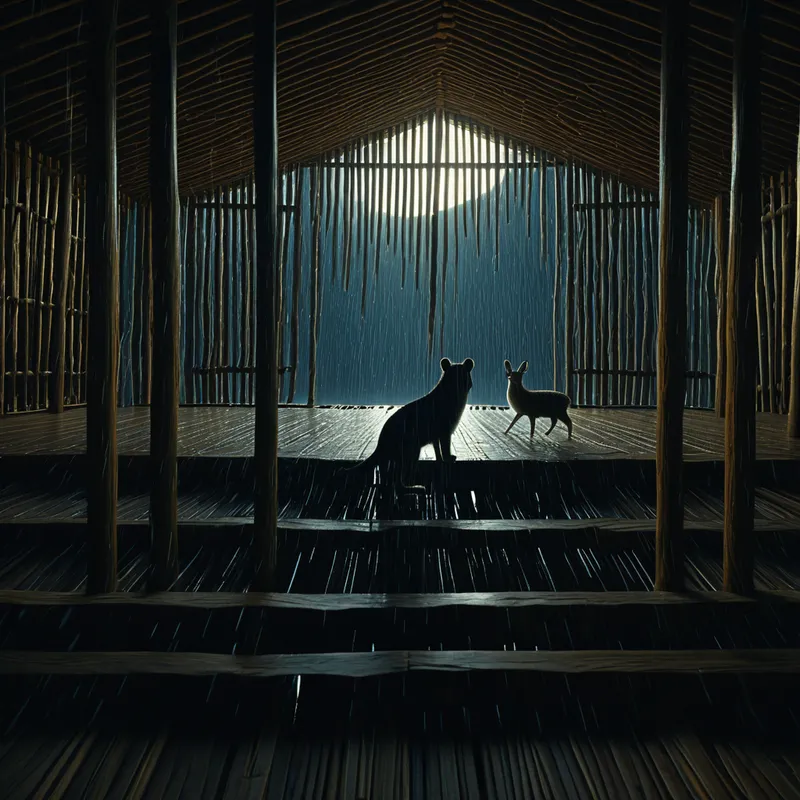
For decades, under a sun that grew increasingly indifferent, Noah and his sons labored. The Ark rose, a monstrous, tar-black box against the horizon, a folly to his neighbors who drank and married and bartered, deaf to the gathering stillness. Then came the gathering: from the misty forests and the sun-baked plains, in pairs they came—the great and the small, the predator and the prey. Led by an instinct older than fear, they entered the shadow of the Ark, their breath creating a warm, living cloud in the cool, resin-scented dark.
Then, the skies remembered they were once water. The fountains of the great deep broke open. It was not merely rain; it was the ceiling of the world falling in. Water rose from below and hammered from above, until the highest mountains were swallowed, and every echo of laughter, every cry of war, was silenced beneath the roar. For forty days and nights, the Ark alone moved upon the face of the waters, a wooden womb adrift in a universe of grey.
Inside was a world of its own: the rhythm of breath, the rustle of straw, the creak of timber holding fast against the pressure of the abyss. Time stretched and condensed. Finally, the rains ceased. The waters receded with a vast, sighing slowness. The Ark came to rest on the bones of the mountains of Ararat. Noah sent out a raven, which flew to and fro over the still-drowned world. He sent a dove, which returned with nothing. He sent it again, and it returned with a freshly plucked olive leaf—a fragment of green life. The third time, it did not return.
They emerged, blinking, onto mud and rock. The air was sharp, new-washed. And Noah built an altar. The scent of the offering rose, and the Voice spoke again, but now with a new tone—a vow. “Never again.” The bow was set in the clouds, not as a weapon, but as a rainbow, a bridge of fractured light. A covenant between the Divine and all flesh. A promise etched not in stone, but in the very physics of light and water.
Cultural Origins & Context
The story of Noah is not originally a Christian myth. Its deep roots are in the ancient Near East, found in the Torah (Genesis chapters 6-9), making it a foundational narrative for Judaism before being inherited by Christianity and Islam. It belongs to a family of cataclysmic flood myths found across Mesopotamian cultures, most notably in the Epic of Gilgamesh. For the early Hebrew scribes, adapting this widespread tale served a crucial theological function: to assert the sovereignty and moral character of Yahweh over the capricious gods of neighboring pantheons. Here, the flood is not a divine whim, but a response to profound moral corruption.
In Christian culture, the story was preserved, transmitted, and interpreted through the lens of the Church. It was read allegorically by Church Fathers, seen as a prefiguration of baptism (water as cleansing) and of Christ himself (the Ark as the Church, the vehicle of salvation). For centuries, it was told not as a distant legend but as sacred history, a pivotal chapter in the divine drama of sin, judgment, and redemption that culminated in the Gospel. It functioned as a societal anchor, a stark reminder of divine justice, the necessity of righteousness, and the foundational promise of grace that undergirds a fragile world.
Symbolic Architecture
At its core, the myth of Noah is an archetypal drama of the death and rebirth of a world. It maps the painful but necessary process by which a corrupted system must be dissolved so that a new, more conscious one can emerge.
The Ark is not an escape from the world, but the vessel in which the essential soul of the world is preserved through its own dissolution.
The Flood represents the overwhelming, unconscious force of the psyche itself, rising to purge a consciousness that has become irredeemably one-sided, violent, and self-serving. Noah is the archetypal Senex in his positive aspect—the principle of order, patience, and preservation. He is not a warrior-hero, but a caregiver on a cosmic scale. His task is not to fight the chaos, but to build a container sturdy enough to endure it.
The animals, taken in pairs, symbolize the totality of instinctual life and the paired opposites (conscious/unconscious, masculine/feminine) that must be integrated for a whole world to be reborn. The forty days and nights mirror the biblical periods of trial and transformation (Moses on Sinai, Jesus in the desert), a symbolic gestation in the amniotic waters of the unconscious. The dove with the olive branch is the first messenger from the reborn world, an emblem of peace and the return of life-giving spirit after the storm of judgment.
The Dreamer's Resonance
When this myth stirs in the modern dreamer, it often signals a profound psychological crisis or impending transformation. To dream of a great flood may feel like being overwhelmed by repressed emotions, a life situation collapsing, or a deep sense that one's old identity and ways of being are no longer sustainable.
Dreaming of building or finding an ark suggests the ego is attempting, often against great internal resistance or external ridicule, to construct a vessel of consciousness—a new attitude, a therapy, a creative practice—to survive this inner deluge. The specific “animals” brought aboard in the dream are critical; they represent the instinctual energies and personality traits the dreamer’s psyche deems essential to save and integrate into the future self. The somatic experience is often one of profound pressure, a feeling of being “in the hold”—confined, anxious, yet protected, waiting out a storm one cannot control. The eventual appearance of dry land or a rainbow in the dream marks the beginning of a new psychological contract with oneself, a hard-won promise of non-violence toward one's own soul.

Alchemical Translation
The alchemical process mirrored in Noah’s saga is the solutio followed by coagulatio. The flood is the solutio: the total dissolution of the old, leaden personality—its corrupt alliances, its hardened prejudices, its inflated certainties. Everything is returned to the primal waters of the prima materia.
The covenant of the rainbow is the psyche’s oath to itself: having known the flood, it will now honor the tension of opposites, holding the spectrum of light within a single arc, rather than drowning in one extreme.
Noah’s long, obedient work of building the Ark represents the crucial, often tedious labor of constructing a conscious container—the vas—before the dissolution begins. This is the work of developing ego strength, ethical principles, and a practice of observation that can withstand the flooding of the unconscious. The preserved life within is the lapis, the incorruptible spark of the Self.
For the modern individual, the myth does not call for a literal waiting for divine wrath, but for the courage to acknowledge when one's inner world has become a “wickedness” of neurotic patterns, self-deception, or soul-neglect. It then mandates the patient, often lonely work of building an “Ark”—a disciplined vessel of consciousness—to hold what is essential through the necessary flood of breakdown, depression, or life-upheaval. The promise is that on the other side is not merely survival, but a new covenant: an integrated consciousness that has made peace with the depths and carries the rainbow of wholeness as its testament.
Associated Symbols
Explore related symbols from the CaleaDream lexicon: